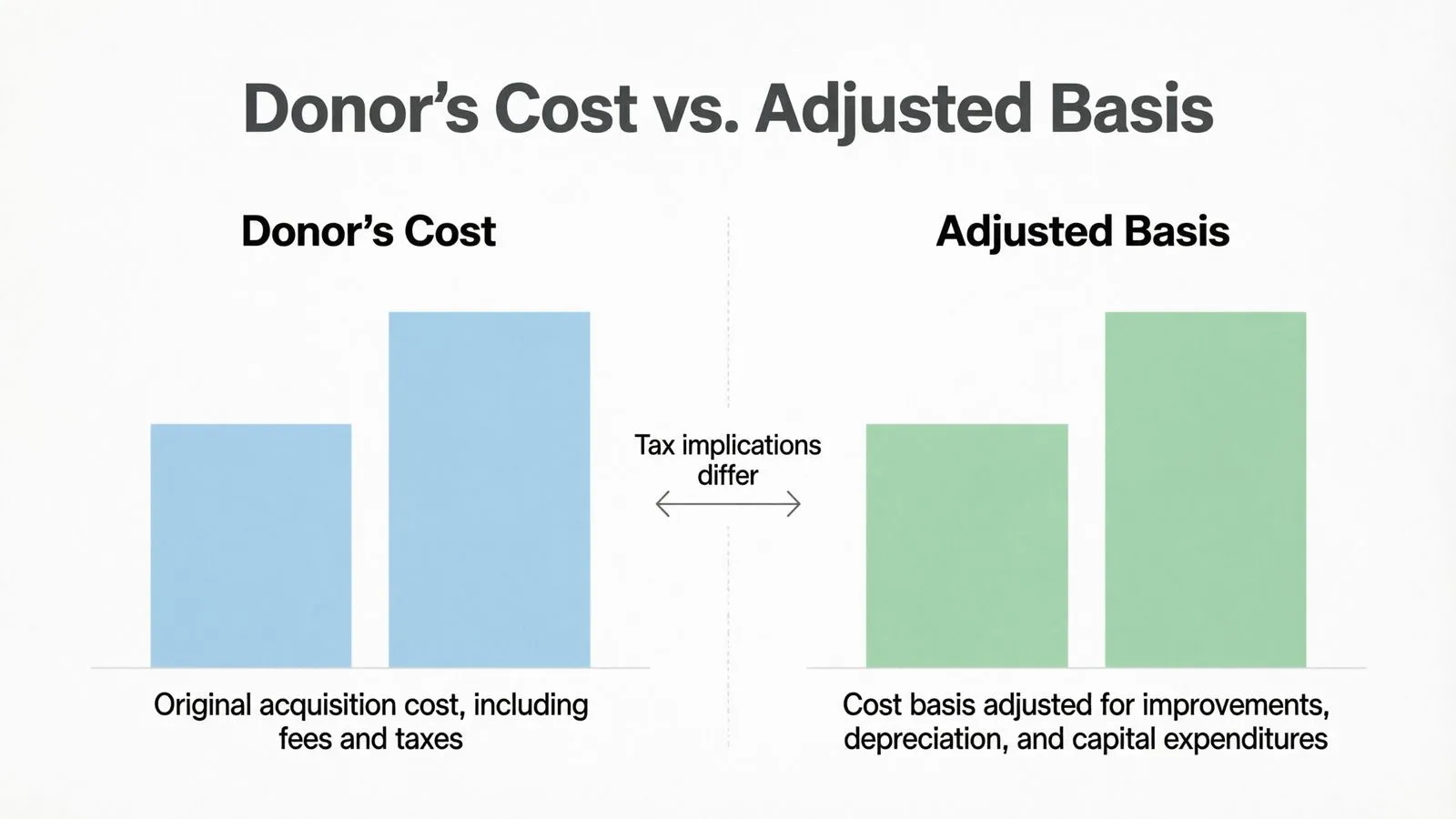
When donating property to charity, the amount you originally paid may differ from its current tax basis. Donor’s cost generally refers to the original purchase price, while adjusted basis reflects applicable changes during ownership. Knowing the difference helps you report donated property accurately and understand what the IRS asks for on Form 8283.
Quick Answer:
Use original cost to describe what you paid. Use adjusted basis when referring to the tax basis after applicable adjustments. For certain noncash donations, Form 8283 asks for cost or adjusted basis and fair market value (FMV). These figures serve different purposes, and your deduction is not automatically equal to your original cost.
What Is Donor’s Cost?
Donor’s cost generally means the amount you paid for an item, including applicable purchase-related costs. Receipts, bank statements, and credit card records can help establish the amount.
If you have lost the receipt, use available evidence to make a reasonable estimate of what you actually paid. Do not automatically substitute the item’s current retail price or resale value.
What Is Adjusted Basis?
Adjusted basis is the original tax basis after applicable increases and decreases. Qualifying improvements may increase it, while depreciation and certain other adjustments may reduce it.
Example: You buy equipment for $2,000 and make $500 in qualifying improvements. If no other adjustments apply, its adjusted basis becomes $2,500.
For gifted property, the recipient generally needs the donor’s adjusted basis and the property’s FMV when gifted. Special rules apply when FMV is lower than adjusted basis. See IRS Publication 551.
Donor’s Cost vs. Adjusted Basis vs. FMV
| Term | Meaning |
| Donor’s cost | Original amount paid |
| Adjusted basis | Tax basis after applicable adjustments |
| Fair market value (FMV) | Property’s value on the donation date |
For example, a jacket bought for $200 might have an adjusted basis of $200 but a donation-date FMV of $50. The allowable deduction depends on the applicable charitable-contribution rules, not simply what you paid.
How to Determine Cost Basis for Donated Items
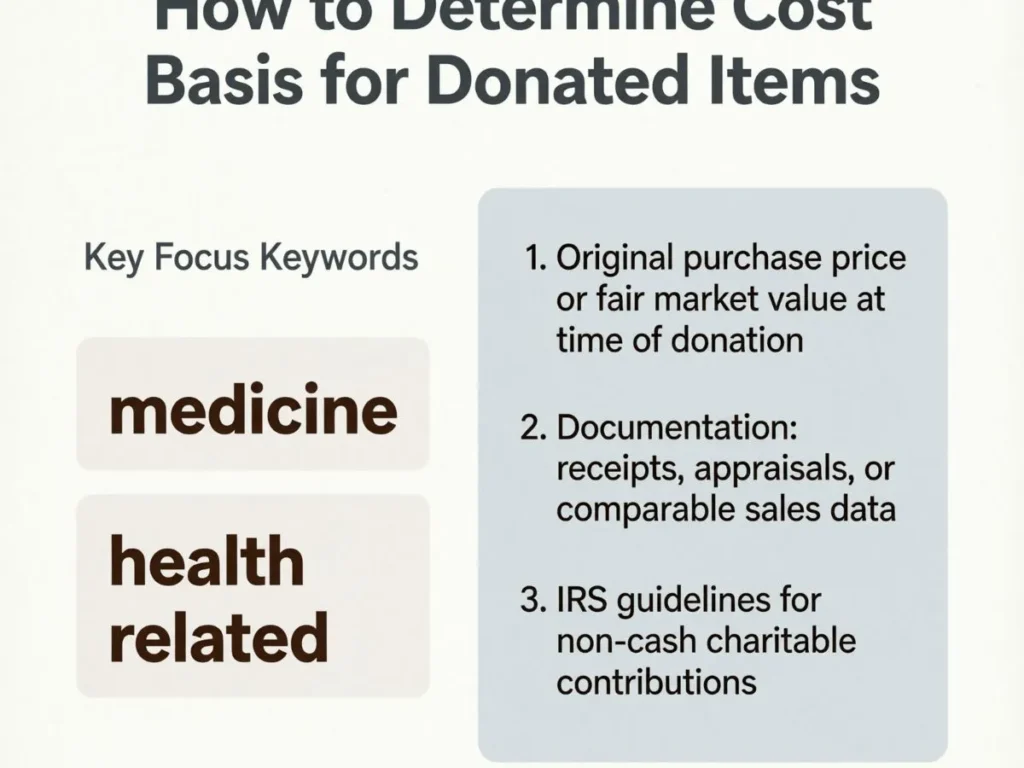
- Receipts available: Use documented purchase costs.
- No receipts: Make a reasonable estimate from available evidence and note your method.
- Similar items donated together: Estimate the combined cost or adjusted basis where required.
- Gifted or inherited property: Follow the applicable basis rules rather than assuming the original price determines the answer.
- Self-made items: Basis generally includes qualifying material costs, not the value of your personal time.
Keep records of the item’s description and condition, acquisition date and method, basis estimate, FMV calculation, and donation acknowledgment. Do not treat a charity’s valuation guide or a fixed percentage of replacement cost as an IRS-approved formula for cost basis. See IRS Publication 561.
When Is Form 8283 Required?
Generally, you must file Form 8283 when claiming more than $500 in noncash charitable deductions. Section A generally applies to items or groups of similar items with deductions over $500 through $5,000; Section B generally applies when the deduction exceeds $5,000.
A qualified appraisal is generally required above $5,000, but exceptions apply, including certain publicly traded securities and other specified property. A separate rule applies to a single clothing or household item that is not in good used condition: if you claim a deduction over $500 for it, you generally need a qualified appraisal and Section B. Check the current IRS Form 8283 instructions for the complete rules and exceptions.
FAQs
Are donor’s cost and adjusted basis the same?
No. Adjusted basis reflects applicable changes to the original tax basis.
Is cost basis the amount I can deduct?
No. FMV and other tax rules affect the allowable deduction.
What if I cannot remember what I paid?
Use available evidence to make a reasonable estimate and document your reasoning.
Conclusion
Donor’s cost, adjusted basis, and FMV serve different tax purposes. Identify the correct figure, keep supporting records, and check current IRS guidance before filing.
Related Articles
- Faced vs. Unfaced Insulation: Which Should You Use?
- Callus or Wart on Foot? How to Tell the Difference
- Appendix Left or Right? Location, Pain and Warning Signs

William Strunk is a respected authority on English grammar, usage, and writing style, known for his influential work The Elements of Style. At EduNexxa, his focus is on clear, concise, and effective English.
 Bryan Garne
 Mignon Fogarty