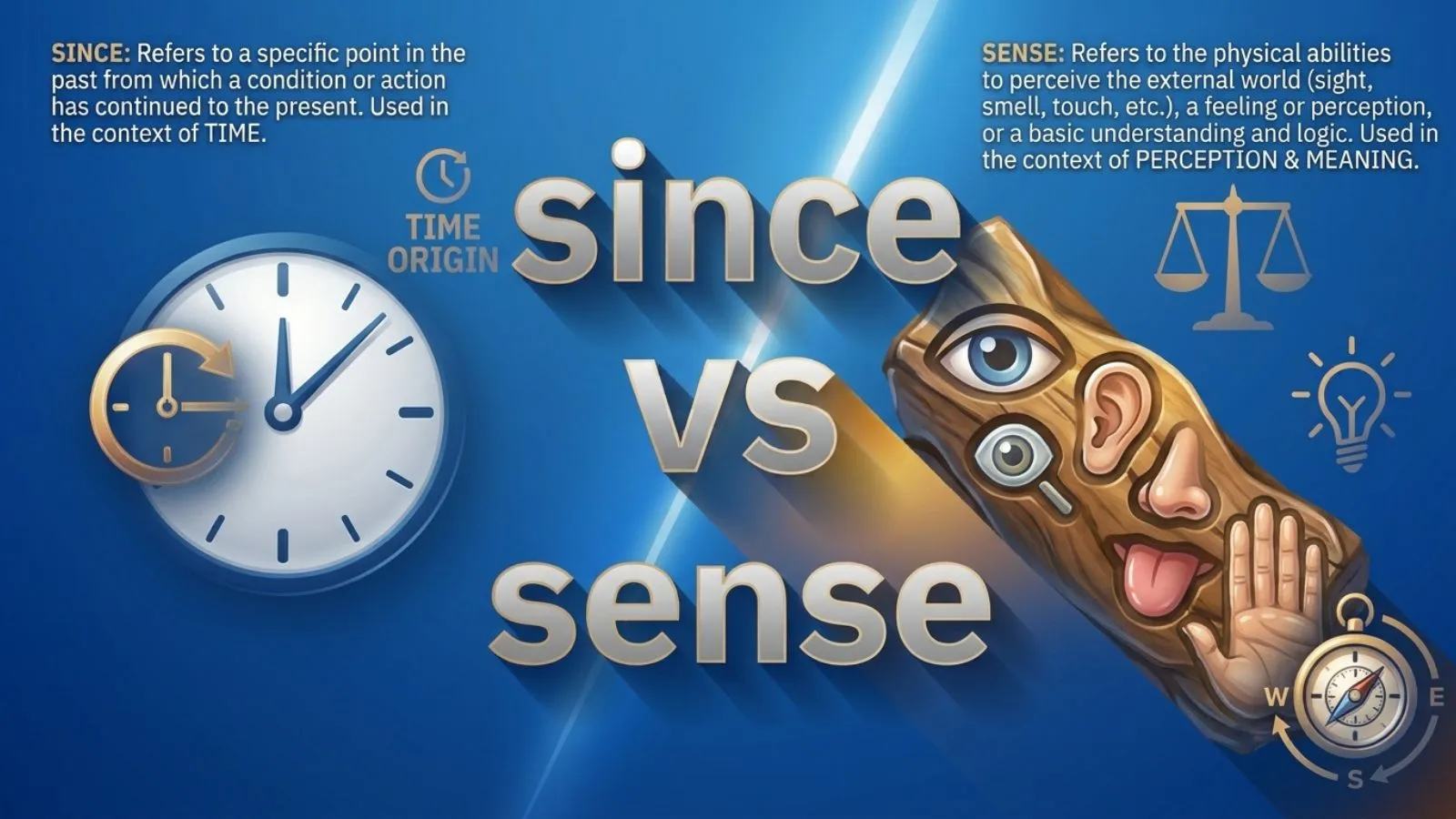
Since and sense are easy to mix up because their spellings look similar. However, they have different meanings and uses. Since refers to a starting point in time or a reason, while sense relates to understanding, perception, or judgment. Knowing the difference helps you choose the right word.
Quick Answer:
- Since: Shows when something began or explains why something happened.
- Sense: Describes physical perception, understanding, feelings, or judgment.
What Does Since Mean?
Since can be a preposition, conjunction, or adverb. It refers to a point in the past or introduces a reason.
Examples:
- I’ve lived here since 2021. (preposition)
- Since it was late, we decided to leave. (conjunction)
- We met years ago and haven’t spoken since. (adverb)
Use since with a starting point, such as Monday or 2021. It often appears with the present perfect when something began in the past and continues now. It can also mean because when it introduces a reason.
What Does Sense Mean?
Sense is a noun or verb connected with the five senses, awareness, understanding, and judgment.
As a noun, it can describe physical perception or the ability to understand something:
- She has a strong sense of smell.
- Your explanation makes sense.
- He has a good sense of humor.
Common expressions include common sense, meaning practical judgment, and make sense, meaning to be clear or logical. As a verb, sense means to notice or become aware of something: “I sensed that something was wrong.”
Since vs. Sense: Key Differences
| Since | Sense |
| Preposition, conjunction, or adverb | Noun or verb |
| Refers to time or reason | Relates to perception or understanding |
| Example: since Monday | Example: common sense |
| Answers when or why | Describes what you feel or understand |
How Are Since and Sense Pronounced?

In standard English, since is pronounced /sɪns/, with a short “i” sound. Sense is /sɛns/, with the vowel sound in bed. They look alike but do not usually sound the same.
What Does Cense Mean?
Cense is a rare verb meaning to burn incense near something or perfume it with incense, often during a religious ceremony.
Example: The priest began to cense the altar during the service.
Cense is pronounced /sɛns/, like sense. It is uncommon in everyday writing and cannot replace since or sense.
Common Mistakes and How to Remember
- Incorrect: That doesn’t make since.
Correct: That doesn’t make sense. - Incorrect: I’ve worked here sense 2021.
Correct: I’ve worked here since 2021. - Incorrect: She has a good since of direction.
Correct: She has a good sense of direction.
Remember:
- Since = a starting point or reason.
- Sense = perception, understanding, or judgment.
- Cense = incense.
Also, don’t confuse since with for. Use since for a starting point (since Monday) and for for a length of time (for three days).
FAQs
Is cense used in everyday English?
No. Cense is a rare verb and usually appears in religious or literary contexts.
Is it make sense or make since?
Make sense is correct. The expression means that something is logical, clear, or understandable.
Can sense be used as a verb?
Yes. “She sensed danger nearby” means she noticed or became aware of a possible threat.
Conclusion
Since refers to time or a reason, while sense describes perception and understanding. Remembering their meanings, grammar, and pronunciation will help you use the right word.
Related Articles
- Plural of Foreman: Is It Foremen or Foremans?
- Message or Messege: Which Spelling Is Correct?
- Afterward or Afterwards: Which Is Correct?

Bryan Garner an experienced English language writer specializing in grammar, usage, word choice, and clear American English. He focuses on making complex language rules simple, accurate, and practical.
 William Strunk
 Mignon Fogarty