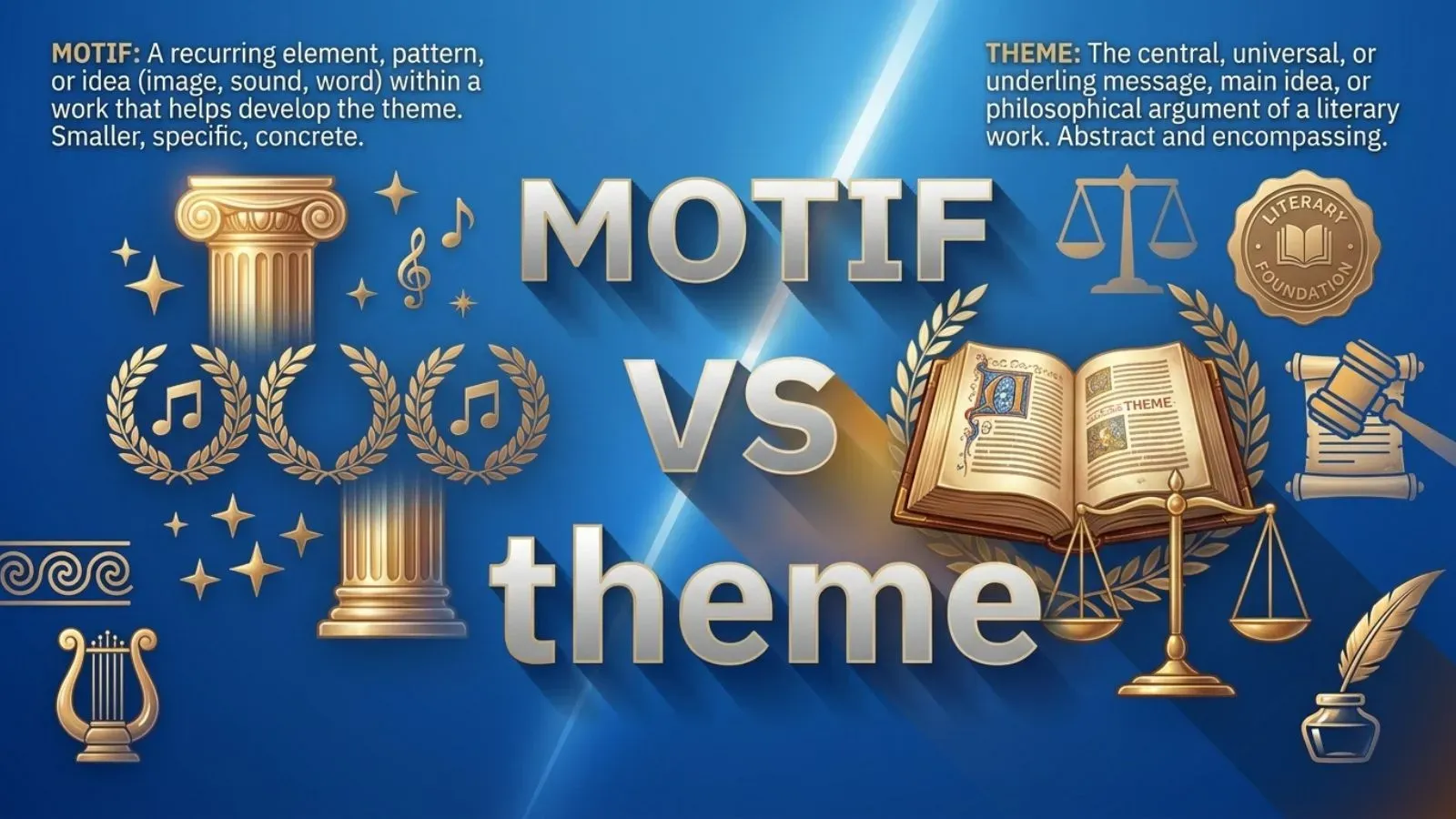
When reading a novel, film, or poem, you may notice recurring images, objects, or ideas that reveal deeper meaning. A motif is a recurring element in a creative work, while a theme is the central idea or message it explores. Although they work together, they serve different purposes.
Quick Answer
- Motif: A recurring image, object, phrase, sound, or situation that adds meaning.
- Theme: The broader idea a creative work explores about life, people, or society.
What Does Motif Mean?
A motif is a detail that recurs in a novel, poem, play, or film. It may be an object, color, sound, image, phrase, or action that connects scenes and emphasizes an idea.
For example, repeated images of locked doors and closed windows can create a motif of confinement. As the story develops, these details may reflect a character’s lack of freedom or growing isolation.
Repetition alone is not enough; the detail must contribute to the story’s meaning.
What Does Theme Mean?
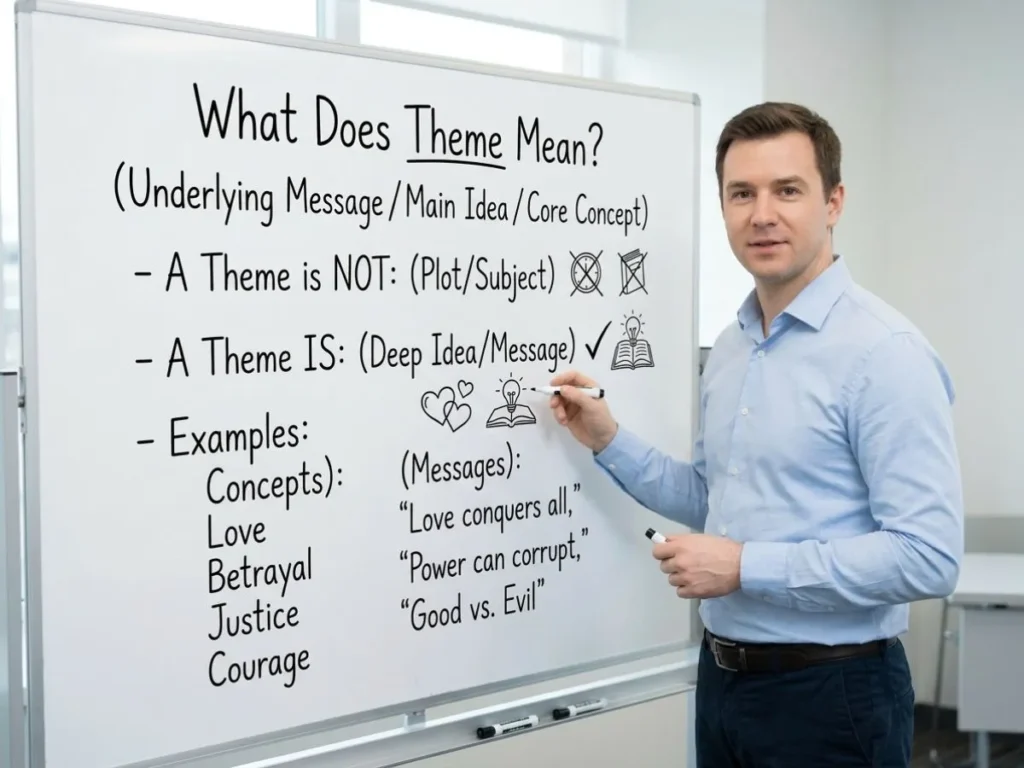
A theme is the central idea or insight a creative work develops about human experiences, relationships, choices, or society. Unlike a topic, it communicates a message rather than simply naming a subject.
Common themes include:
- Love and sacrifice
- Friendship and loyalty
- Power and corruption
- Freedom and responsibility
For example, a story about friends supporting each other through hardship may suggest that true loyalty is proven in difficult times.
Motif vs. Theme: Key Differences
| Motif | Theme |
| A recurring element | A central idea or message |
| Usually specific and recognizable | Usually broad and abstract |
| Appears repeatedly throughout a work | Develops through the story |
| Helps communicate deeper meaning | Expresses what the work explores |
| Example: locked doors | Example: the struggle for freedom |
Readers notice a motif recurring in the story; they understand a theme from the work as a whole. A motif can support a theme, but it does not express the entire message by itself.
Examples of Motif and Theme in Literature
Writers use recurring details to develop larger ideas:
- Romeo and Juliet: Light and darkness recur as a motif, reflecting love, hope, danger, and secrecy. Their contrast supports the theme of love challenged by conflict and family hatred.
- To Kill a Mockingbird: The mockingbird represents innocence and vulnerability. Its significance is reinforced through the story’s treatment of innocent characters, supporting themes of compassion, justice, and protecting the vulnerable.
- The Great Gatsby: The green light repeatedly represents Gatsby’s hopes and longing for an ideal future. Its recurrence develops the theme of the American Dream and the gap between dreams and reality.
These examples show how recurring details give readers clues about a work’s deeper ideas. A single motif may support more than one theme, and a story can use several motifs to develop its message.
Motif vs. Symbol: What’s the Difference?
A symbol represents an idea beyond its literal meaning; a motif is an element that recurs and contributes to a work’s meaning.
For example, a dove can symbolize peace. If it appears repeatedly to reinforce that idea, it also functions as a motif. However, a symbol that appears only once is not a recurring motif.
Why Are Motifs Important?
Motifs help writers connect separate scenes and give ordinary details a deeper purpose. Their repetition can establish mood, reveal changes in a character, build suspense, or draw attention to an important idea.
For example, repeated images of darkness may reflect fear or uncertainty as a character faces difficult choices. Recognizing such patterns helps readers understand how small details strengthen a story’s larger themes.
Theme vs. Topic: What’s the Difference?
A topic is a work’s general subject; a theme expresses a deeper idea about it. A topic may take one or two words, while a theme usually makes a complete point.
For example, friendship is a topic because it names what a story is about. “True friendship requires trust and sacrifice” is a theme because it expresses an idea about friendship.
A topic names the subject; a theme explains what the work suggests about it.
FAQs
Can a story have multiple motifs and themes?
Yes. A story can use several motifs and explore multiple themes that work together. Different recurring details may highlight different aspects of its central message.
Is love a motif or a theme?
Love is usually a theme because it is a broad idea. Recurring objects, images, or actions connected with love can become motifs.
Can a motif exist without a theme?
A motif may not point to one clear theme. It can also establish mood, reveal emotions, or connect events, even when its deeper meaning is open to interpretation.
Conclusion
A motif is a recurring detail that adds meaning, while a theme is the deeper idea a work explores. Recognizing both helps readers understand how writers use repeated details to communicate larger messages.
Related Articles
- Afterward or Afterwards: Which Is Correct?
- Message or Messege: Which Spelling Is Correct?
- Writing or Writting: Which Spelling Is Correct?

William Strunk is a respected authority on English grammar, usage, and writing style, known for his influential work The Elements of Style. At EduNexxa, his focus is on clear, concise, and effective English.
 Bryan Garne
 Mignon Fogarty