
Whether you are sending a text, writing an email, or sharing important information, correct spelling makes communication clearer. Message is the correct spelling, while messege is incorrect. Although the two forms look similar, only message is accepted in standard English.
Message or Messege: Quick Answer
- Message: The correct spelling. It means information shared with someone.
- Messege: An incorrect spelling and a common typing mistake.
Correct: I received your message this morning.
Incorrect: I received your messege this morning.
Why Is Message the Correct Spelling?
Message is the standard spelling. It ends in -age, not -ege. Its pronunciation /ˈmes.ɪdʒ/ may make the middle vowel hard to identify.
To remember the spelling, look at its letters:
M-E-S-S-A-G-E = MESSAGE
The two s letters are followed by a-g-e. Replacing a with e creates messege.
What Does Message Mean?
A message is information, news, an instruction, or an idea shared with someone. It can be sent by text, email, phone, or letter, or spoken.
It can also mean the main idea or lesson in a book, movie, or speech.
Examples:
- I sent my friend a message about the meeting.
- She left a message on my phone.
- The movie has a powerful message about friendship.
Why Do People Spell Message as Messege?
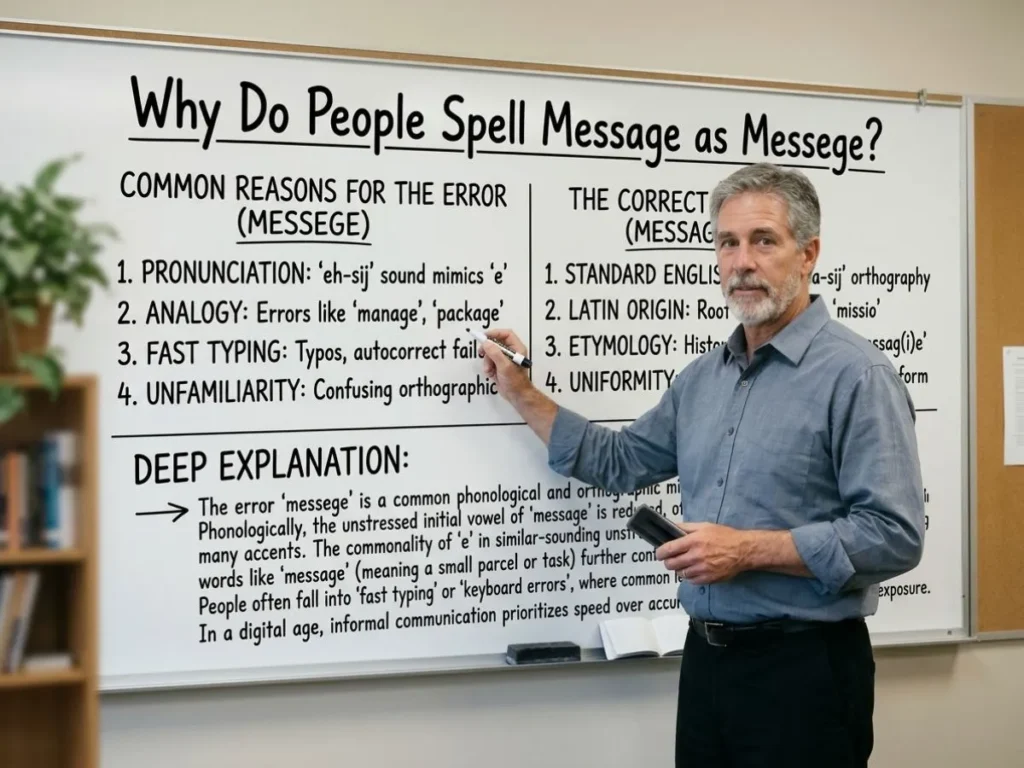
The mistake often comes from English pronunciation. People may be unsure whether the middle vowel is a or e.
Some learners spell words by sound rather than memory.
Remember message by comparing it with other words ending in -age:
- Package
- Damage
- Advantage
These words reinforce the pattern.
Message vs. Messege: Common Word Forms
These forms help you use message correctly in different sentences. They also show how the word changes when you describe more than one message or the act of sending one.
| Word Form | Correct Spelling | Example |
| Singular | Message | I sent a message. |
| Plural | Messages | She received three messages. |
| Past tense | Messaged | He messaged me yesterday. |
| Present participle | Messaging | They are messaging online. |
In messaging, the final e is dropped before adding -ing.
Why Does Correct Spelling Matter in Digital Communication?
Messages appear in personal chats, business emails, and workplace updates. Spelling mistakes can look unprofessional or confuse readers.
Correct spelling makes information easier to understand and shows attention to detail. Before sending an important message, use spell-check, but review its suggestions because automatic tools can make mistakes. This small check can prevent avoidable spelling errors.
Is Message Different in American and British English?
No. Message is spelled and used the same way in both varieties. There is no alternate spelling to learn for readers in the United States or the United Kingdom.
| American English | British English |
| Message | Message |
| Messages | Messages |
| Messege (incorrect) | Messege (incorrect) |
Use message in American and British writing.
FAQs
1. Is messege a real English word?
No. Messege is a misspelling. Use message.
2. Is message a noun or a verb?
It can be both.
- Noun: I received your message.
- Verb: I will message you tonight.
3. What is the plural of message?
The plural is messages: add -s.
4. How can I remember the spelling of message?
Remember -age: M-E-S-S-A-G-E, with a after the two s letters. You can silently spell it out before typing if you often mix up the vowels.
Conclusion
Message is correct; messege is incorrect in standard English. Remember -age and use message in both American and British English.
Related Articles
- How to Tell an Idiom from a Proverb: Meaning & Examples
- Ill vs. Sick: What’s the Difference and How to Use Them
- Trash vs. Garbage: Meaning, Differences, and Examples

William Strunk is a respected authority on English grammar, usage, and writing style, known for his influential work The Elements of Style. At EduNexxa, his focus is on clear, concise, and effective English.
 Mignon Fogarty
 Bryan Garne