
Ill and sick both describe someone who is unwell, but they do not work in exactly the same way. Sick can come before a noun, while ill usually follows a linking verb. In British English, be sick can also mean to vomit.
Quick Answer: Ill vs. Sick
- Ill: Means unwell and commonly follows verbs such as be, feel, or look.
- Sick: Also means unwell, but can come before a noun, as in a sick child. In British English, be sick can mean vomit.
Ill vs. Sick: Key Differences
| Feature | Ill | Sick |
| Main meaning | Not in good health | Not in good health; sometimes nauseated |
| Before a noun | Not usually | Yes |
| After a linking verb | Yes | Yes |
| British English | Means unwell | Be sick can mean vomit |
| American English | Means unwell | Common word for unwell |
When to Use Ill
Use ill after linking verbs such as be, become, feel, look, and seem to describe someone’s health. It often appears when discussing an illness or someone’s general condition.
Examples:
- She felt ill after lunch.
- My uncle was seriously ill last winter.
You will also see ill in phrases such as ill health, mentally ill, and critically ill. These describe a health condition rather than a specific symptom. Before a noun, it is usually more natural to say a person who is ill than an ill person.
When to Use Sick
Use sick after linking verbs and before nouns. It is especially common in everyday American English and can describe nausea as well as general illness.
Examples:
- I feel sick, so I’m going home.
- She is caring for a sick child.
The meaning changes with the phrase. Feel sick can mean unwell or nauseated. Sick leave means time off work because of illness, while sick of something means fed up with it.
Ill vs. Sick in American and British English
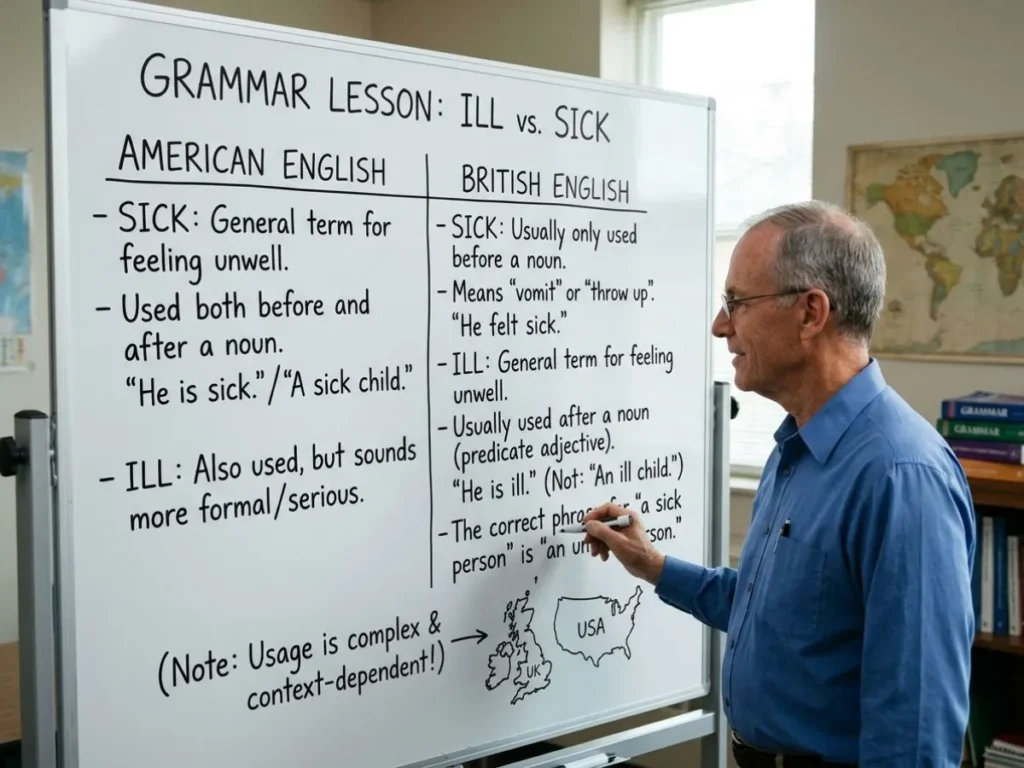
Both words are used in the UK and the US, but one expression has a notable regional difference:
- American English: Sick commonly means unwell. Example: “I’m sick today.”
- British English: Be sick can mean vomit. Example: “The child was sick.”
In both varieties, ill generally means unwell.
Common Mistakes to Avoid
- “An ill child” is not the usual everyday choice. Prefer “a sick child” or “a child who is ill.”
- “I’m sick of a fever” is incorrect. Say “I’m sick with a fever” or “I have a fever.”
- “I’m sick of this noise” is correct when you mean you are fed up with it.
FAQs
Can ill and sick mean the same thing?
Yes. Both can describe someone who is not in good health.
Can you say “feel ill” and “feel sick”?
Yes. Both are correct. Feel sick can also suggest nausea.
Is “sick child” correct?
Yes. Sick commonly comes before a noun; ill usually does not.
Conclusion
Use ill to describe someone’s health after a linking verb, and sick before a noun or in everyday expressions. In British English, remember that be sick can also mean to vomit.
Related Articles
- Much vs. Many: Simple Rules, Differences, and Examples
- Reel vs. Real: Meaning, Examples & Key Differences (2026)
- How to Tell an Idiom from a Proverb: Meaning & Examples

Mignon Fogarty is an experienced English grammar and writing expert specializing in grammar, word usage, and clear American English. At EduNexxt, her focus is making grammar simple, accurate, and practical.
 William Strunk
 Bryan Garne