
An idiom and a proverb may both use figurative language, but they serve different purposes. An idiom has a meaning beyond its individual words, while a proverb expresses a general truth or gives advice.
Quick Answer:
- Idiom: A figurative expression.
- Proverb: A familiar saying that shares a lesson.
Idiom vs. Proverb: Key Differences
| Feature | Idiom | Proverb |
| Purpose | Express an idea figuratively | Share advice or wisdom |
| Meaning | Not clear from individual words | Communicates a general lesson |
| Form | Usually part of a sentence | Usually a complete sentence |
| Use | Describes an action or situation | Comments on life or behavior |
What Is an Idiom?
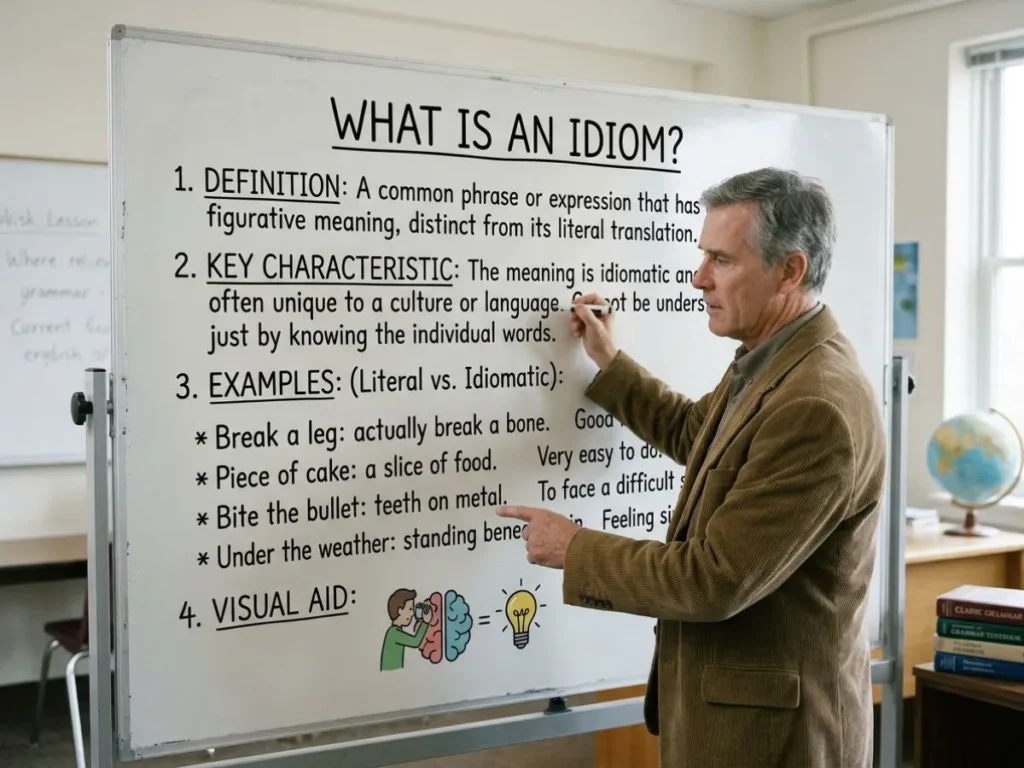
An idiom is an expression whose intended meaning differs from its literal words. Some idioms allow small changes in tense or pronouns without losing their meaning.
Examples:
- By the skin of your teeth: She passed by the skin of her teeth, meaning she barely succeeded.
- Rub someone the wrong way: His blunt comments rub people the wrong way, meaning they irritate them.
What Is a Proverb?
A proverb is a short saying that expresses a common belief or offers advice. It usually forms a complete sentence with a lesson that applies broadly. Proverbs often reflect cultural values.
Examples:
- Don’t cry over spilled milk: There is no point worrying about something that has already happened.
- A stitch in time saves nine: Fixing a small problem early can prevent a bigger one later.
How to Tell Them Apart
Look at the expression’s purpose. A figurative phrase is usually an idiom; a saying that offers general advice or a life lesson is a proverb.
Both can use figurative language, so the difference is not simply literal versus nonliteral. Purpose is the better clue.
Common Mistakes to Avoid
- Taking an idiom literally: Its intended meaning differs from its words.
- Calling every saying a proverb: A proverb must express general wisdom or advice.
FAQs
1. Are idioms and proverbs the same?
No. An idiom has a figurative meaning beyond its literal words.
A proverb expresses a general truth or gives advice.
2. Can a proverb contain figurative language?
Yes. It can use a metaphor or imagery while communicating a broader lesson.
3. Is every familiar saying a proverb?
No. Some expressions are idioms; proverbs specifically share general wisdom or advice.
Conclusion
An idiom gives a phrase a figurative meaning, while a proverb shares a life lesson. Focus on its purpose to tell them apart.
Related Articles
- Set or Sit: Meaning, Differences, and How to Use Them
- Skillset or Skill Set: Which Spelling Is Correct?
- Plurals of Ox and Fox: Is It Oxen or Foxes?

William Strunk is a respected authority on English grammar, usage, and writing style, known for his influential work The Elements of Style. At EduNexxa, his focus is on clear, concise, and effective English.
 Mignon Fogarty
 Bryan Garne