
Both pre-existing and preexisting are accepted spellings meaning “existing beforehand.” The difference is the hyphen, not the meaning. Your best choice depends on the dictionary or style guide you follow.
Quick Answer: Pre-existing or Preexisting?
- Pre-existing: The hyphenated form.
- Preexisting: The closed form, written as one word.
- Best practice: Follow your preferred style guide and use the same spelling consistently.
Pre-existing vs. Preexisting at a Glance
| Feature | Pre-existing | Preexisting |
| Form | Hyphenated | One word |
| Meaning | Existing beforehand | Same meaning |
| Accepted spelling | Yes | Yes |
| Example | A pre-existing condition | A preexisting condition |
What Does Pre-existing Mean?
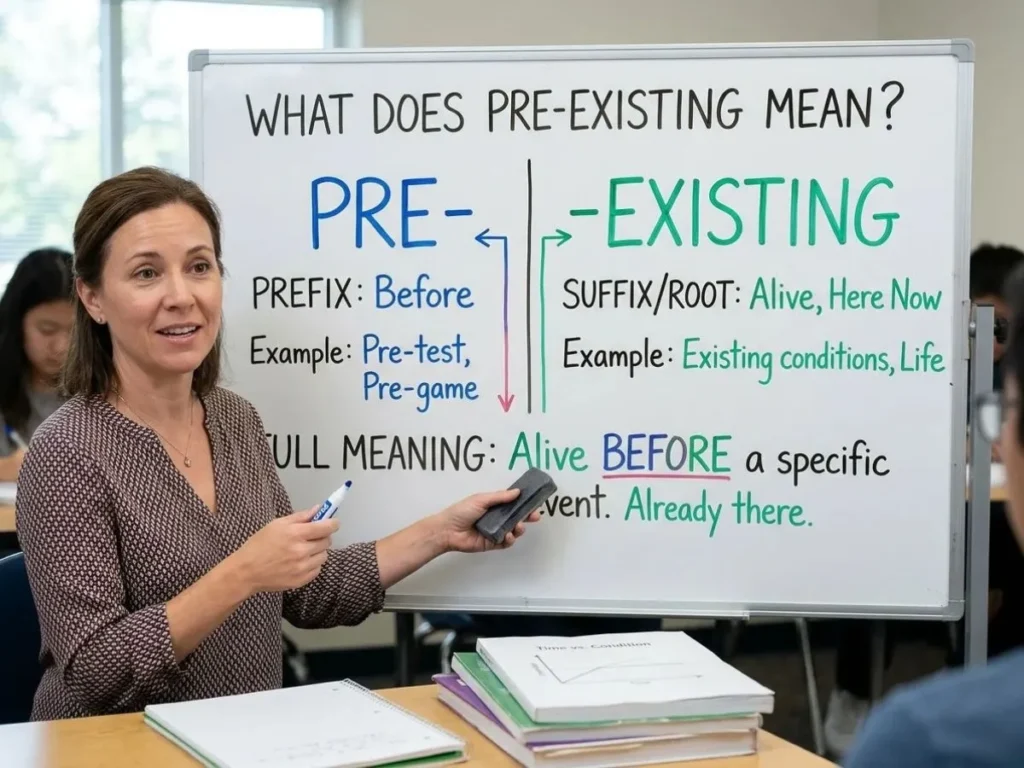
Pre-existing describes something that was already present before a particular event, date, or situation. For example, a pre-existing medical condition is a health issue that existed before a specified time, such as the start of an insurance policy.
The term also applies to earlier agreements, rules, infrastructure, problems, and circumstances.
Why Are There Two Spellings?
The prefix pre- means “before.” Writers sometimes use a hyphen to make a word’s structure easier to recognize, but English does not require a hyphen after every prefix.
As prefixed words become familiar, many dictionaries and style guides favor writing them as one word. The hyphen does not change the meaning of pre-existing or preexisting.
When Should You Use Each Form?
Use pre-existing when it matches your preferred dictionary or publication style. Use preexisting when your style guide favors closed compounds.
Cambridge lists pre-existing and recognizes preexisting as an alternative. The Chicago Manual of Style and Microsoft Style Guide generally prefer closed forms when a hyphen is unnecessary.
In legal, medical, and academic writing, formality alone does not determine whether a hyphen is required. Follow the relevant organization’s rules, and preserve the original spelling in official names or direct quotations.
Examples of Pre-existing and Preexisting
- The patient reported a pre-existing medical condition.
- The project had to work around preexisting infrastructure.
- The agreement excluded pre-existing damage.
- Researchers examined the preexisting evidence before reaching a conclusion.
- The new policy changed several preexisting procedures.
Common Mistakes
- Assuming one spelling is wrong: Both forms are accepted.
- Switching spellings randomly: Choose one form and use it consistently.
- Adding a hyphen automatically: Check your style guide instead of assuming every word with pre- needs a hyphen.
FAQs
Is pre-existing one word or hyphenated?
Both forms are accepted. Pre-existing uses a hyphen, while preexisting is written as one word.
Do pre-existing and preexisting mean different things?
No. Both describe something that existed before a particular time or event.
Is preexisting correct in formal writing?
Yes. Some major style guides prefer the closed form, even in formal writing. Follow your publication’s chosen convention.
Conclusion
Pre-existing and preexisting have the same meaning, and both spellings are accepted. Follow your preferred style guide, choose one form, and use it consistently throughout your writing.
Related Articles
- Of Course or Ofcourse: Which Spelling Is Correct?
- Vicious or Viscous: Meaning, Difference, and Examples
- Hustle or Hussle: Correct Spelling, Meaning, and Examples

Mignon Fogarty is an experienced English grammar and writing expert specializing in grammar, word usage, and clear American English. At EduNexxt, her focus is making grammar simple, accurate, and practical.
 Bryan Garne
 William Strunk