
Of course is the correct spelling; ofcourse is incorrect in standard English. Use two separate words when expressing agreement, certainty, or something that seems natural or expected.
Quick Answer: Of Course vs. Ofcourse
- Of course: The correct two-word expression.
- Ofcourse: An incorrect spelling in standard English.
- Off course: A different expression meaning away from an intended route or direction.
Example: Of course, I can help you with your assignment.
What Does Of Course Mean?
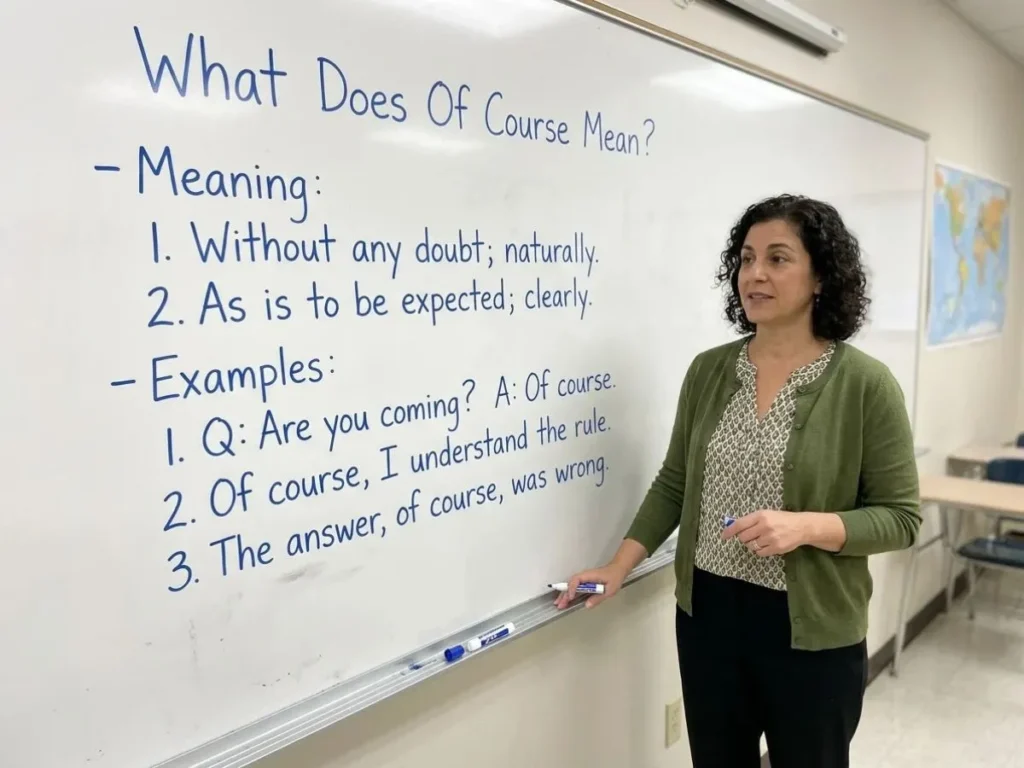
“Of course” expresses agreement, willingness, certainty, or something that seems obvious or expected. It can make a response sound friendly and natural, depending on the context.
Examples:
- Of course, you can borrow my book.
- She will, of course, attend the meeting.
However, tone matters. Saying “Of course!” warmly can sound helpful, while saying it impatiently may sound sarcastic.
Why Is Ofcourse Incorrect?
The confusion happens because people often pronounce “of course” quickly, making the two words sound connected. This can lead writers to assume that the expression should be written as one word.
However, standard English keeps the words separate. Even if you see “ofcourse” in informal online posts, use “of course” in professional writing, school assignments, emails, and published articles.
Of Course vs. Off Course: What’s the Difference?
Although these expressions sound similar, they have different meanings. Use “of course” to express agreement or certainty and “off course” to describe something that has moved away from its intended direction.
| Word or Phrase | Correct? | Meaning | Example |
| Of course | Yes | Agreement, certainty, or something expected | Of course, I can help you. |
| Ofcourse | No | Incorrect spelling in standard English | Write “of course,” not “ofcourse.” |
| Off course | Yes | Away from the intended route or direction | The boat drifted off course. |
| Offcourse | No | Nonstandard spelling of “off course” | The plane went off course. |
Remember: “Of course” expresses a response or idea, while “off course” describes a direction or deviation.
Alternatives to Of Course
Depending on the sentence, you can replace “of course” with:
- Certainly: A polite or formal way to agree.
- Absolutely: A strong expression of agreement.
- Naturally: Something that seems expected.
- Sure: A casual way to say yes.
- Without a doubt: A clear expression of certainty.
These alternatives are not interchangeable in every situation, so choose one that fits your meaning and tone.
Examples of Of Course in Sentences
- Of course, I will help you prepare for the exam.
- “Can I sit here?” “Of course!”
- Of course, regular practice can improve your writing.
- She knew, of course, that the deadline was approaching.
Punctuation Tip
When “of course” begins a sentence, it is often followed by a comma.
- Beginning: Of course, we can discuss it tomorrow.
- Middle: The answer is, of course, correct.
- End: I would be happy to help, of course.
Punctuation can vary with sentence structure, but the expression itself remains two words.
FAQs
Is “ofcourse” ever correct?
No. In standard English, write it as two words: “of course.”
Is “of course” one word or two?
It is two words: of course.
Is the spelling different in American and British English?
No. “Of course” is spelled the same way in both American and British English.
Conclusion
When choosing between “of course” and “ofcourse,” always use “of course” in standard English. Keep the words separate, pay attention to your tone, and use “off course” only when describing something that has strayed from its intended route or direction.
Related Articles
- Hoodie or Hoody: Which Spelling Is Correct?
- Heyday or Hayday: Which Spelling Is Correct?
- Igniter or Ignitor: Correct Spelling, Meaning & Examples

Mignon Fogarty is an experienced English grammar and writing expert specializing in grammar, word usage, and clear American English. At EduNexxt, her focus is making grammar simple, accurate, and practical.
 William Strunk
 Bryan Garne