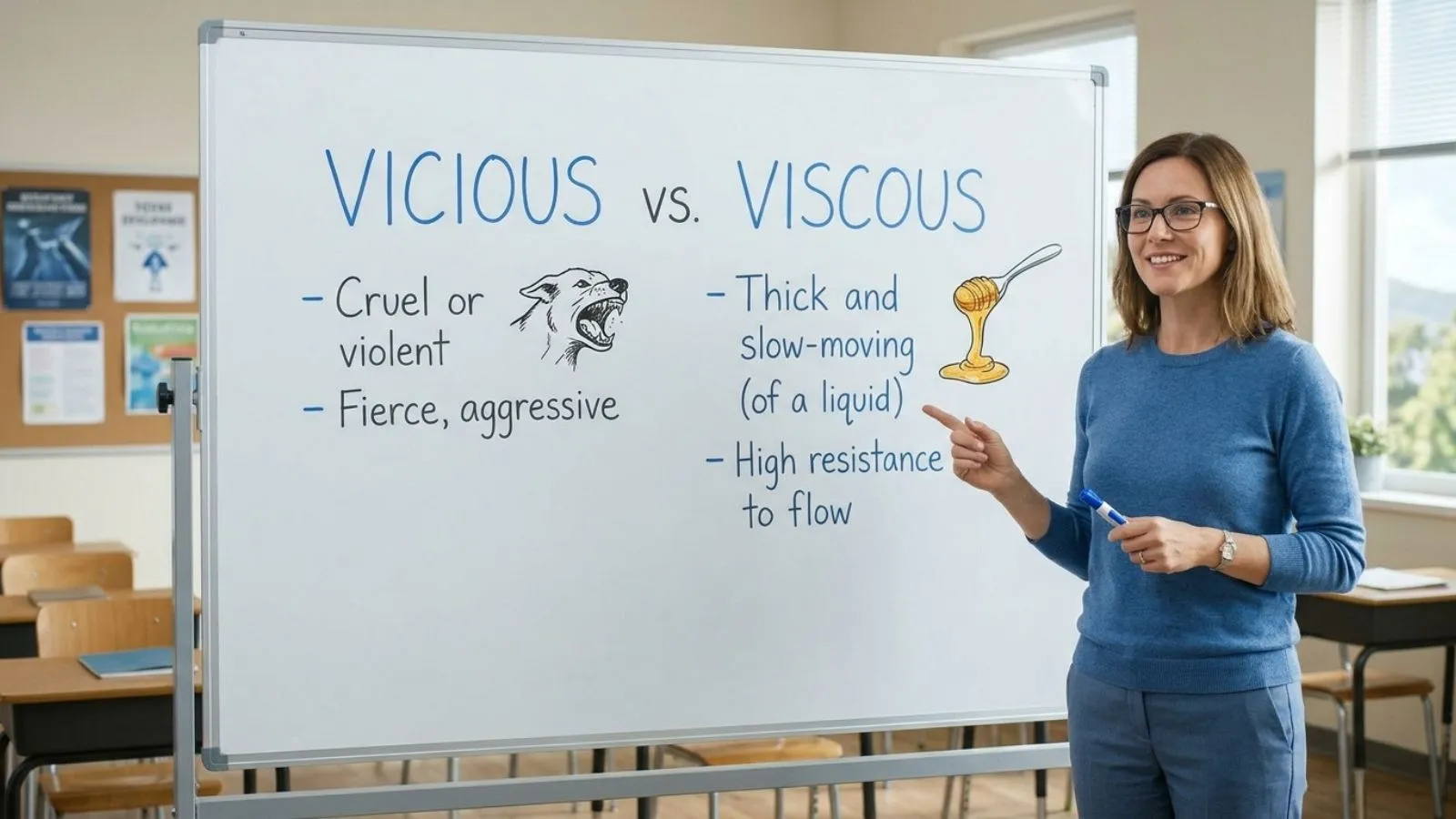
Vicious means cruel, aggressive, or harmful. Viscous, on the other hand, describes a substance that resists flowing and moves slowly. The words look and sound alike, but their meanings are different. The right word describes behavior or liquids.
Quick Answer: Vicious vs. Viscous
- Vicious (VISH-us): cruel, violent, severe, or intentionally harmful.
- Viscous (VIS-kus): thick or slow-flowing, usually describing a liquid.
Examples: A vicious attack can injure someone, while viscous honey drips slowly from a spoon.
What Does Vicious Mean?
Vicious describes cruel, aggressive, or seriously harmful behavior. It can describe people and animals, as well as words, attacks, criticism, competition, and situations.
Examples include a vicious rumor, response, or online criticism. The phrase vicious cycle has a specific meaning: it describes a harmful pattern in which one problem leads to another and makes the original problem harder to fix.
For example, debt can lead to fees, and those fees can increase the debt and make repayment harder. This repeating pattern may become a vicious cycle.
What Does Viscous Mean?

Viscous describes how much a fluid resists flowing. A viscous liquid moves more slowly than one with lower viscosity. Honey, syrup, some oils, paint, and molasses are familiar examples.
The related noun viscosity means a fluid’s resistance to flow. Temperature matters: many liquids become more viscous as they cool and less viscous as they warm. That is why cold oil may pour more slowly than warm oil.
Vicious vs. Viscous: Key Differences
| Feature | Vicious | Viscous |
| Meaning | Cruel, aggressive, or harmful | Resistant to flow; thick or slow-moving |
| Usually describes | Behavior, attacks, words, or cycles | Liquids, oils, and other fluid materials |
| Example | Vicious criticism | Viscous syrup |
Common Mistakes and Examples
Both spellings are valid English words, so spell-check may not catch the mistake if you choose the wrong one. Check the sentence’s meaning instead.
- Correct: The dog became vicious when threatened.
- Correct: The laboratory tested a highly viscous liquid.
- Incorrect: The honey was vicious. Better: The honey was viscous.
- Incorrect: She made a viscous remark. Better: She made a vicious remark.
- The company faced vicious competition.
- The sauce became more viscous as it cooled.
In technical writing, use viscous to describe a fluid’s properties. In everyday writing, use vicious for cruelty, harsh attacks, or harmful patterns. Writers sometimes use viscous figuratively, as in “a viscous silence,” but this is an uncommon, poetic expression. Choose a clearer word unless you want that specific effect.
Easy Way to Remember
Connect vicious with violence to remember its link to harm. Connect viscous with viscosity, the term for resistance to flow. Ask yourself: am I describing harmful behavior or the way a substance moves?
FAQs
Is honey vicious or viscous?
Honey is viscous because it is thick and often flows slowly.
Can a person be viscous?
Not often in the literal sense. A person can be vicious, while viscous generally describes fluids or fluid-like materials.
What does “vicious cycle” mean?
It means a harmful pattern in which one problem makes another worse, allowing the difficulties to continue.
Conclusion
When choosing vicious or viscous, think about what you are describing. Use vicious for cruelty, aggression, harsh criticism, or a harmful cycle. Use viscous for liquids that resist flowing easily. Remember the distinction: vicious relates to violence; viscous relates to viscosity.
Related Articles
- Heyday or Hayday: Which Spelling Is Correct?
- Hoodie or Hoody: Which Spelling Is Correct?
- Igniter or Ignitor: Correct Spelling, Meaning & Examples

Bryan Garner an experienced English language writer specializing in grammar, usage, word choice, and clear American English. He focuses on making complex language rules simple, accurate, and practical.
 William Strunk
 Mignon Fogarty