
Immersion means being submerged or deeply involved in something, while emersion means emerging or becoming visible again. Though their spellings differ by one letter, they describe different actions.
Quick Answer: Emersion vs. Immersion
- Immersion: Going into liquid or becoming involved in an activity, language, or environment.
- Emersion: Coming out of a hidden or submerged state; in astronomy, a celestial body’s reappearance after an eclipse or occultation.
Emersion vs. Immersion at a Glance
| Feature | Emersion | Immersion |
| Main meaning | Emerging or reappearing | Submerging or deep involvement |
| Common contexts | Astronomy and technical writing | Education, technology, everyday language |
| Example | The Moon’s emersion was observed. | The course uses language immersion. |
What Does Emersion Mean?
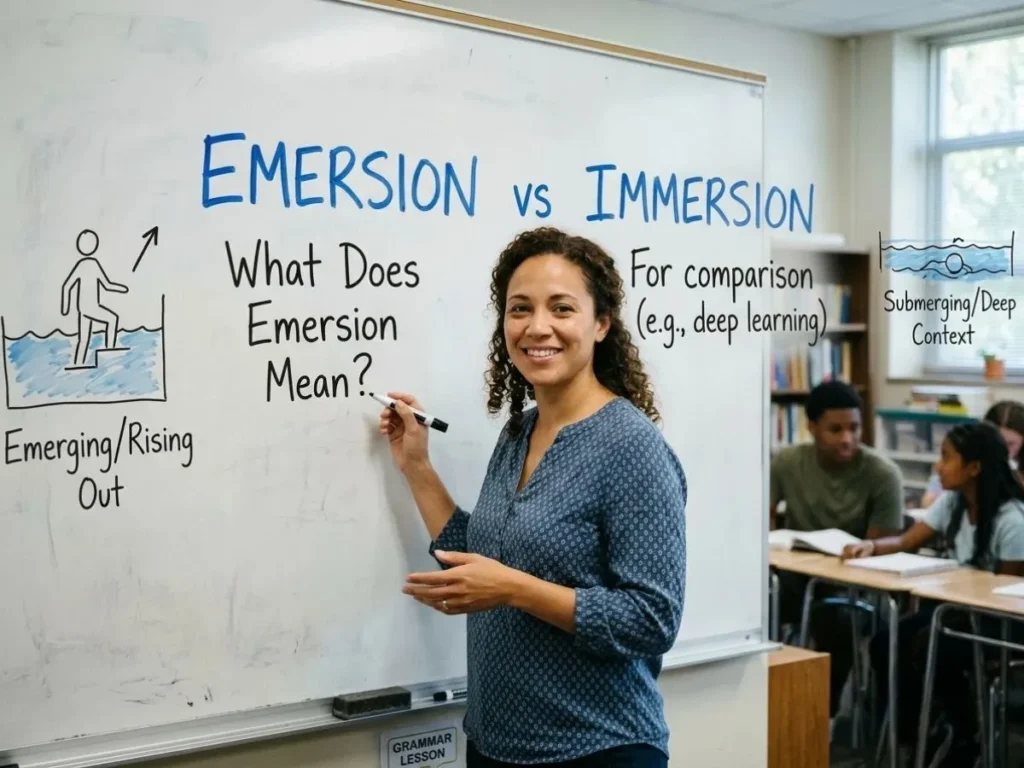
Emersion means coming out of something or becoming visible again. Although the word is uncommon in everyday English, it has a specific meaning in astronomy: a celestial body reappears after being hidden during an eclipse or occultation. The term can also describe marine life exposed to air as the tide goes out. In everyday writing, “emergence” is often more natural.
What Does Immersion Mean?
Immersion means placing something under liquid or becoming absorbed in an activity. Physical examples include immersion in water or using an immersion blender. Figurative uses include language immersion, where learners practise regularly, and cultural immersion, such as experiencing local customs while travelling. Virtual reality and gaming also create a sense of immersion by drawing users into a digital world.
Key Differences and Correct Usage
Use immersion when something enters liquid or a person becomes deeply involved. Use emersion when something emerges or reappears, especially in science.
Submersion emphasizes being beneath a surface, while immersion can also mean deep engagement. Coastal organisms may experience immersion underwater and emersion when exposed to air at low tide. The words describe different directions, not alternate spellings.
Examples of Emersion and Immersion
- The diver’s immersion lasted several minutes.
- Spanish immersion helped students practise daily.
- Virtual reality can create a sense of immersion.
- Astronomers recorded the Moon’s emersion after it reappeared.
- Coastal organisms adapt to immersion and emersion.
Common Mistake
Do not use these words interchangeably. “The diver’s immersion from the water” is unsuitable if you mean coming out; emersion or the more familiar emergence may fit. Emersion is not a standard term for reflection after language learning.
Memory Trick
- Immersion = Into: going in or becoming involved.
- Emersion = Exit: coming out or reappearing.
FAQs
Is emersion a real word?
Yes. It means emerging or, in astronomy, reappearing after an eclipse or occultation.
Are emersion and immersion opposites?
They can describe opposite directions: immersion involves going in; emersion involves coming out.
Is emersion used in psychology or language learning?
Immersion is the established term for deep involvement in learning. Emersion is not a standard name for a post-learning reflection phase.
What is an immersion blender?
A handheld tool that blends ingredients directly in a pot. “Emersion blender” is incorrect.
What is the difference between submersion and immersion?
Submersion emphasizes being beneath liquid. Immersion can also mean deep participation in an activity or environment.
Conclusion
Immersion means going in or becoming absorbed; emersion means coming out or reappearing. Choose the word that matches the action and context.
Related Articles
- Of Course or Ofcourse: Which Spelling Is Correct?
- Vicious or Viscous: Meaning, Difference, and Examples
- Igniter or Ignitor: Correct Spelling, Meaning & Examples

Bryan Garner an experienced English language writer specializing in grammar, usage, word choice, and clear American English. He focuses on making complex language rules simple, accurate, and practical.
 William Strunk
 Mignon Fogarty