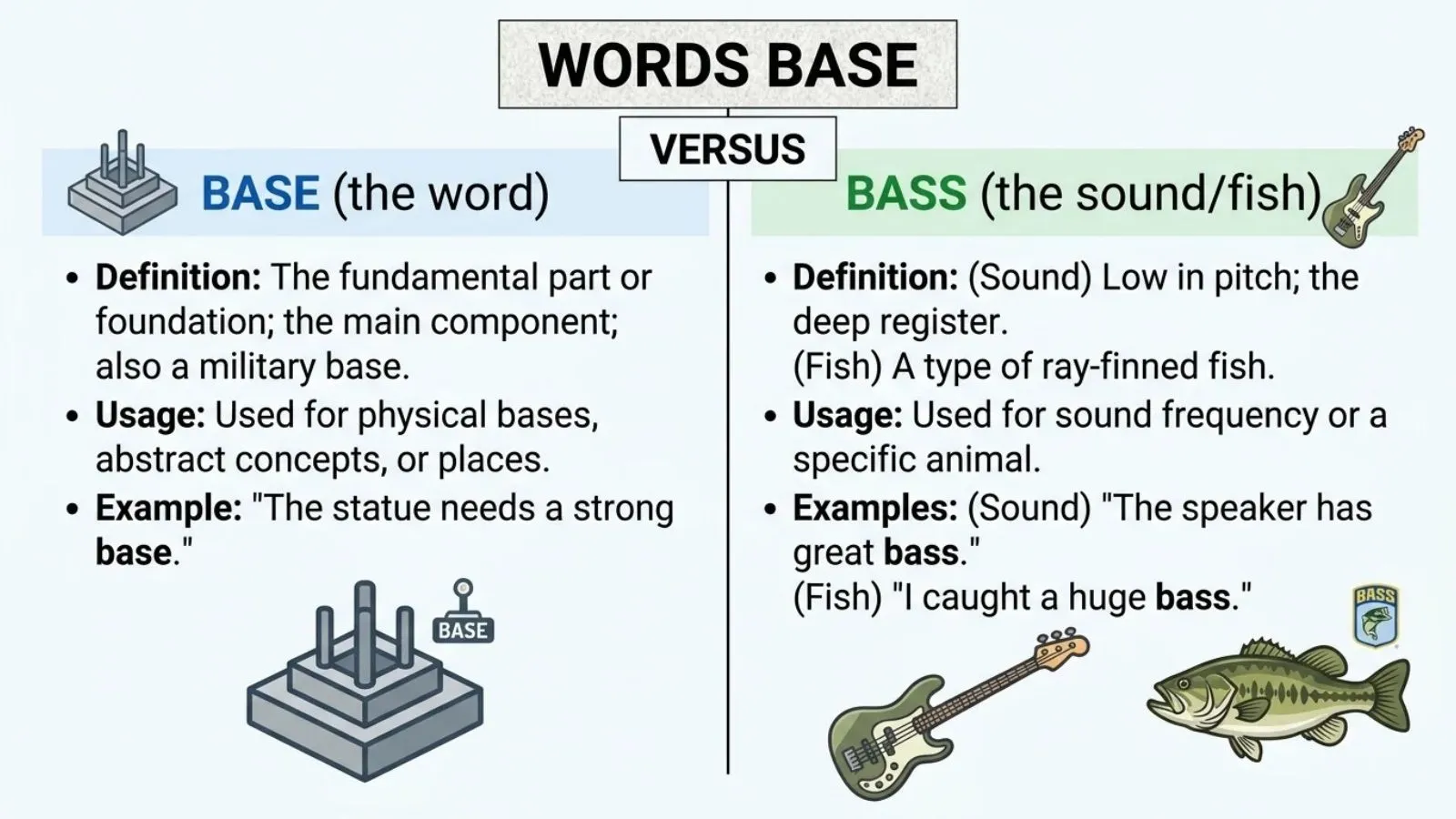
Base refers to a foundation or starting point, while bass can mean low musical sounds, a musical instrument, or a type of fish. Although the words look similar, their meanings and pronunciations depend on the context.
Quick Answer: Base or Bass?
- Base: The bottom or support of something, a starting point, or a place where people operate.
- Bass: Low musical notes, a deep singing voice or instrument, or a type of fish.
- Pronunciation: Base and musical bass sound alike, but bass referring to fish sounds different.
Base vs. Bass at a Glance
| Feature | Base | Bass |
| Main meaning | Foundation, starting point, or main location | Low musical sound, instrument, or fish |
| Part of speech | Noun, verb, adjective | Noun, adjective |
| Pronunciation | /beɪs/ | /beɪs/ for music; /bæs/ for fish |
| Example | The lamp has a sturdy base. | She plays bass in a band. |
What Does Base Mean?
Base usually refers to the bottom support of an object or the foundation of an idea. It can also describe a place where people work or operate, such as a military base or a company’s main base of operations.
The word has other uses, too. In chemistry, a base is a substance that reacts with an acid. As a verb, base means to build something on evidence or information, as in “The report is based on interviews.” It can also describe dishonorable behavior in certain contexts.
What Does Bass Mean?
Bass has several meanings, particularly in music and fishing. In music, it refers to low notes, a deep singing voice, or an instrument such as a bass guitar. It can also describe low-frequency sound, as in “Turn up the bass.”
In fishing, bass names a type of fish found in freshwater or saltwater, depending on the species. The plural is generally bass for the fish, while basses can be used for musical voices or instruments.
American vs. British English: Base or Bass?
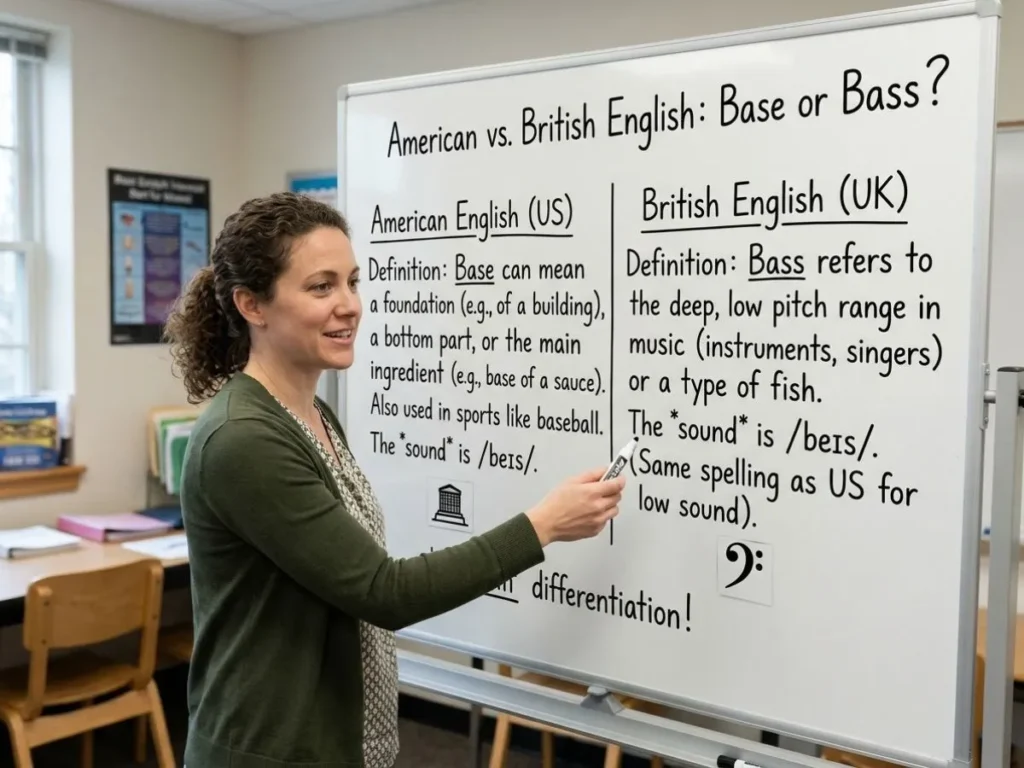
Unlike words such as color/colour and center/centre, base and bass have the same spelling in American and British English. Neither word is specific to one variety.
- Base: in both US and UK English.
- Bass (music): in both varieties.
- Bass (fish): in both varieties.
The key difference is meaning and pronunciation, not regional spelling.
How Do You Pronounce Base and Bass?
Base is pronounced /beɪs/, rhyming with “case.” Musical bass has the same pronunciation. However, bass referring to fish is pronounced /bæs/, which rhymes with “class” in many American accents.
Context usually makes the intended meaning clear, but knowing both pronunciations helps avoid confusion.
Examples of Base and Bass
- The lamp’s base keeps it steady.
- The team returned to its base after the mission.
- The experiment used a base to react with an acid.
- His deep bass voice filled the concert hall.
- The DJ turned up the bass during the song.
- We caught a bass while fishing at the lake.
Common Mistake
Don’t choose between these words based on spelling alone.
Use base for a foundation or starting point, and bass for music or fish. Remember that musical bass and base sound alike, while fish bass has a different pronunciation.
Memory Trick to Avoid Confusion
Base = bottom or foundation.
Bass = music or fish.
Remember: musical bass rhymes with base, but fish bass sounds different.
FAQs
Are base and bass pronounced the same?
Base and musical bass sound alike. Bass referring to fish has a different vowel sound.
Is bass a musical instrument or a fish?
It can mean either. In music, bass refers to low sounds, a voice, or an instrument. In fishing, it refers to a type of fish.
What does “based on” mean?
It means founded on or developed from something. For example, “The film is based on a true story.”
Conclusion
Base means a foundation or starting point, while bass refers to low musical sounds, instruments, or fish. Use the meaning and pronunciation to choose the correct word.
Related Articles
- Of Course or Ofcourse: Which Spelling Is Correct?
- Emersion vs. Immersion: Meaning, Differences & Examples
- Flavor vs. Flavour: Which Spelling Is Correct?

Mignon Fogarty is an experienced English grammar and writing expert specializing in grammar, word usage, and clear American English. At EduNexxt, her focus is making grammar simple, accurate, and practical.
 William Strunk
 Bryan Garne