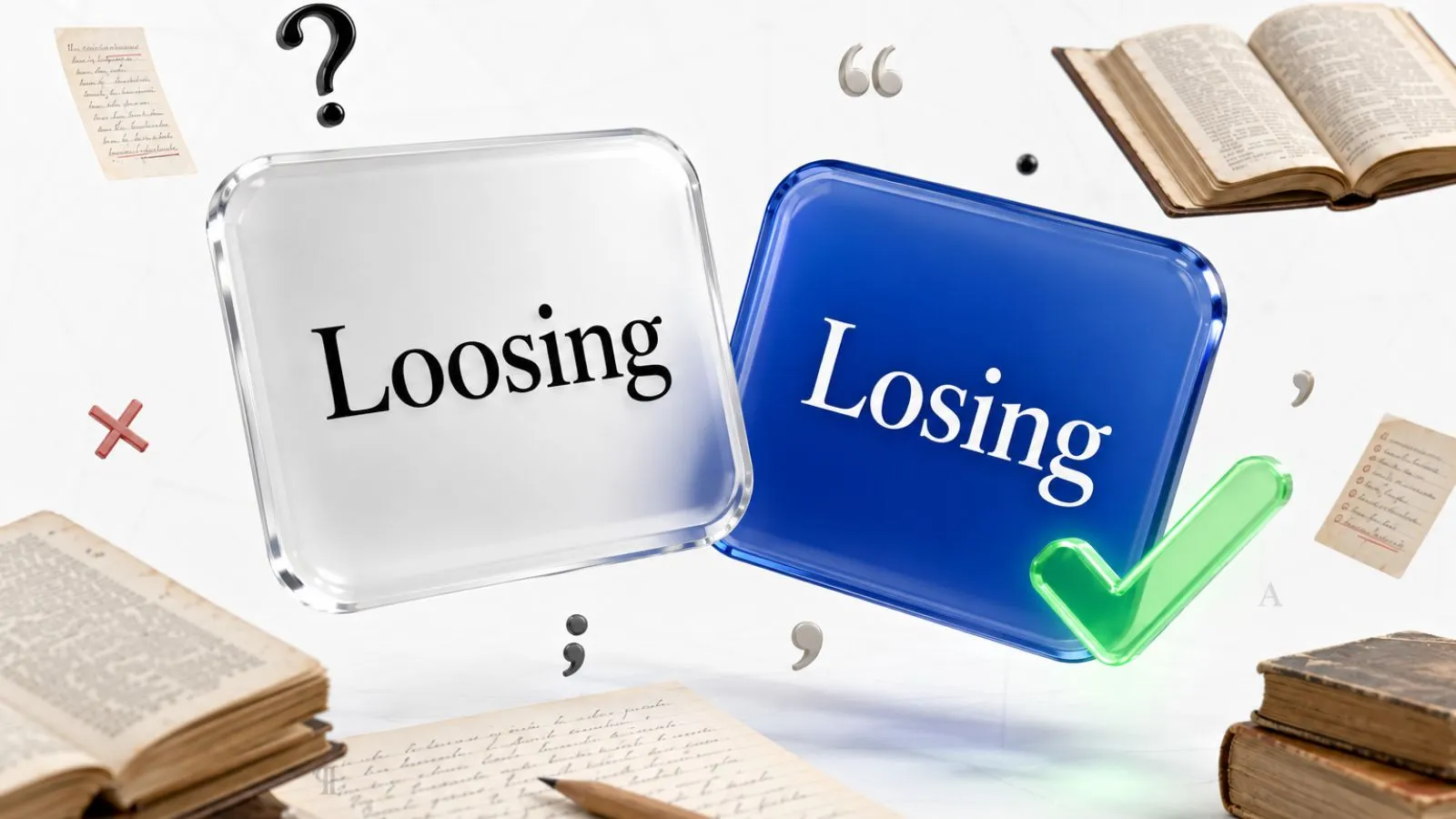
Losing is correct when you mean failing to keep, find, win, or have something anymore. Loosing is also a real English word, but it has a different meaning: releasing or setting something free. These words are easy to confuse because they look almost identical, but they come from different base words lose and loose.
Knowing that small difference can help you choose the right spelling every time. This guide explains when to use losing and loosing, with clear rules and natural examples.
Quick Answer:
Losing is the correct form of lose and refers to experiencing a loss, misplacing something, failing to win, or no longer having something. Loosing comes from loose and means releasing, freeing, or letting something go. The easiest way to choose between them is to check the base word: lose → losing and loose → loosing.
Loosing vs. Losing: Comparison Table
| Word | Base Word | Meaning | Example |
| Losing | Lose | Failing to keep, win, find, or have something | She is losing her patience. |
| Loosing | Loose | Releasing or setting something free | They were loosing the horses. |
What Does Losing Mean?
Losing is the present participle of lose. It describes an ongoing situation in which someone fails to keep, win, find, or retain something.
You use losing in many everyday situations:
- Losing an object: “I keep losing my keys.”
- Losing a game: “Our team is losing the match.”
- Losing control: “He felt he was losing control.”
- Losing patience: “She is losing patience with the delay.”
- Losing weight: “He is losing weight through regular exercise.”
- Losing hope: “They are slowly losing hope.”
The important point is that losing is connected to the idea of loss. If something is being taken away, misplaced, defeated, or no longer retained, losing is usually the word you need.
What Does Loosing Mean?
Loosing is the present participle of loose. It means releasing, freeing, or letting something go.
Although it is a correct word, it is much less common than losing. You may see it in formal, literary, historical, or specific contexts.
For example:
- “The soldiers were loosing the prisoners.”
- “The hunter was loosing an arrow.”
- “They were loosing the horses from the stable.”
In each case, something is being released or allowed to go free. If you simply mean that something is becoming less tight, loosening is generally the more natural word.
Key Difference: Losing vs. Loosing
The difference becomes simple when you look at their base words:
Lose → Losing
Used when something is lost, missed, defeated, or no longer kept.
Loose → Loosing
Used when something is released, freed, or let go.
There is also a pronunciation difference between lose and loose. Lose has a /z/ sound, while loose has an /s/ sound. Their -ing forms keep that distinction.
Spelling Rule
When lose becomes an -ing form, the final e is dropped:
lose + ing → losing
You do not add another o.
With loose, the final e is also removed before adding -ing:
loose + ing → loosing
This gives you a useful visual distinction:
- losing = one o
- loosing = two o’s
Common Mistakes
The most common mistake is using loosing when the sentence actually needs losing.
❌ “I am loosing my phone.”
✅ “I am losing my phone.”
Here, the meaning is that the phone is being misplaced, so losing is correct.
Another common error occurs with sports:
❌ “Our team is loosing the game.”
✅ “Our team is losing the game.”
The team is failing to win, not releasing the game.
Be careful with loose, too. If you mean something is becoming less tight, use loosening:
❌ “The screw is loosing.”
✅ “The screw is loosening.”
This distinction prevents three commonly confused forms losing, loosing, and loosening from being mixed up.
5 Useful Facts About Losing and Loosing
- Losing is far more common in everyday English than loosing.
- Losing comes from the verb lose, while loosing comes from loose.
- Losing can describe losing objects, games, control, patience, hope, or opportunities.
- Loosing refers to releasing, freeing, or letting something go.
- If you mean “not winning” or “no longer having something,” choose losing with one o.
6 Natural Examples
- I keep losing my keys, so I need to put them in the same place every day.
- Our team is losing the game, but there is still time to make a comeback.
- She was losing patience after waiting for more than an hour.
- The workers were loosing the animals from their restraints.
- The archer was loosing an arrow toward the target.
- The old rope was loosening around the box, not “loosing” it.
Simple Memory Trick
Think of the base words:
LOSE = LOSS → LOSING
If something is being lost, missed, or not won, use losing.
LOOSE = LET GO → LOOSING
If something is being released or set free, use loosing.
A quick visual trick also works:
losing = one O
loosing = two O’s
So, when you mean “not winning,” remember: You are losing, not loosing.
Mini Quiz
1. Which sentence is correct?
A. I am loosing my wallet.
B. I am losing my wallet.
C. I am loosening my wallet.
Answer: B
2. Which word means releasing or setting free?
A. Losing
B. Loosing
C. Lose
Answer: B
3. Choose the correct sentence.
A. Our team is losing the match.
B. Our team is loosing the match.
C. Our team is loosening the match.
Answer: A
4. Which word completes the sentence? “The hunter was ___ the arrow.”
A. losing
B. loosing
C. loosening
Answer: B
5. Which spelling comes from the verb “lose”?
A. Loosing
B. Losing
C. Looseing
Answer: B
FAQs
Is “loosing” a correct word?
Yes. Loosing is a correct English word, but it is uncommon. It is the -ing form of loose and means releasing, freeing, or letting something go. It should not be used as a replacement for losing, which comes from lose and refers to experiencing a loss or failing to keep or win something.
Is it “losing” or “loosing” a game?
The correct word is losing. For example, “Our team is losing the game.” A team that is losing is failing to win. Loosing would suggest releasing or setting something free, so it does not fit this meaning.
Why is “losing” spelled with one O?
Losing comes from lose. When the final e is removed and -ing is added, the result is losing. The spelling does not require an additional o. Therefore, when you mean experiencing a loss or failing to win, use losing.
What is the difference between “losing” and “loosing”?
Losing means experiencing a loss, misplacing something, failing to win, or no longer having something. Loosing means releasing or setting something free. Their different meanings come from their base verbs: lose and loose.
Is “loosing” the same as “loosening”?
No. Loosing means releasing or setting something free, while loosening means making something less tight or becoming less tight. For example, “They were loosing the horses” means releasing them, while “The knot is loosening” means the knot is becoming less tight.
Key Takeaways
- Losing comes from lose.
- Loosing comes from loose.
- Use losing for loss, defeat, misplacement, or no longer having something.
- Use loosing for releasing or setting something free.
- Use loosening when something becomes less tight.
- Remember: lose → losing and loose → loosing.
Conclusion
Losing and loosing are both correct words, but they have different meanings. Use losing when you mean experiencing a loss, failing to win, misplacing something, or no longer having it. Use loosing when you mean releasing or setting something free.
The simplest way to remember the difference is to connect each word to its base form: lose → losing and loose → loosing. Once you learn this distinction, choosing the correct spelling becomes much easier.
Related More Post
- Trys or Tries: Which Spelling Is Correct? Master the Simple Rule
- Wont or Won’t: Which Is Correct? The Simple Difference Explained
- Fourty or Forty: Which Is Correct? The Spelling Explained

Mignon Fogarty is an experienced English grammar and writing expert specializing in grammar, word usage, and clear American English. At EduNexxt, her focus is making grammar simple, accurate, and practical.
 Bryan Garne