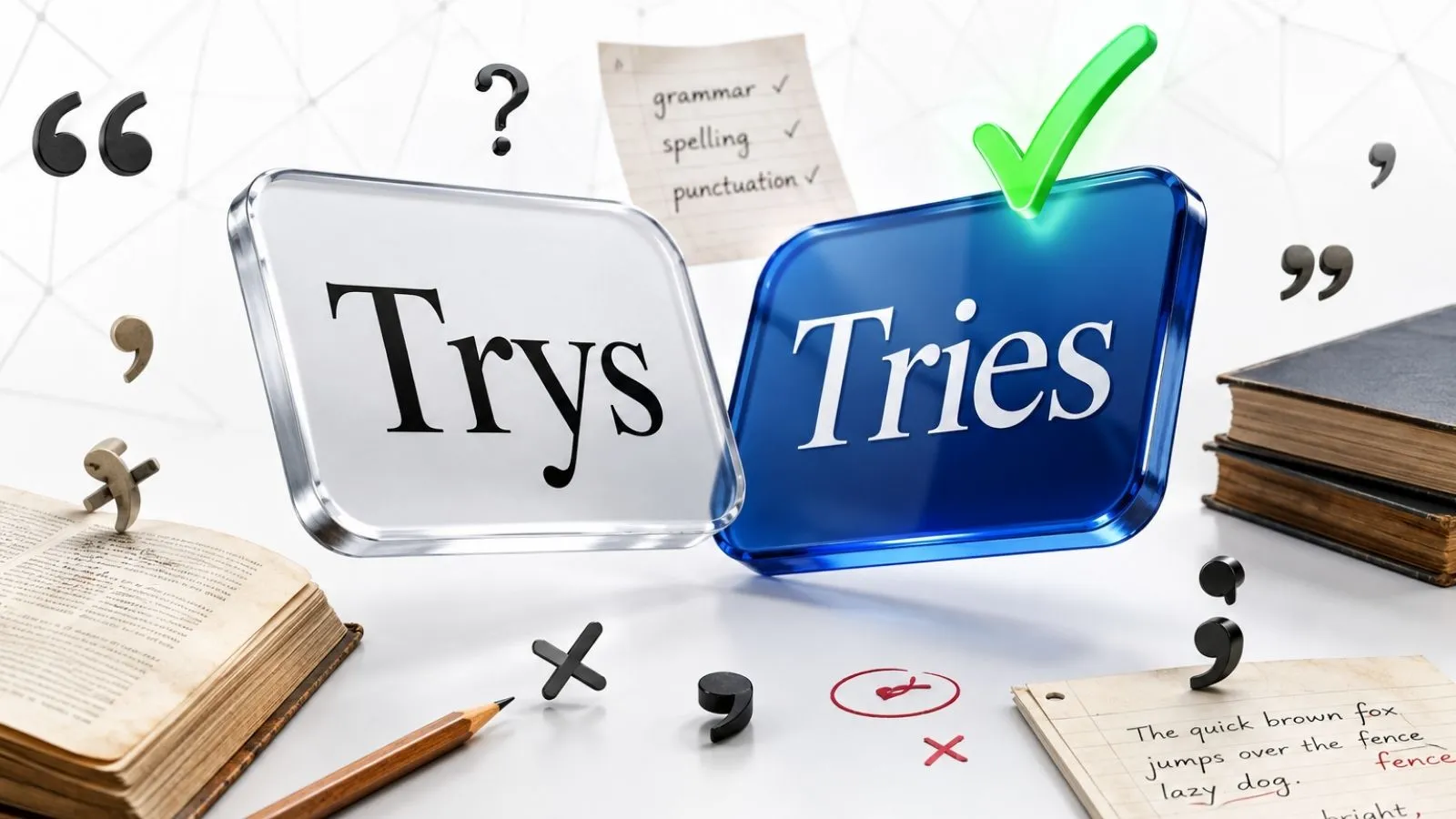
A small spelling rule can make a big difference in everyday English. If you are unsure whether to write trys or tries, the correct spelling is tries. Trys is not the standard form.
The change happens because try ends in a consonant followed by y, so its third-person singular form changes y to ies. Once you understand this simple pattern, you can easily avoid this common spelling mistake.
Quick Answer:
Tries is the correct spelling in standard English. It is the third-person singular present-tense form of try, meaning to attempt or make an effort.
- I try
- You try
- We try
- They try
- He tries
- She tries
- It tries
Trys is not the standard spelling.
Trys vs. Tries: Comparison
| Word | Correct? | Use | Example |
| Tries | ✅ Yes | Third-person singular form of try | She tries her best. |
| Trys | ❌ No | Not standard English | He trys hard. |
What Does “Try” Mean?
The verb try means to make an effort to do something, achieve something, or find out whether something works.
For example:
- I try to exercise every morning.
- We try different methods at work.
- They try to arrive on time.
The base form try is used with I, you, we, and they. When the subject is he, she, or it, the verb becomes tries.
Why Does “Try” Become “Tries”?
The spelling follows a common English rule for verbs ending in a consonant + y.
When forming the third-person singular present tense:
Change y to ies.
So:
try → tries
The same pattern appears in:
- cry → cries
- fly → flies
- study → studies
- carry → carries
- worry → worries
Because r is a consonant, try follows this pattern.
But There Is an Important Exception
If a verb ends in a vowel + y, you normally keep the y and simply add s.
For example:
- play → plays
- enjoy → enjoys
- stay → stays
Compare:
try → tries
play → plays
This is why checking the letter immediately before y is useful.
8 Natural Examples With “Tries”
- She tries to finish her work before lunch.
- He tries his best when things become difficult.
- The student tries a different approach.
- My brother tries to call our parents every evening.
- The company tries to improve its customer service.
- She tries new recipes on weekends.
- The dog tries to catch the ball.
- He tries to stay calm under pressure.
Notice that tries is used because each subject is singular and third person.
Common Mistakes With Trys and Tries
1. Adding “s” Directly
❌ He trys to help.
✅ He tries to help.
The y changes to ies.
2. Using “tries” With a Plural Subject
❌ They tries to understand.
✅ They try to understand.
Use try with I, you, we, and they.
3. Confusing “Tries” With “Trying”
These forms have different grammatical jobs:
- She tries to help.
- She is trying to help.
Tries is the third-person singular present form, while trying is used for ongoing actions with forms such as is trying or was trying.
Is “Trys” Ever Correct?
In standard modern English, trys is not the correct form of the verb try. You may occasionally see it online because of typing mistakes or unfamiliarity with the spelling rule, but its appearance does not make it standard.
For school assignments, professional writing, emails, websites, and other edited writing, use tries.
American and British English
There is no spelling difference between American and British English in this case.
Both use:
try → tries
So whether you are writing for a US or UK audience, tries is the standard form.
Easy Memory Trick
Remember:
Consonant + Y → IES
Think:
Try → Tries
Cry → Cries
Fly → Flies
A simple way to remember it is:
When he tries, the Y flies away and IES takes its place.
Mini Quiz
Choose the correct answer.
1. She ___ to stay positive.
A. trys
B. tries
2. They ___ to help whenever they can.
A. try
B. tries
3. Which sentence is correct?
A. He trys again.
B. He tries again.
4. What happens to the y in try → tries?
A. It stays the same
B. It changes to ies
5. Which follows the same pattern?
A. cry → cries
B. play → plaies
Answers: 1-B, 2-A, 3-B, 4-B, 5-A.
FAQs
Is “trys” a correct spelling?
No. Tries is the standard spelling when try is used with a third-person singular subject in the present tense. Trys is generally considered a spelling error and should be avoided in standard English.
Why does “try” become “tries”?
Because try ends in a consonant followed by y. When forming the third-person singular present tense, the y changes to ies, giving us tries.
Is it “he try” or “he tries”?
The correct form is he tries. A singular third-person subject such as he, she, or it takes tries in the present tense.
Is “tries” used only with people?
No. Tries can be used with animals, organizations, or other singular subjects. For example, “The machine tries to restart” is grammatically correct.
What is the difference between “try” and “tries”?
Try is used with I, you, we, and they. Tries is used with he, she, and it in the present tense. Both forms express the idea of making an effort or attempting something.
Key Takeaways
- Tries is the correct standard spelling.
- Trys is not the standard form.
- Try → tries because consonant + y changes to ies.
- Use tries with he, she, and it.
- Use try with I, you, we, and they.
- Similar patterns include cry → cries and study → studies.
- With vowel + y, normally add s, as in play → plays.
Conclusion
When choosing between trys or tries, the correct answer is tries. The spelling becomes easy once you recognize the consonant + y pattern and remember that try changes to tries with he, she, or it.
Keep this rule in mind whenever you write, and you will avoid one of the most common mistakes involving verbs that end in y.
Related More Post
- Rhythm or Rythm: Which Is Correct? The Right Spelling Explained
- Chosing or Choosing: Which Is Correct? The Simple Spelling Rule
- Forteen or Fourteen: Which Is the Correct Spelling?

Bryan Garner an experienced English language writer specializing in grammar, usage, word choice, and clear American English. He focuses on making complex language rules simple, accurate, and practical.
 Mignon Fogarty