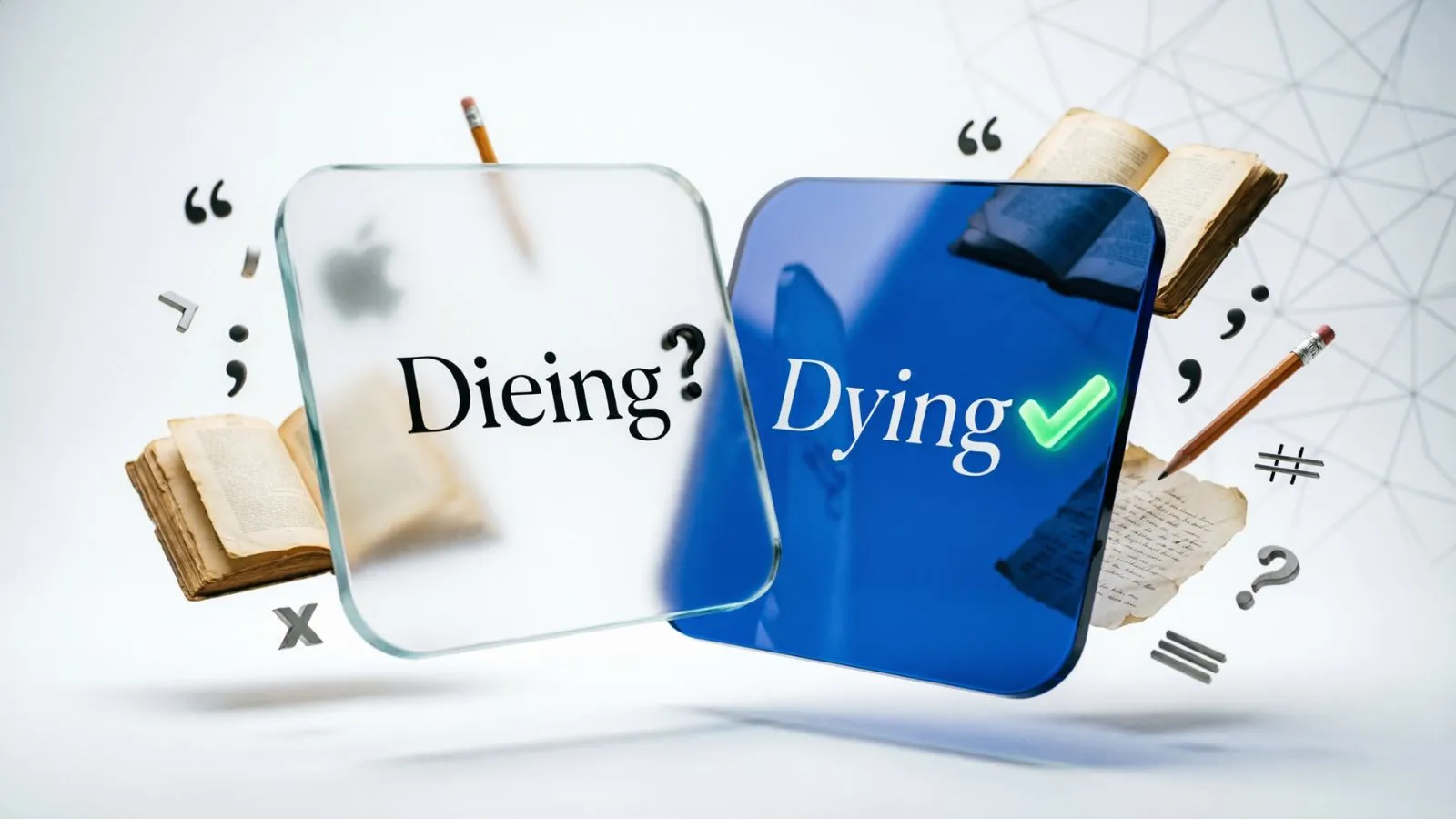
Dying is the correct spelling when you mean approaching death, losing strength, or gradually coming to an end. Dieing is generally incorrect in everyday English. The confusion comes from the verb die, which ends in -ie and changes its spelling before -ing. This gives us dying, not dieing. Another similar word, dyeing, means coloring something.
In this guide, you will learn the spelling rule, understand when each form is used, avoid common mistakes, and see natural examples that make the difference easy to remember.
Quick Answer
Dying is the standard -ing form of die. It describes approaching death or, in a broader sense, something gradually weakening, disappearing, or ending. Dieing is normally a misspelling in everyday English, although rare technical uses can relate to a manufacturing die. Dyeing is a different word meaning coloring something.
Dieing vs. Dying: Comparison Table
| Word | Standard Everyday Use? | Meaning | Example |
| Dying | Yes | Approaching death or gradually ending | The plant is dying. |
| Dieing | Usually no | Rare technical form related to a die | The process involved specialized dieing equipment. |
| Dyeing | Yes | Coloring something | She is dyeing her hair. |
What Does “Dying” Mean?
Dying is the present participle of die. Its literal meaning is the process of approaching death.
The injured animal is dying.
The word can also describe a gradual loss of activity, power, strength, or existence. For example, a fire can die down, a battery can lose power, or an old custom can disappear over time.
This broader use is common in everyday English:
Interest in the product is dying.
So, dying is not limited to living things. The surrounding context determines whether the meaning is literal or figurative.
Why Is “Dying” Spelled Without the “e”?
The spelling follows a useful English pattern.
When a verb ends in -ie, the ie changes to y before -ing:
- die → dying
- lie → lying
- tie → tying
That is why dieing is not the normal spelling of the -ing form of die.
Think of it as a spelling change rather than simply adding the ending:
die + ing → dying
This same pattern in lie → lying and tie → tying can help you recognize the rule in other words.
What Does “Dieing” Mean?
In ordinary writing, dieing is generally a misspelling of dying.
A rare technical use can occur when the word is connected to a die—a manufacturing tool used to cut, shape, or form materials. Because this usage is highly specialized, most people will not need dieing in normal conversation, schoolwork, emails, or general writing.
If you are talking about a person, animal, plant, battery, fire, tradition, business, or other thing that is gradually ending or losing strength, dying is the appropriate spelling.
Dying vs. Dyeing
Dying comes from die and relates to death, decline, or something coming to an end.
Dyeing comes from dye and means changing the color of something.
Compare:
The flowers are dying.
She is dyeing the fabric blue.
The easiest distinction is:
die → dying = death or decline
dye → dyeing = adding color
One extra e changes the word and its meaning, so this is an important distinction to remember.
Common Mistakes
Writing “dieing” for “dying”
❌ The tree is dieing.
✅ The tree is dying.
Adding “-ing” without changing the spelling
The form dieing may seem logical because it looks like die + ing, but the standard spelling rule changes ie to y.
Using “dying” when you mean coloring
❌ She is dying her hair black.
✅ She is dyeing her hair black.
Treating “dieing” as a British spelling
Dying is standard in both American and British English. Dieing is not simply a British alternative.
Assuming “dieing” can never appear anywhere
Although it is usually an error, specialized technical writing may contain dieing in connection with a manufacturing die. Context determines whether the unusual form is intentional.
5 Useful Facts to Remember
- Dying is the standard -ing form of die.
- The spelling changes from ie to y before -ing.
- Dyeing comes from dye and means coloring something.
- Dieing is uncommon and may appear in specialized technical contexts.
- Dying can describe literal death as well as gradual decline or disappearance.
6 Natural Examples
- The flowers are dying because they have not received enough water.
- My phone is dying, so I need to charge it before I leave.
- The fire was dying out as the rain became heavier.
- The doctor said the patient was dying peacefully.
- The old tradition is slowly dying in modern society.
- She is dyeing her hair a darker shade for the wedding.
Easy Memory Trick
Remember the two base words first:
DIE → DYING
DYE → DYEING
If the sentence is about death, decline, or something ending, choose dying.
If it is about color, choose dyeing.
For the spelling itself, remember:
IE changes to Y before -ING.
So:
die → dying
lie → lying
tie → tying
Mini Quiz
1. Which spelling is correct when referring to death?
A. Dieing
B. Dying
C. Dyeing
D. Dieying
2. What is the correct -ing form of “die”?
A. Dieing
B. Dying
C. Dyeing
D. Dyingg
3. Which word means “coloring something”?
A. Dying
B. Dieing
C. Dyeing
D. Dyinge
5. What happens to “ie” when “-ing” is added to “die”?
A. It stays unchanged.
B. It changes to “y.”
C. It changes to “ey.”
D. It is removed completely.
Answers: 1-B, 2-B, 3-C, 5-B
FAQs
Is “dieing” or “dying” correct?
Dying is correct when the word comes from die and describes approaching death, decline, or something gradually ending. Dieing is generally incorrect in everyday English. The standard spelling follows the ie → y change before the -ing ending.
Why is “dieing” wrong?
Dieing is normally wrong because English changes the final ie of die to y before adding -ing. The correct form is therefore dying. This is similar to the spelling changes seen in lie → lying and tie → tying.
Can “dieing” ever be used?
Yes, but only rarely. Dieing can occur in specialized technical contexts associated with a manufacturing die, a tool used to shape or cut materials. This use is uncommon, so writers should not use dieing as the ordinary -ing form of die.
What is the difference between “dying” and “dyeing”?
Dying comes from die and relates to death, decline, or an ending. Dyeing comes from dye and means coloring something. For example, a plant can be dying, while a person can be dyeing clothing or hair.
Is “dying” correct in American and British English?
Yes. Dying is the standard spelling in both American and British English. The difference between the two varieties does not change this spelling. If you mean the -ing form of die, use dying, not dieing.
Key Takeaways
- Dying is the correct everyday form of die.
- Die → dying because ie changes to y before -ing.
- Dyeing means coloring something.
- Dieing is rare and mainly associated with specialized technical usage.
- Dying is standard in both American and British English.
Conclusion
The correct everyday spelling is dying when you mean approaching death, declining, or gradually coming to an end. Dieing is normally a spelling mistake, though rare technical contexts can explain its occasional use. If you are talking about changing a color, use dyeing instead.
The most useful rule to remember is die → dying: the final ie changes to y before -ing. With these simple distinctions, you can choose the correct form confidently in everyday writing.

Bryan Garner an experienced English language writer specializing in grammar, usage, word choice, and clear American English. He focuses on making complex language rules simple, accurate, and practical.
 Mignon Fogarty