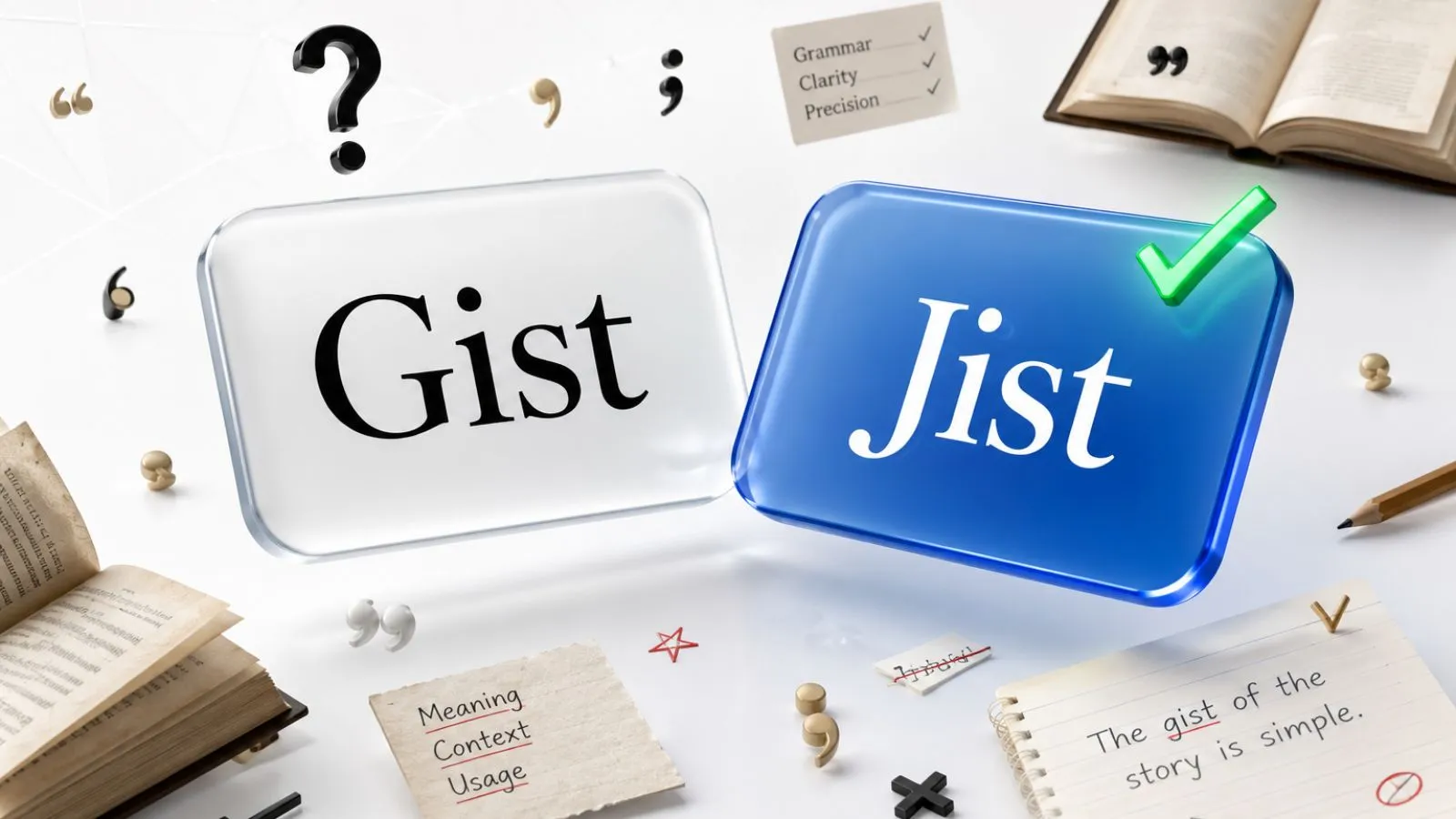
Have you ever heard someone say “gist” and wondered whether it should be spelled gist or jist? The confusion is understandable because the word sounds like it begins with a “j” sound
Gist is the correct spelling when you mean the main idea, essential point, or overall meaning of something. Jist is a common misspelling and is not the standard spelling of this word.
In this guide, you will learn the meaning of gist, why its spelling is confusing, how to use it correctly, and how to avoid this mistake.
Quick Answer:
Gist is the correct spelling. It means the main idea, central point, or essential meaning of something. Jist is a common misspelling of gist and should not be used in standard English.
For example, “I understood the gist of the article” means you understood its main point without necessarily knowing every detail.
Gist vs. Jist: Comparison Table
| Word | Correct Spelling? | Meaning | Example |
| Gist | Yes | The main idea or essential point | I understood the gist of the story. |
| Jist | No | Common misspelling of gist | ❌ I understood the jist of the story. |
What Does Gist Mean?
Gist is a noun that means the main idea, essential point, or central meaning of something.
When you understand the gist of a conversation, article, speech, story, or argument, you understand what it is mainly about without necessarily remembering every detail.
For example, if someone gives you a long explanation and you understand the most important message, you can say:
“I got the gist of what she was saying.”
The word is especially useful when you want to summarize the central message rather than repeat all the information.
Common Expressions With Gist
Several natural expressions are frequently used with gist:
- get the gist
- understand the gist
- the gist of the story
- the gist of the conversation
- the gist of the argument
- the gist of the article
- give someone the gist
The expression “get the gist” means to understand the general meaning or most important point of something.
What Does Jist Mean?
In standard English, jist is not the correct spelling of the word meaning “main idea” or “essential point.”
People commonly write jist because of the way gist is pronounced. When someone hears the word without seeing it written, the initial sound can make jist seem like a logical spelling.
However, the standard written form is always:
gist
not:
jist
So if you are writing an email, article, essay, report, or other formal text, use gist when referring to the main point of something.
Key Difference: Gist or Jist?
There is only one standard spelling for the meaning discussed here:
Gist = correct
Jist = misspelling
The main reason for the confusion is pronunciation.
Gist is pronounced with a soft g sound, represented by /dʒ/. This is the same general sound heard at the beginning of words such as giant, general, and gym.
So although gist sounds similar to “jist,” its spelling remains gist.
Gist Pronunciation
Gist is pronounced approximately:
/dʒɪst/
It sounds similar to “jist.”
This is an important distinction: the pronunciation may sound like “j,” but the spelling begins with “g.”
Spelling Rule and Word Formation
There is no spelling rule that changes gist into jist based on its pronunciation. The word has its own established spelling, and standard English uses g.
A helpful way to remember it is to connect gist with words beginning with a soft g, such as:
- giant
- general
- genuine
- gym
In these words, g can represent the same soft sound associated with gist.
Word Origin
The spelling of gist also has a historical explanation. The word entered English from Anglo-French and is connected with a legal expression meaning that an action “lies.” Over time, gist developed its modern sense of the essential point or substance of something.
Today, the everyday meaning is much more common: the main idea or essential meaning.
Gist in Legal English
Gist can also have a more specialized meaning in legal language.
In a legal context, gist can refer to the grounds or basis on which a legal action rests. This meaning is less common in everyday conversation, but it explains why the word has a more specific use in legal writing.
For most readers, however, the meaning they will encounter is simply the main point or essence of something.
Common Mistakes
1. Spelling gist as jist
❌ “I understand the jist of the story.”
✅ “I understand the gist of the story.”
The incorrect form is usually caused by pronunciation.
2. Assuming “jist” is an alternative spelling
Jist is not simply another accepted spelling of gist. If you mean “main idea,” use gist.
3. Confusing gist with every detail
Gist refers to the central meaning, not a complete list of details.
For example, understanding the gist of a 10-minute explanation means you understand its main message, even if you cannot repeat every point.
4. Pronouncing the G as a hard sound
The word is not pronounced with a hard /g/ sound. Its initial g has a soft sound, which is why it resembles “jist” when spoken.
5 Useful Facts About Gist
- Gist is the standard spelling for the word meaning the main idea or essential point.
- Jist is a common misspelling caused mainly by the pronunciation of gist.
- Gist is a noun and commonly appears in the phrase “get the gist.”
- The word can describe the main point of a story, conversation, article, speech, argument, or explanation.
- In legal English, gist can refer to the grounds or basis of a legal action.
6 Natural Examples
- I didn’t have time to read the entire report, but I got the gist of it.
- Can you give me the gist of the conversation while I was away?
- She understood the gist of the teacher’s explanation after a few minutes.
- The article is long, but the gist is that regular practice improves your writing.
- He explained the gist of the proposal before the meeting began.
- I understand the gist of your argument, although I disagree with some of the details.
Simple Memory Trick
Use this simple connection:
Gist = General Idea
Both gist and general begin with G. When you think of gist, think of the general idea.
You can also remember:
Gist → G → General → main idea
Even though the word sounds like “jist,” keep the G in the spelling.
Mini Quiz
1. Which spelling is correct?
A. Jist
B. Gist
C. Gyst
Answer: B. Gist
2. What does “gist” mean?
A. The smallest detail
B. The main idea
C. A spelling mistake
Answer: B. The main idea
3. Choose the correct sentence.
A. I got the jist of the story.
B. I got the gist of the story.
Answer: B. I got the gist of the story.
4. What does “get the gist” mean?
A. Understand the main point
B. Memorize every detail
C. Rewrite a complete story
Answer: A. Understand the main point
5. Why do people often spell gist as “jist”?
A. Both spellings are standard.
B. Gist is pronounced with a soft “g” sound.
C. Jist has a different meaning.
Answer: B. Gist is pronounced with a soft “g” sound.
FAQs
Is “jist” a correct spelling?
No. Jist is generally considered a misspelling when you mean the main idea or essential point of something. The standard spelling is gist. The confusion happens because gist is pronounced with a soft “g” sound, making it sound similar to “jist.”
What does gist mean?
Gist means the main idea, central point, or essential meaning of something. If you understand the gist of an article, conversation, speech, or story, you understand its most important message without necessarily knowing every detail.
How do you use gist in a sentence?
You can use gist when referring to the central meaning of something. For example, “I got the gist of the report” means you understood the report’s main point. Common phrases include “the gist of the story,” “get the gist,” and “understand the gist.”
Why is gist pronounced like “jist”?
The g in gist has a soft sound, represented by /dʒ/. This makes the word sound similar to “jist” when spoken. However, its standard spelling has always been gist, so pronunciation should not be used as a guide for spelling the word.
Can gist be used in legal English?
Yes. In legal English, gist can refer to the grounds or basis of a legal action. This is a more specialized use than the everyday meaning of “main idea.” In ordinary writing and conversation, gist most often refers to the essential point or general meaning of something.
Key Takeaways
- Gist is the correct spelling.
- Jist is a common misspelling.
- Gist means the main idea or essential point.
- Gist has a soft g sound, which causes the spelling confusion.
- “Get the gist” means to understand the main point.
- In legal contexts, gist can refer to the basis of a legal action.
- Remember: Gist = General Idea.
Conclusion
Gist is the correct spelling when you mean the main idea, essential point, or central meaning of something. Jist is a common misspelling caused by the way gist sounds when spoken.
Although its initial sound resembles “j,” the standard spelling begins with g. you are discussing a story, article, conversation, argument, or explanation, use gist when referring to its main point. Remembering “Gist = General Idea” makes the spelling easy to recall.
Related More Post
- Fourty or Forty: Which Is Correct? The Spelling Explained
- Trys or Tries: Which Spelling Is Correct? Master the Simple Rule
- Wont or Won’t: Which Is Correct? The Simple Difference Explained

William Strunk is a respected authority on English grammar, usage, and writing style, known for his influential work The Elements of Style. At EduNexxa, his focus is on clear, concise, and effective English.
 Mignon Fogarty
 Bryan Garne