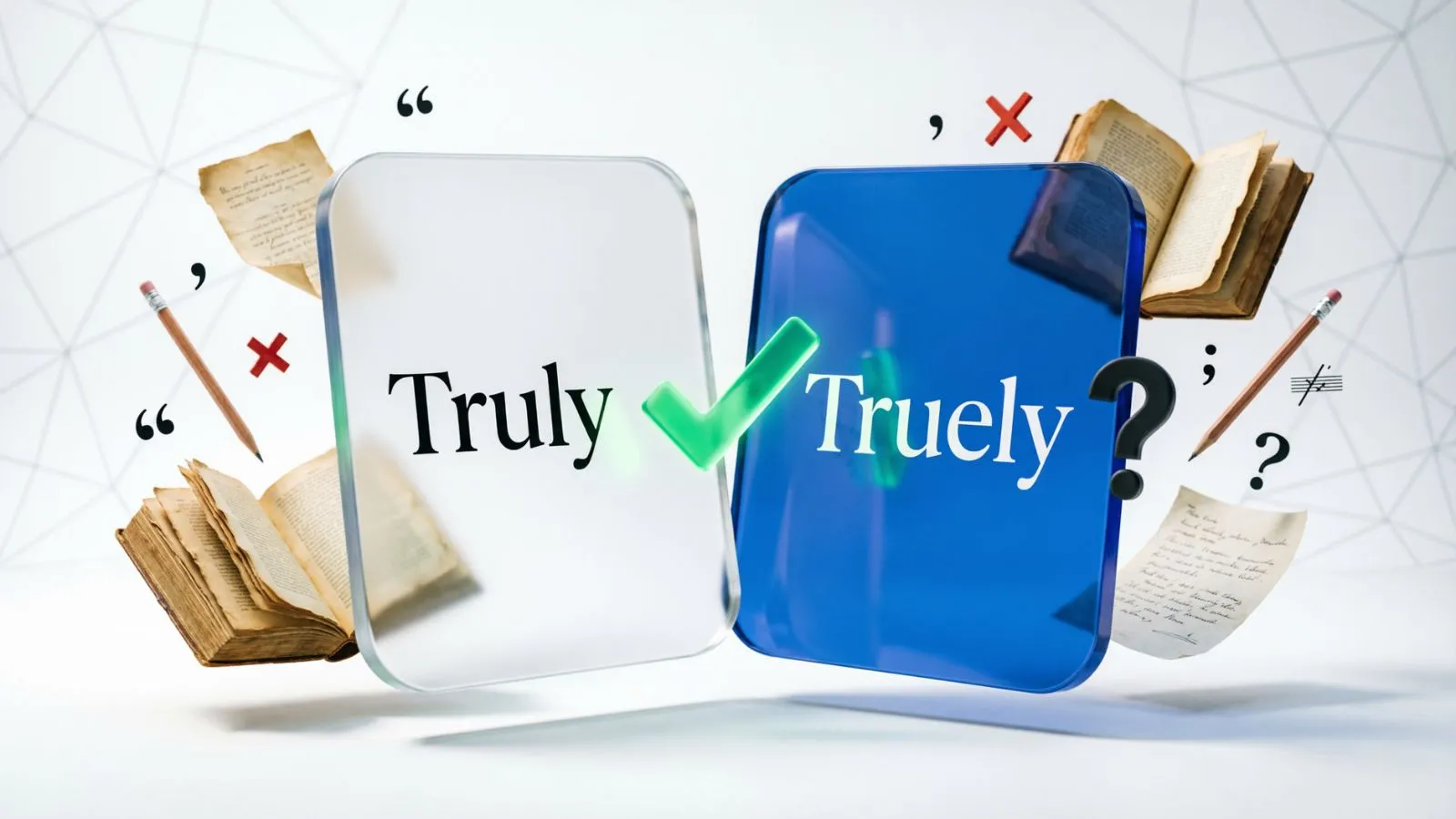
A single missing letter can make a familiar English word look wrong. That is exactly what happens with truly and truely. The confusion often comes from true, because it may seem natural to keep the final e when forming the adverb. This small spelling change can easily lead to mistakes in writing.
In this guide, you will learn the difference between the two forms, understand the spelling pattern, and see clear examples of how to use the word correctly.
Quick Answer:
Truly is the correct spelling. Truely is a common misspelling. Truly is the adverb form of true and can mean sincerely, genuinely, or completely. The correct spelling is true → truly, not true → truely, because the final e is removed before the -ly suffix is added.
Truly vs. Truely: Comparison Table
| Word | Correct? | Meaning | Example |
| Truly | ✅ Yes | In a sincere, genuine, or completely certain way | I truly appreciate your help. |
| Truely | ❌ No | Common misspelling of truly | ❌ I truely appreciate your help. |
What Does Truly Mean?
Truly is an adverb that means in a sincere, genuine, truthful, or completely certain way.
Its meaning can change slightly depending on the context.
When it expresses sincerity, it shows that a feeling or statement is genuine:
“I truly appreciate your support.”
Here, truly emphasizes that the appreciation is sincere.
It can also strengthen an adjective:
“She is truly talented.”
In this sentence, truly emphasizes that her talent is genuine or remarkable.
Truly can also express strong agreement or certainty:
“This is truly important.”
So, in everyday English, truly is often used to add sincerity, emphasis, or certainty to a statement.
Why Is “Truely” Incorrect?
The spelling truely looks logical at first because the base word is true. A reader might assume that adding -ly simply produces:
true + ly = truely
However, that is not the standard spelling.
The correct form is:
true → truly
The final e is removed before -ly is added.
This is the main reason learners make the mistake. Some adjectives ending in e do retain the letter when -ly is added, so there is no single visual pattern that works for every word.
For example:
- nice → nicely
- fine → finely
- complete → completely
But:
- true → truly
Therefore, you should memorize truly as the established spelling rather than trying to create it from true each time.
Spelling Rule: True → Truly
The most important spelling rule is simple:
true + ly → truly
The final e in true disappears before -ly is added.
This gives us:
❌ truely
✅ truly
Do not add an extra e between tru and ly.
A useful comparison is:
true = adjective
truly = adverb
For example:
- “That is true.”
- “I truly believe you.”
The word changes from an adjective to an adverb, and its spelling changes with it.
Pronunciation of Truly
Truly is pronounced approximately /ˈtruːli/, which sounds like “troo-lee.”
The pronunciation does not contain an extra syllable for the e in truely. However, pronunciation alone should not be used to determine the spelling.
The safest approach is to remember the written form:
TRULY
This is particularly useful when writing quickly, because truely can feel natural if you are thinking only about the base word true.
Common Mistakes
Mistake 1: Writing “truely”
❌ “I truely believe this is the best choice.”
✅ “I truly believe this is the best choice.”
The correct adverb is truly.
Mistake 2: Assuming all words ending in “e” keep the e
Some words do keep their final e before -ly, but true does not.
For example:
nice → nicely
but:
true → truly
Learning the individual spelling of truly is more reliable than applying the same pattern to every adjective.
Mistake 3: Treating “truely” as an alternative spelling
Truely is not a standard alternative form of truly. In school assignments, professional writing, emails, articles, and other formal contexts, use truly.
Mistake 4: Confusing “truly” with “truthfully”
These words are related but are not always interchangeable. Truly can express sincerity, certainty, or emphasis, while truthfully specifically relates to telling or stating something truthfully.
5 Useful Facts About Truly
- Truly is the correct standard spelling.
- Truely is a common spelling mistake, not an accepted alternative spelling.
- Truly is the adverb form associated with the adjective true.
- The final e in true is removed when forming truly.
- Truly can express sincerity, genuineness, certainty, or emphasis depending on the sentence.
6 Natural Examples
- I truly appreciate everything you have done for me.
- She truly believes that regular practice leads to improvement.
- That was a truly remarkable performance.
- He was truly surprised when his friends arrived unexpectedly.
- If you truly want to succeed, you need to stay consistent.
- I truly hope you find the answer you are looking for.
Simple Memory Trick
Use this formula:
TRUE loses its E → TRULY
Think:
TRUE − E + LY = TRULY
So, whenever you are tempted to write truely, stop and remember:
True loses the E before becoming truly.
You can also remember:
TRULY = TRUE without E + LY
That gives you the correct spelling every time.
Mini Quiz
1. Which spelling is correct?
A. Truely
B. Truly
C. Trueley
Answer: B. Truly
2. What is the correct adverb form of “true”?
A. Truely
B. Truly
C. Truefully
Answer: B. Truly
3. Choose the correct sentence.
A. I truely understand your concern.
B. I truly understand your concern.
Answer: B. I truly understand your concern.
4. What happens to the final “e” in “true”?
A. It is doubled.
B. It stays in the word.
C. It is removed before “-ly.”
Answer: C. It is removed before “-ly.”
5. Which sentence is correct?
A. She is truely talented.
B. She is truly talented.
C. She is trueley talented.
Answer: B. She is truly talented.
FAQs
Is “truely” a correct word?
No. Truely is a common misspelling of truly. When you want the adverb form of true, the standard spelling is truly. The final e from true is removed before -ly is added.
Why is “truly” spelled without the e?
The correct spelling follows the established form true → truly. When -ly is added, the final e in true is dropped. Therefore, truely is not the correct spelling.
What does truly mean?
Truly can mean sincerely, genuinely, or completely. It can also emphasize a statement. For example, “I truly appreciate your help” shows sincere appreciation, while “It was truly beautiful” strongly emphasizes the adjective beautiful.
How do you use “truly” in a sentence?
Use truly as an adverb to express sincerity, genuineness, certainty, or emphasis. For example: “I truly believe you can do it.” It can also appear before an adjective, as in “a truly amazing experience.”
Is “truly” an adverb?
Yes. Truly is an adverb. It is commonly used to modify verbs or strengthen adjectives and statements. In “I truly appreciate your help,” it modifies appreciate. In “a truly beautiful place,” it strengthens beautiful.
Key Takeaways
- Truly is the correct spelling.
- Truely is a common misspelling.
- Truly is an adverb related to true.
- The correct spelling is true → truly.
- The final e is removed before -ly is added.
- Truly can express sincerity, certainty, genuineness, or emphasis.
- Remember: TRUE loses E → TRULY.
Conclusion
Truly is the correct spelling, while truely is a common mistake. The confusion happens because true appears to keep its final e when -ly is added, but the standard form is different. The correct transformation is true → truly. Use truly to express sincerity, genuineness, certainty, or emphasis.
Once you remember that true loses its final e before -ly, you can avoid this spelling mistake confidently in everyday, academic, and professional writing.
Related More Articles
- Loosing or Losing: Which Is Correct? Don’t Make This Common Mistake
- Fourty or Forty: Which Is Correct? The Spelling Explained
- Gist or Jist: Which Is Correct? The Simple Spelling Difference

Bryan Garner an experienced English language writer specializing in grammar, usage, word choice, and clear American English. He focuses on making complex language rules simple, accurate, and practical.
 Mignon Fogarty