
Should you send a CV or a resume when applying for a job? It depends on the role and country. A resume usually highlights experience relevant to one job, while an academic CV gives a fuller record of education, research, and achievements.
In many countries, however, CV is simply the usual name for a standard job application document.
Quick Answer:
- Resume: A focused summary of relevant skills, experience, education, and results.
- Academic CV: A detailed record of research, teaching, publications, and academic achievements.
- Which one? Follow the job advertisement and local hiring practices.
CV vs. Resume: Key Differences
| Feature | Resume | Academic CV |
| Purpose | A specific job | Academic or research roles |
| Length | Usually 1–2 pages | Can be several pages |
| Main focus | Relevant skills and results | Academic and research record |
| Common US use | Most non-academic jobs | University and research positions |
These differences mainly reflect US usage. In many other countries, CV is the standard term for an ordinary job application document.
What Is a CV?
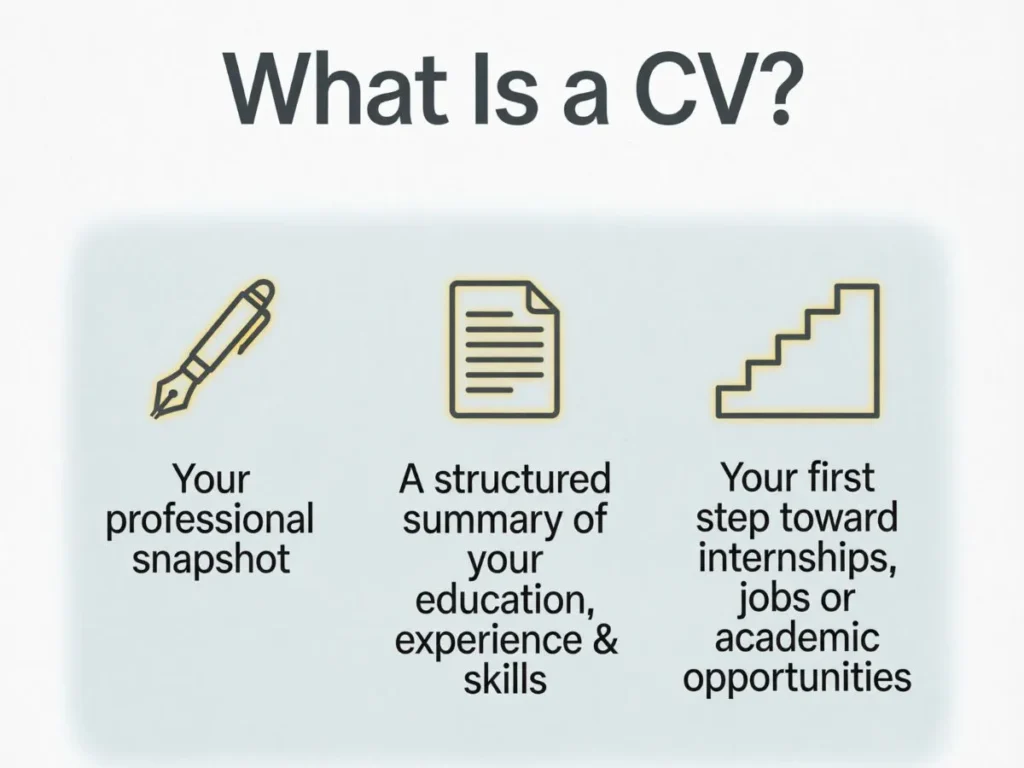
CV stands for curriculum vitae, meaning “course of life.” In the US, an academic CV may include:
- Education and academic qualifications
- Research and teaching experience
- Publications and presentations
- Awards, grants, and fellowships
- Relevant certifications and memberships
Include only sections relevant to your field.
What Is a Resume?
A resume is a focused summary of why you fit a particular job. It usually includes contact details, relevant work experience, job-related skills, education, and useful certifications.
For example, a resume might say, “Managed three campaigns and increased leads by 20%.” An academic CV might list a research project or published paper.
CV vs. Resume: Differences by Country
The terms vary by location:
- United States: Resumes are standard for most jobs; academic roles may require a CV.
- Canada: Resumes are common for regular jobs; academic applications may ask for a CV.
- United Kingdom and New Zealand: CV is the usual term for a standard job application document.
- Australia and South Africa: CV and resume may be used interchangeably.
- Pakistan and other South Asian countries: CV is widely used, but requirements vary by employer.
If a job posting asks for a CV, check its instructions rather than assuming it means a long academic record.
How to Choose the Right Document
- Read the job posting. Follow the requested document type and format.
- Consider the role. Business jobs usually need relevant experience and results; academic roles may need research, teaching, and publications.
- Keep it relevant. Put the strongest details first and remove information that does not help the employer assess your fit.
Keep a master document with your full work history, education, skills, and achievements. Use it to prepare a tailored version for each application.
FAQs
Is a CV better than a resume?
Neither is automatically better. Choose based on the job, country, and employer’s instructions.
Can a CV and resume mean the same thing?
Yes. In many countries, CV means the standard job application document. In the US, an academic CV is usually more detailed.
Should I include personal information?
Include professional contact details and required information. Avoid sensitive details, such as marital status or identification numbers, unless there is a clear, legitimate reason.
Conclusion
A CV and a resume both show what you can offer, but their meanings vary by country. A resume focuses on experience relevant to one job, while an academic CV records broader academic achievements. Check the job posting and choose the format that presents your qualifications clearly.
Related Articles
- Donor’s Cost or Adjusted Basis: What Should You Report?
- Metric vs. Imperial: Differences, Examples & Conversions
- Optometrist vs. Ophthalmologist: Differences and Which to See

William Strunk is a respected authority on English grammar, usage, and writing style, known for his influential work The Elements of Style. At EduNexxa, his focus is on clear, concise, and effective English.
 Bryan Garne
 Mignon Fogarty