
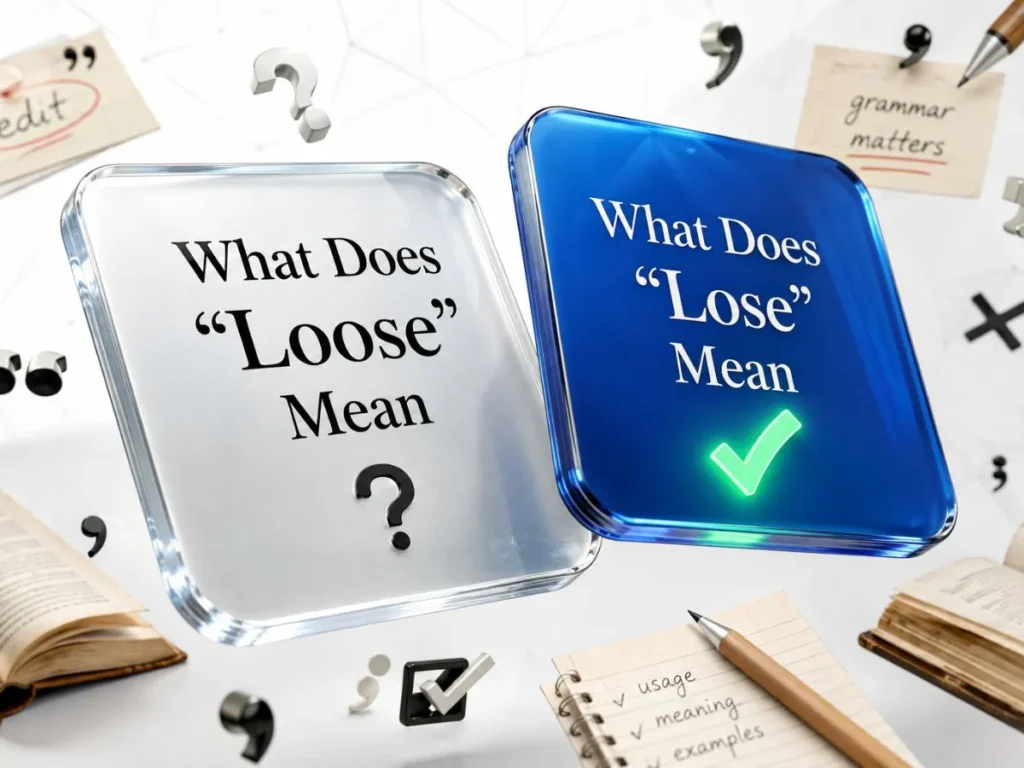
Lose or loose? These words look similar, but they have very different meanings and uses.
Lose means to misplace something, fail to win, or be unable to keep something. Loose means not tight, free, or not firmly fixed. Using the wrong word can completely change the meaning of your sentence.
In this guide, you will learn how to use lose and loose correctly, understand their key differences, avoid common mistakes, and remember the right word with clear examples and a simple memory trick.
Quick Answer:
Lose is a verb meaning to misplace, fail to win, or no longer have something: “Don’t lose your keys.”
Loose is usually an adjective meaning not tight or firmly fixed: “My shirt is loose.”
Remember: lose rhymes with “choose,” while loose rhymes with “goose.”
Lose vs. Loose: Comparison Table
| Feature | Lose | Loose |
| Word | Lose | Loose |
| Meaning | To misplace, fail to win, or no longer have | Not tight, fixed, or controlled |
| Definition | To be unable to find or keep something; to fail to win | Not firmly held, attached, or fitting closely |
| Part of speech | Mainly verb | Mainly adjective; sometimes verb |
| Pronunciation | /luːz/ | /luːs/ |
| Sound | Rhymes with choose | Rhymes with goose |
| Grammar rule | Usually describes an action or state | Usually describes a person, thing, or condition |
| Correct usage | “I don’t want to lose my phone.” | “These shoes are loose.” |
| Common mistake | Writing “loose” when you mean “lose” | Writing “lose” when you mean “loose” |
| Memory tip | Lose = misplace or fail | Loose = not tight |
| Example | “Our team could lose the game.” | “The rope is loose.” |
What Does “Lose” Mean?
Lose is primarily a verb. It means to misplace something, fail to win, no longer have something, or be deprived of something.
Common meanings of “lose”
- To misplace something
- I always lose my keys.
- She lost her wallet at the airport.
- To fail to win
- Our team may lose the game.
- They lost the championship last year.
- To no longer have something
- He lost his job.
- The company lost several customers.
- To experience a reduction
- She wants to lose weight.
- The business lost money last quarter.
- To stop having contact with someone or something
- I lost touch with my old friend.
- We lost contact during the storm.
Forms of “lose”
| Tense/Form | Word |
| Base form | lose |
| Past tense | lost |
| Past participle | lost |
| Present participle | losing |
For example:
- I might lose my ticket.
- I lost my ticket yesterday.
- I have lost my ticket.
- I am losing patience.
What Does “Loose” Mean?
Loose is most often an adjective. It describes something that is not tight, firmly attached, closely controlled, or held securely.
Common meanings of “loose”
- Not tight
- These pants are too loose.
- The jacket feels loose around my shoulders.
- Not firmly attached
- There is a loose screw on the chair.
- One of the floorboards is loose.
- Not contained or controlled
- The dog got loose from the yard.
- Several animals were running loose.
- Not exact or strict
- The movie is based on a loose interpretation of the book.
- We followed a loose schedule.
“Loose” can also be a verb
Although less common, loose can function as a verb meaning to release or set free.
- The prisoner was loosed from his restraints.
- The hunter loosed an arrow.
In everyday English, however, loose is much more commonly used as an adjective.
Lose vs. Loose: Key Differences
- Lose is primarily a verb.
- Loose is primarily an adjective.
- Lose can mean to misplace something.
- Loose can mean something is not tight.
- Lose can mean failing to win.
- Loose can describe something that is not firmly attached.
- Lose is pronounced /luːz/, with a z sound.
- Loose is pronounced /luːs/, with an s sound.
Compare these sentences:
Don’t lose your keys.
The person might misplace the keys.
The keys are loose in my pocket.
The keys are not secured or fixed in place.
How Do You Pronounce Lose and Loose?
Pronunciation is one of the easiest ways to tell these words apart.
Lose is pronounced /luːz/. The final sound is like the z in “zoo.”
Loose is pronounced /luːs/. The final sound is like the s in “snake.”
A useful sound comparison is:
- Lose → rhymes with choose
- Loose → rhymes with goose
This pronunciation difference can help you remember which spelling to use.
When Should You Use “Lose”?
Use lose when you are talking about an action or situation involving misplacing, failing, or no longer having something.
Academic writing
- Students can lose points for incorrect answers.
- A writer may lose the reader’s attention with unclear arguments.
Professional and business writing
- The company could lose valuable customers.
- We cannot afford to lose this opportunity.
Emails
- Please make sure you do not lose the attached document.
- We do not want to lose contact with the client.
Daily conversation
- I always lose my phone.
- Don’t lose your ticket.
When Should You Use “Loose”?
Use loose when describing something that is not tight, firmly attached, controlled, or exact.
Academic writing
- The theory is based on a loose interpretation of the evidence.
Professional and business writing
- The cable is loose and needs to be secured.
- The company uses a loose organizational structure.
Emails
- The handle on the door is loose.
- One of the connections appears loose.
Daily conversation
- These shoes are too loose.
- My shirt feels loose.
Common Mistakes With Lose and Loose
The biggest mistake is using loose when you need lose.
Incorrect:
I don’t want to loose my job.
Correct:
I don’t want to lose my job.
The sentence describes no longer having a job, so lose is correct.
Incorrect:
My shoes are too lose.
Correct:
My shoes are too loose.
The sentence describes shoes that are not tight, so loose is correct.
Why does this confusion happen?
The two words look and sound similar. They both begin with loo-, but their meanings and final sounds differ.
A particularly common error occurs because people pronounce lose incorrectly as if it were spelled “loose.” Remember that lose ends with a z sound, not an s sound.
10 Original Examples of Lose and Loose
- School: If you lose your textbook, you may need to buy another copy.
- Workplace: The manager warned the team that they could lose an important client.
- Business: The company could lose money if sales continue to fall.
- Conversation: I hope I don’t lose my phone on the train.
- Books: The author did not want to lose the reader’s attention.
- News: The candidate could lose support after the announcement.
- Social media: Be careful not to lose your account information.
- Everyday English: This button is loose and needs to be repaired.
- Clothing: My new jacket is loose around the waist.
- Home: The loose handle fell off the cabinet.
A Simple Memory Trick
Use this rule:
Lose = choose to lose or fail to keep.
Loose = goose without the “g.”
Another quick test:
- If you mean misplace, fail, or no longer have, use lose.
- If you mean not tight or not firmly attached, use loose.
Quick decision guide
Can you replace the word with “misplace” or “fail to win”?
→ Use lose.
Can you replace it with “not tight” or “not firmly attached”?
→ Use loose.
Mini Quiz
1. I don’t want to ___ my wallet.
A. loose
B. lose
C. losing
D. loosen
Answer: B. lose
2. This shirt is too ___ for me.
A. lose
B. lost
C. loose
D. losing
Answer: C. loose
3. Our team might ___ the final match.
A. loose
B. lose
C. loosen
D. lost
Answer: B. lose
4. The screw is ___.
A. lose
B. lost
C. loose
D. losing
Answer: C. loose
5. She ___ her keys yesterday.
A. loose
B. lose
C. lost
D. losing
Answer: C. lost
FAQs
Is it “lose weight” or “loose weight”?
The correct expression is “lose weight.” The verb lose means to reduce or no longer have something, while loose means not tight. Therefore, “I want to lose weight” is correct, but “I want to loose weight” is incorrect.
Is it “lose or loose your keys”?
The correct phrase is “lose your keys.” Use lose because it means to misplace something or no longer know where it is. For example, “Be careful not to lose your keys.” Loose would be incorrect because it does not mean “misplace.”
Is loose an adjective or a verb?
Loose is most commonly an adjective describing something that is not tight, firmly attached, or controlled. It can also function as a less common verb meaning “to release” or “set free.” In everyday English, you will usually encounter loose as an adjective.
Why do people confuse lose and loose?
People often confuse lose and loose because their spellings are very similar and both begin with the same “loo” sound. Their final sounds are different: lose ends with a /z/ sound, while loose ends with an /s/ sound. Their meanings and grammatical roles also differ.
What is the easiest way to remember lose vs. loose?
Remember lose = misplace or fail and loose = not tight. You can also remember their pronunciation: lose rhymes with “choose,” while loose rhymes with “goose.” If something can be tightened, it is probably loose. If something can be misplaced or failed, use lose.
Key Takeaways
- Lose is primarily a verb.
- Loose is primarily an adjective.
- Lose means to misplace, fail to win, or no longer have something.
- Loose means not tight, firmly attached, or controlled.
- Lose is pronounced /luːz/.
- Loose is pronounced /luːs/.
- Say “lose weight,” not “loose weight.”
- Say “loose shirt,” not “lose shirt.”
- A quick memory rule is lose = misplace/fail; loose = not tight.
Conclusion
The difference between lose or loose becomes easy once you focus on meaning.
Use lose for misplacing something, failing to win, or no longer having something.
Use loose to describe something that is not tight, firmly attached, or controlled. Remember lose = choose in pronunciation and loose = goose.
With this simple distinction, you can avoid one of the most common spelling and word-choice mistakes in English.
Discover More Post
- Through or Threw: Which One Should You Use (2026)?
- Whether or Wether: How Are They Different? Examples and Rules
- Chose or Choose: Which One Should You Use (2026)?

Mignon Fogarty is an experienced English grammar and writing expert specializing in grammar, word usage, and clear American English. At EduNexxt, her focus is making grammar simple, accurate, and practical.
 William Strunk
 info.asadblogger@gmail.com