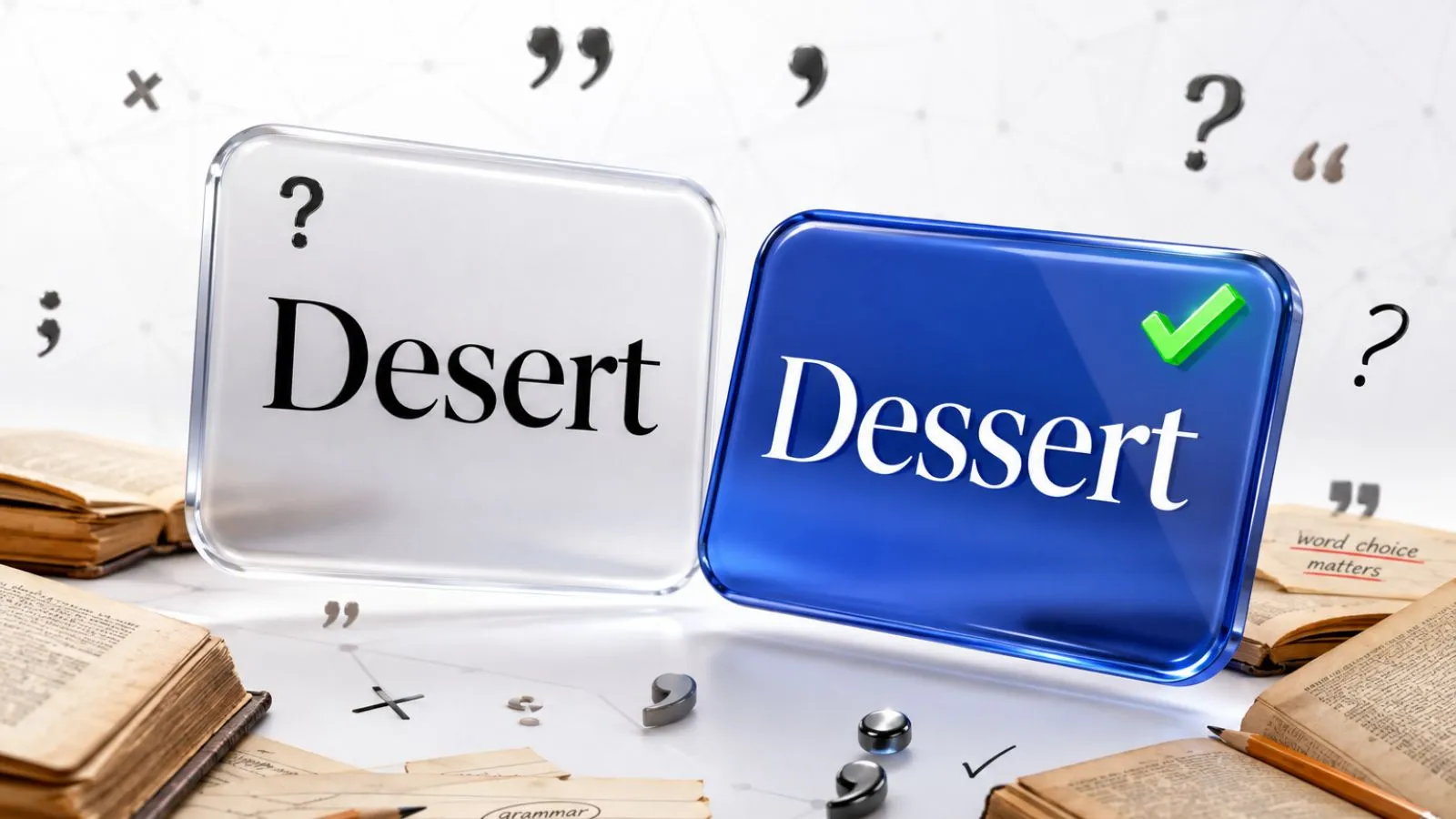
Desert or dessert? These words look similar, but they have very different meanings.
Desert refers to a dry, sandy place with very little water or life.
Dessert is the sweet food you eat after a meal. Because they are spelled almost the same, they are often confused in writing.
In this guide, you will learn the difference between desert and dessert, when to use each word, common mistakes, clear examples and simple tips to remember them easily.
Quick Answer:
Desert usually means a very dry area of land, such as the Sahara Desert, or it can mean to abandon someone or something.
Dessert is a sweet food eaten at the end of a meal, such as cake, ice cream, or pie.
A simple memory trick is: dessert has two s’s because you want seconds of something sweet.
Desert vs. Dessert: Quick Comparison
| Feature | Desert | Dessert |
| Meaning | A dry region; also, to abandon | A sweet food eaten after a meal |
| Part of speech | Noun or verb | Noun |
| Definition | A dry area with little rainfall, or to leave someone/something behind | A sweet course served after a meal |
| Pronunciation | DEZ-ert (dry land); di-ZURT (abandon) | di-ZURT |
| Grammar rule | Can function as a noun or verb | Usually functions as a noun |
| Correct usage | We crossed the desert. | We ordered dessert. |
| Incorrect usage | We crossed the dessert. | We ordered desert. |
| Common mistake | Confusing it with the sweet course | Using one s instead of two |
| Memory tip | One s = the sandy place | Two s’s = you want seconds |
| Example | The desert receives very little rain. | She made chocolate cake for dessert. |
What Does “Desert” Mean?
Desert has more than one meaning, and its pronunciation changes depending on how it is used.
1. Desert as a noun
As a noun, desert usually means a very dry region that receives little precipitation and supports limited vegetation.
Examples:
- The Sahara is one of the world’s largest hot deserts.
- Many plants and animals have adapted to life in the desert.
- We watched the sunset over the desert.
The word can also appear in the names of specific geographic regions, such as the Mojave Desert and Gobi Desert.
2. Desert as a verb
As a verb, desert means to leave someone or something behind, especially when that person or thing needs support.
Examples:
- The soldier was accused of deserting his post.
- He would never desert his family during a difficult time.
- The hikers were afraid that their guide might desert them.
When desert means “abandon,” it is pronounced di-ZURT, with the stress on the second syllable.
Pronunciation Matters
The two meanings of desert have different pronunciations:
- DEZ-ert = a dry region
- di-ZURT = to abandon
This makes desert a useful example of a word whose pronunciation changes according to meaning.
What Does “Dessert” Mean?
Dessert is a noun that means a sweet food or course served at the end of a meal.
Common desserts include:
- Cake
- Pie
- Ice cream
- Cookies
- Pudding
- Cheesecake
- Fruit-based desserts
Examples:
- We had ice cream for dessert.
- The restaurant offers three different desserts.
- My favorite dessert is apple pie.
Unlike desert, dessert normally refers to food and is pronounced di-ZURT.
Desert vs. Dessert: Key Differences
The easiest way to separate these words is to focus on their meanings and spelling.
- Desert with one s can mean a dry area of land.
- Desert can also be a verb meaning “to abandon.”
- Dessert with two s’s means a sweet food served after a meal.
- The geographic desert is pronounced DEZ-ert.
- Both the “abandon” meaning of desert and dessert are pronounced di-ZURT.
- Dessert is always spelled with two s’s.
- The spelling difference changes the meaning completely.
A Simple Decision Guide
Ask yourself:
Are you talking about a dry place?
→ Use desert.
Do you mean to abandon someone or something?
→ Use desert.
Are you talking about sweet food after a meal?
→ Use dessert.
Grammar Rules for Desert and Dessert
Rule 1: Use “desert” for a dry geographical region
Use desert as a noun when discussing a dry area of land.
The researchers traveled through the desert.
Rule 2: Use “desert” as a verb for abandoning
Use desert as a verb when someone leaves a person, responsibility, place, or position behind.
He refused to desert his teammates.
Its forms include desert, deserts, deserted, and deserting.
Rule 3: Use “dessert” for sweet food
Use dessert as a noun when referring to a sweet course or food eaten after a meal.
We saved room for dessert.
The plural form is desserts.
Important Pronunciation Rule
The geographic noun desert and the food noun dessert are not pronounced the same:
- desert = DEZ-ert
- dessert = di-ZURT
However, the verb desert, meaning “abandon,” is pronounced like dessert.
When Should You Use Desert or Dessert?
Academic Writing
Use desert when discussing geography, climate, ecology, literature, or history.
The study examines how plants survive in desert environments.
Use dessert when discussing food, nutrition, cooking, or meals.
The students wrote a report about traditional desserts.
Professional and Business Writing
In workplace writing, choose the word based on its meaning.
The company plans to expand operations in desert regions.
The team ordered dessert after the business dinner.
Formal English
Both words are standard in formal English. The important point is spelling and meaning.
The explorers crossed the desert.
The guests were served dessert.
Emails and Daily Conversation
The same distinction applies in casual communication.
Are you going to the desert this weekend?
What are we having for dessert?
Common Mistakes With Desert and Dessert
Mistake 1: Using “desert” for sweet food
Incorrect:
We had cake for desert.
Correct:
We had cake for dessert.
The correct word has two s’s because it refers to food.
Mistake 2: Using “dessert” for a dry region
Incorrect:
The group traveled across the dessert.
Correct:
The group traveled across the desert.
A dry geographical region takes desert with one s.
Mistake 3: Assuming both words sound identical
They do not always sound identical.
Desert meaning a dry region is pronounced DEZ-ert, while dessert is pronounced di-ZURT.
Why Do People Confuse Them?
The words are visually similar, and the verb desert has the same pronunciation as dessert. Because the spelling and sounds overlap, writers often rely on memory rather than meaning.
The safest approach is to identify the meaning first and then choose the spelling.
10 Original Examples
- The scientists studied how animals survive in the desert.
- We ordered chocolate cake for dessert after dinner.
- The travelers carried extra water before entering the desert.
- The restaurant serves homemade desserts every Friday.
- The commander warned the soldiers not to desert their positions.
- The business opened a research center near a desert region.
- My family usually has fruit for dessert.
- The novel describes a difficult journey across the desert.
- The chef prepared a special dessert for the wedding guests.
- She promised that she would never desert her friends when they needed help.
Memory Trick: “Dessert Has Two S’s”
Use this simple trick:
Dessert = two S’s = seconds.
You usually want seconds of a delicious dessert, so remember:
Dessert → two S’s → seconds
For the dry landscape:
Desert → one S → sand
So:
One S = sand → desert
Two S’s = seconds → dessert
This is one of the quickest ways to remember the spelling.
Mini Quiz
1. Which word means a sweet food served after a meal?
A. Desert
B. Dessert
C. Desart
D. Dessert
Answer: B. Dessert
3. Which word means a dry region of land?
A. Dessert
B. Desert
C. Dessert
D. Desart
Answer: B. Desert
4. Which sentence uses “desert” as a verb?
A. The desert was extremely hot.
B. We ordered dessert.
C. He refused to desert his family.
D. She prepared a dessert.
Answer: C. He refused to desert his family.
5. Which spelling is correct for a sweet course?
A. Desert
B. Dessart
C. Dessert
D. Desart
Answer: C. Dessert
FAQs
Is it desert or dessert for food?
Use dessert when you mean a sweet food served at the end of a meal. Cake, ice cream, pie, and pudding are examples of desserts. Remember that dessert has two s’s. The spelling desert refers to a dry region of land or, as a verb, to abandon someone or something.
What is the difference between desert and dessert?
Desert usually means a dry area of land, such as the Sahara Desert, but it can also mean “to abandon.” Dessert means a sweet food eaten after a meal. The geographic noun desert is pronounced “DEZ-ert,” while dessert is pronounced “di-ZURT.”
Why does dessert have two S’s?
A useful memory trick is that dessert has two S’s because you may want seconds. This helps distinguish it from desert, which has one S and can mean a dry, sandy region. The spelling reflects two different words with different meanings, even though their forms look very similar.
Is desert pronounced the same as dessert?
Not always. Desert meaning a dry region is pronounced DEZ-ert. Desert meaning “to abandon” is pronounced di-ZURT, which sounds like dessert. Dessert, meaning a sweet food served after a meal, is pronounced di-ZURT as well.
Can desert be a verb?
Yes. Desert can function as a verb meaning “to abandon” or “to leave.” For example, “The soldier refused to desert his post.” In this use, desert is pronounced di-ZURT, the same way as dessert. The surrounding context tells you which meaning is intended.
Key Takeaways
- Desert with one s can mean a dry region of land.
- Desert can also be a verb meaning “to abandon.”
- Dessert with two s’s means a sweet food served after a meal.
- Geographic desert is pronounced DEZ-ert.
- The verb desert and noun dessert are both pronounced di-ZURT.
- Remember: dessert has two S’s because you want seconds.
- Always identify the meaning before choosing the spelling.
Conclusion
Although desert and dessert differ by only one letter, their meanings are completely different.
Desert refers to a dry region or, as a verb, to abandoning someone or something. Dessert refers to a sweet food served after a meal.
When you remember “dessert has two S’s because you want seconds,” you can quickly choose the correct word in both writing and conversation.
Related More Post
- Complement or Compliment: Which One Should You Use?
- Lose or Loose: Which One Is Correct (2026)?
- Chose or Choose: Which One Should You Use (2026)?

William Strunk is a respected authority on English grammar, usage, and writing style, known for his influential work The Elements of Style. At EduNexxa, his focus is on clear, concise, and effective English.
 info.asadblogger@gmail.com