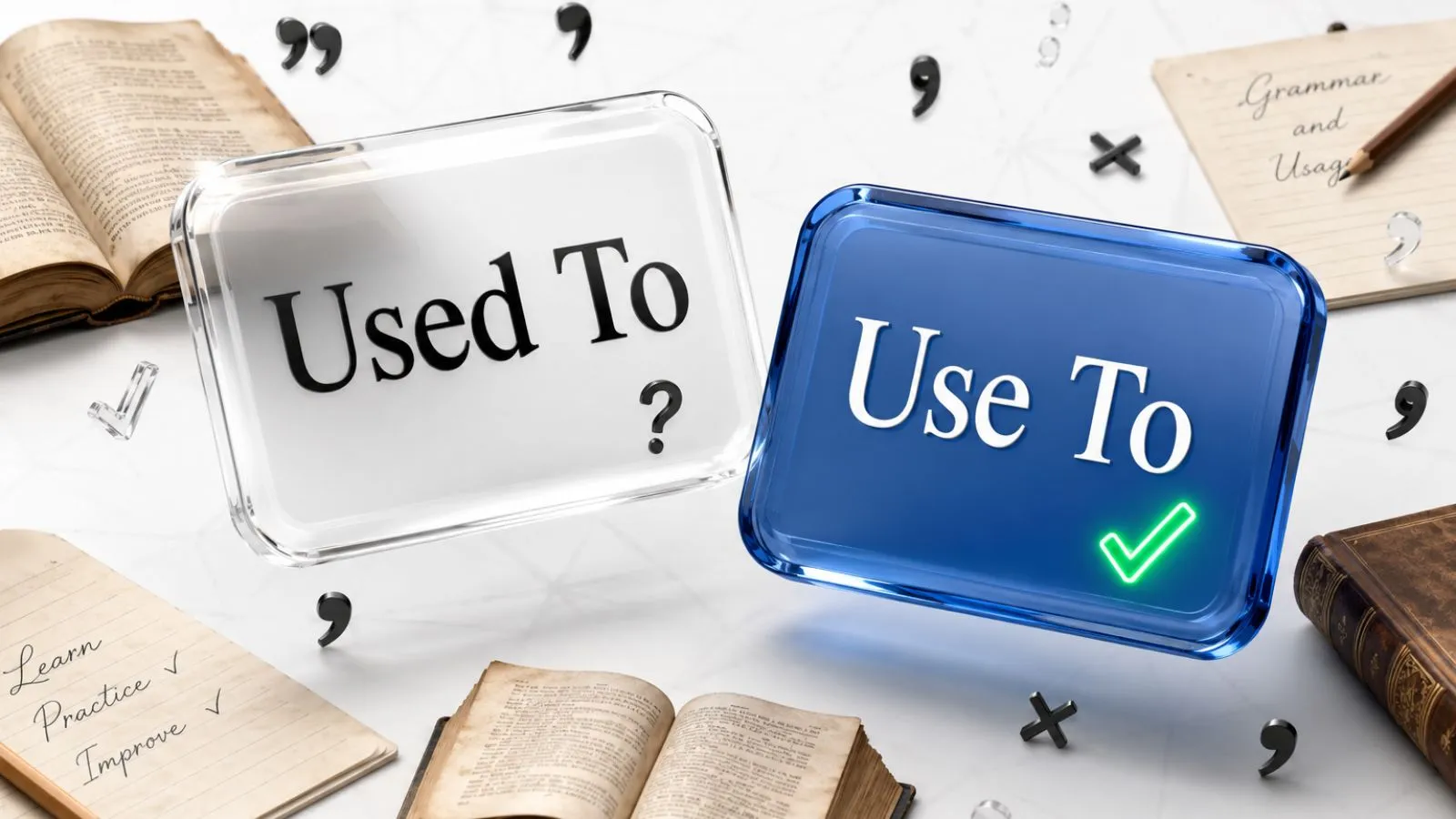
Used to or use to? These phrases look similar but are used in different ways.
Used to describes a past habit or situation that is no longer true, while use to usually appears after did or didn’t in questions and negative sentences. Using the wrong form can make your sentence grammatically incorrect.
In this guide, you will learn the difference between used to and use to, when to use each one, common mistakes, clear examples, and simple tips to remember the correct form.
Quick Answer:
Use used to + base verb for a past habit, repeated action, or past situation that is no longer true: I used to play tennis.
Use use to after did or didn’t: Did you use to play tennis? and I didn’t use to play tennis.
Be used to” means “be accustomed to,” while “get used to means “become accustomed to.”
Used To vs. Use To at a Glance
| Form | Correct Use | Meaning | Example |
| used to + verb | Positive past statement | A former habit or situation | I used to walk to school. |
| did + use to + verb | Past question | Asks about a former habit or situation | Did you use to walk to school? |
| didn’t + use to + verb | Past negative | Says something was not a former habit or situation | I didn’t use to walk to school. |
| be used to + noun/-ing | State of familiarity | Be accustomed to something | I am used to waking early. |
| get used to + noun/-ing | Process of adaptation | Become accustomed to something | I am getting used to waking early. |
| use + to + verb | Ordinary verb use | Employ something for a purpose | What do you use to clean the table? |
What Does “Used To” Mean?

Used to + base verb describes something that happened regularly in the past or a situation that was true in the past but is no longer true.
Examples
- I used to play basketball after school.
- She used to live in Chicago.
- We used to visit our grandparents every summer.
- He used to be very shy.
- There used to be a bookstore on this street.
The expression can describe both past actions and past states.
Past action
I used to run every morning.
This means running was a regular habit in the past.
Past state
I used to live in Boston.
This means living in Boston was true in the past but is not true now.
Basic structure
Subject + used to + base verb
She used to work here.
They used to have a small house.
When Do You Use “Use To”?
When used to express a former habit or state, use to normally appears after did or didn’t.
Questions
Use:
Did + subject + use to + base verb?
Examples:
- Did you use to live here?
- Did she use to work with you?
- Did they use to play tennis?
- Did your parents use to travel often?
The correct form is:
Did you use to play football?
Not:
❌ Did you used to play football?
Why?
The word did already carries the past tense. The main verb therefore stays in its base form.
Compare:
You used to play tennis.
Did you use to play tennis?
The -d moves from used to the auxiliary did.
“Didn’t Use To” in Negative Sentences
The same rule applies after didn’t.
Structure
Subject + didn’t + use to + base verb
Examples:
- I didn’t use to like coffee.
- She didn’t use to eat spicy food.
- We didn’t use to have a car.
- He didn’t use to watch television.
Incorrect:
❌ I didn’t used to like coffee.
Correct:
I didn’t use to like coffee.
A simple way to remember it
Did → use to
Didn’t → use to
No did → used to
“Use To” Can Also Be an Ordinary Verb
Not every example of use to involves the past-habit expression.
Sometimes use is simply the main verb, meaning to employ something for a particular purpose.
For example:
What do you use to clean the windows?
Here, use means “employ,” and to clean is an infinitive showing the purpose.
Another example:
What do you use to decorate cakes?
This is completely different from:
Did you use to decorate cakes?
The first sentence asks which tool or thing you employ.
Compare these structures
Ordinary verb:
What do you use to clean the floor?
Past-habit expression:
I used to clean the floor every Saturday.
Understanding this difference prevents a lot of confusion.
Used To vs. Be Used To
One of the most important distinctions is between used to + base verb and be used to + noun/-ing.
They do not mean the same thing.
Used to + base verb
Means a former habit, action, or situation.
I used to work nights.
This means working nights was my past routine.
Be used to + noun or -ing
Means be accustomed to or find something familiar or normal.
I am used to working nights.
This means working nights is familiar to me.
Compare
| Sentence | Meaning |
| I used to work nights. | Working nights was my former habit. |
| I am used to working nights. | Working nights is familiar to me. |
Notice the verb after be used to:
I am used to working late.
Not:
❌ I am used to work late.
Structure
used to + base verb
She used to drive.
be used to + noun/-ing
She is used to driving.
This is a key grammar difference.
What Does “Get Used To” Mean?
Get used to means become accustomed to something. It describes the process of adapting to a new situation.
Examples
- I am getting used to waking up early.
- She will get used to working remotely.
Compare the three expressions:
I used to wake up late.
This describes a former habit.
I am getting used to waking up early.
This describes the process of adapting.
I am used to waking up early.
This means waking up early is now familiar.
Remember
Used to = past habit
Be used to = already accustomed
Get used to = become accustomed
Used To vs. Would
Used to can sometimes be replaced by would when talking about repeated actions in the past.
For example:
When I was young, I used to visit my grandparents every summer.
When I was young, I would visit my grandparents every summer.
Both can describe a repeated past action.
However, used to can also describe a past state:
I used to live in Seattle.
You normally would not use would in this way:
❌ I would live in Seattle.
Therefore, used to is the better choice when describing a former state, such as where someone lived or what someone was like.
Key Grammar Rules
Rule 1: Use “used to” in positive statements
I used to play tennis.
She used to live here.
Rule 2: Use “use to” after “did”
Did you use to play tennis?
Did he use to work here?
Rule 3: Use “use to” after “didn’t”
I didn’t use to drink coffee.
They didn’t use to travel much.
Rule 4: Use a base verb after “used to”
Correct:
She used to dance.
Incorrect:
❌ She used to danced.
Incorrect:
❌ She used to dancing.
Rule 5: Use a noun or -ing form after “be used to”
Correct:
I am used to cold weather.
I am used to working late.
Incorrect:
❌ I am used to work late.
Rule 6: Use a noun or -ing form after “get used to”
Correct:
He is getting used to the noise.
He is getting used to working at night.
Incorrect:
❌ He is getting used to work at night.
Common Mistakes With “Use To” and “Used To”
Mistake 1: Using “use to” in a positive past statement
❌ I use to live in Dallas.
✅ I used to live in Dallas.
Because there is no did, use used to.
Mistake 2: Using “used to” after “did”
❌ Did you used to live here?
✅ Did you use to live here?
Did already expresses the past.
Mistake 3: Using “used to” after “didn’t”
❌ I didn’t used to eat vegetables.
✅ I didn’t use to eat vegetables.
Mistake 4: Writing “I am use to it”
❌ I am use to it.
✅ I am used to it.
Here, used to means “accustomed to.”
Mistake 5: Following “be used to” with the base verb
❌ She is used to work late.
✅ She is used to working late.
Mistake 6: Confusing “used to” with “use”
❌ What do you used to clean the windows?
✅ What do you use to clean the windows?
Here, use is the ordinary present-tense verb.
When Should You Use These Forms?
Academic Writing
Use used to when discussing past conditions, behaviors, or practices.
Students used to rely heavily on printed textbooks.
Professional Writing
Our team used to meet every Monday.
Business Writing
The company used to process customer requests manually.
Formal English
Both used to and use to are correct when their grammatical structures require them. The important point is to use the correct form after did and didn’t.
Emails
We used to send invoices by mail, but we now send them electronically.
Daily Conversation
Did you use to play video games as a child?
Yes, I used to play them every weekend.
10 Real-Life Examples
- School: I used to walk to school with my brother.
- Work: Our manager used to hold weekly meetings.
- Business: The company used to accept orders by phone.
- Conversation: Did you use to watch cartoons after school?
- Travel: We used to visit that beach every summer.
- Books: The novel describes a town that used to depend on fishing.
- News: The area used to experience frequent flooding.
- Social media: I didn’t use to post much online.
A Simple Memory Trick
Use the D Rule:
No DID → USED TO
I used to play.
DID → USE TO
Did I use to play?
DIDN’T → USE TO
I didn’t use to play.
The easiest explanation is:
Did already carries the past tense, so use the base form “use.”
For the other expressions, remember:
USED TO + verb → former habit
BE USED TO + noun/-ing → accustomed
GET USED TO + noun/-ing → becoming accustomed
Quick Decision Guide
Ask yourself one question:
What do I mean?
A past habit or past situation?
→ used to + base verb
A question or negative with did/didn’t?
→ use to + base verb
Already accustomed to something?
→ be used to + noun/-ing
Becoming accustomed to something?
→ get used to + noun/-ing
Examples
I used to drive to work.
Did you use to drive to work?
I am used to driving to work.
I am getting used to driving to work.
Mini Quiz
1. Choose the correct sentence.
A. I use to play tennis.
B. I used to play tennis.
C. I used play tennis.
D. I using to play tennis.
Answer: B
2. Which sentence is correct?
A. Did you used to live here?
B. Did you use to live here?
C. Did you use live here?
D. Did you using to live here?
Answer: B
3. Complete the sentence:
“I didn’t ___ drink coffee.”
A. used to
B. use to
C. using to
D. used
Answer: B
5. Which sentence describes becoming accustomed to something?
A. I used to the noise.
B. I am use to the noise.
C. I am getting used to the noise.
D. I get used the noise.
Answer: C
FAQs
Is “used to” or “use to” correct?
Use used to + base verb for positive statements about former habits or situations. Use use to after did or didn’t, as in Did you use to live here? and I didn’t use to live here.
Why is it “Did you use to” instead of “Did you used to”?
Because did already marked the sentence as past tense. After the auxiliary did, the main verb takes its base form. The same principle applies to didn’t use to.
Is “I didn’t used to” grammatically correct?
I didn’t use to is the preferred form in careful standard writing. Since didn’t already carries the past tense, the verb following it remains in its base form: use.
What is the difference between “used to” and “be used to”?
Used to + base verb describes a former habit or past state: I used to work nights. Be used to + noun or -ing means “be accustomed to”: I am used to working nights. One describes something from the past; the other describes familiarity with something.
What is the difference between “used to” and “get used to”?
Used to describes a former habit or situation, while get used to describes becoming accustomed to something. For example, I used to live in the country describes the past, whereas I am getting used to city life describes an ongoing process of adaptation.
Key Takeaways
- Used to + base verb describes a past habit, repeated action, or past state that is no longer true.
- Use to + base verb follows did or didn’t when discussing a former habit or state.
- Did you use to…? is the standard question pattern.
- I didn’t use to… is the preferred negative pattern in careful writing.
- After used to, use a base verb.
- After be/get used to, use a noun or -ing form.
- Remember the D Rule: No DID → used to; DID/DIDN’T → use to.
Conclusion
The difference between used to and use to is mainly a matter of sentence structure.
Use used to + base verb for positive statements about past habits or situations, but use use to after did or didn’t.
Also keep be used to and get used to separate: they describe being accustomed to something and becoming accustomed to something. Once you recognize these patterns, choosing the correct form becomes simple.
Related More Articles
- Lose or Loose: Which One Is Correct (2026)?
- Led or Lead: Learn the Difference With Simple Examples(2026)?
- Desert or Dessert: Which Word Is Correct (2026)?

William Strunk is a respected authority on English grammar, usage, and writing style, known for his influential work The Elements of Style. At EduNexxa, his focus is on clear, concise, and effective English.
 info.asadblogger@gmail.com
 Mignon Fogarty