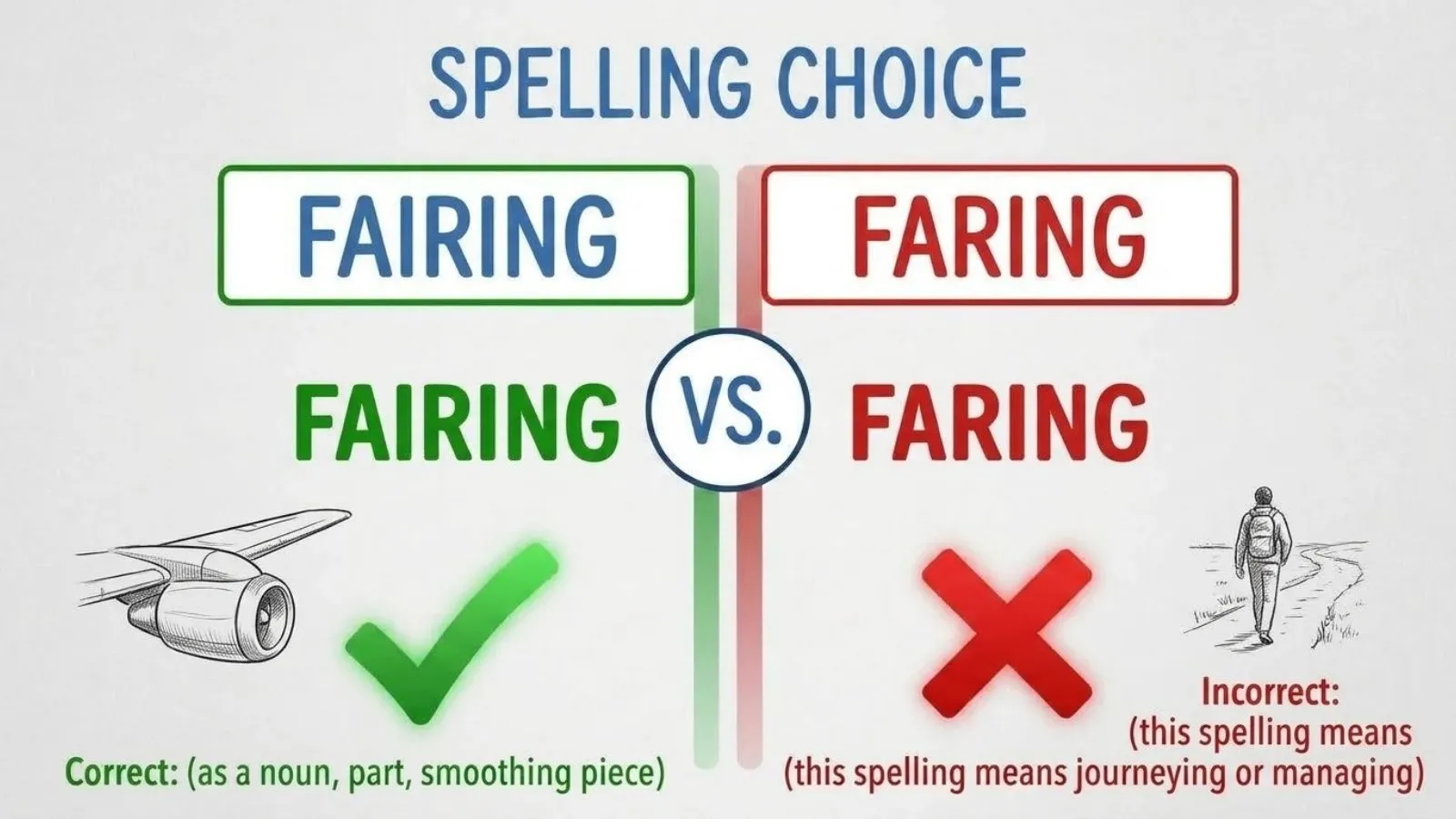
Fairing and faring sound alike but have different meanings. Fairing refers to an aerodynamic covering or smoothing surfaces, while faring describes how someone or something is doing or progressing.
Quick Answer: Fairing vs. Faring
- Fairing: A shaped covering that reduces air resistance or protects vehicle parts. It can also mean joining surfaces smoothly.
- Faring: The -ing form of fare, meaning managing, performing, or progressing.
What Does Fairing Mean?
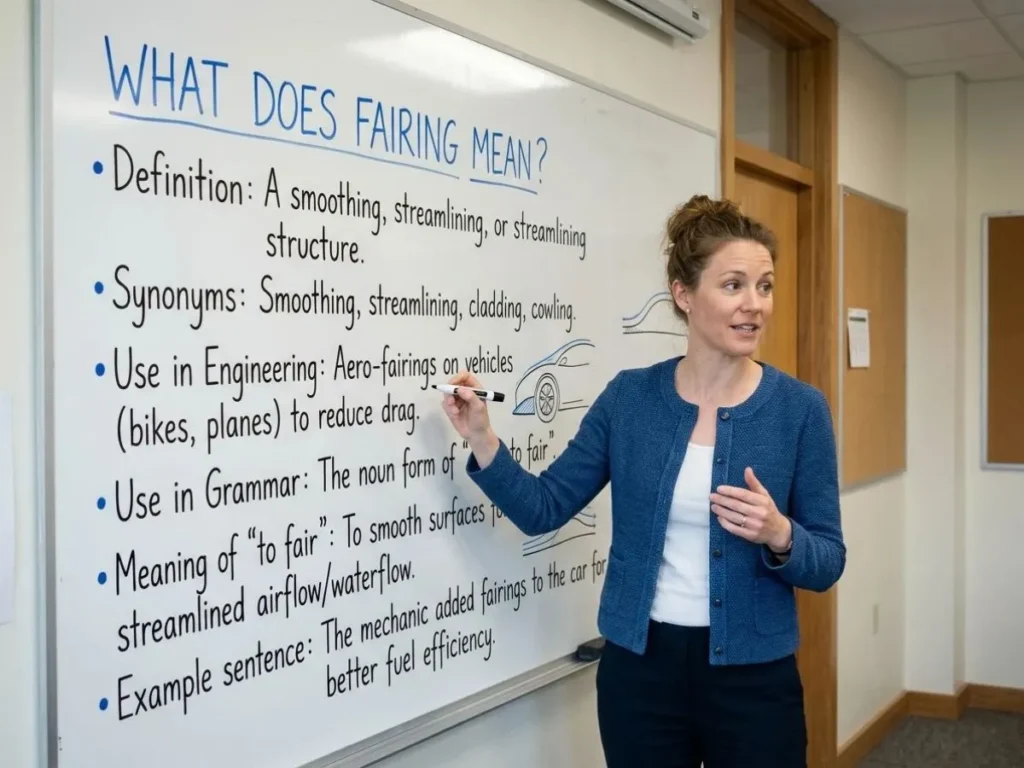
Fairing is usually a noun in automotive and aerospace contexts. It describes a shaped structure that reduces drag or protects components. Motorcycle fairings direct airflow around riders, while rocket fairings protect cargo during launch.
Fairing can also be the -ing form of fair, meaning to shape or join surfaces so they blend smoothly.
Examples:
- The motorcycle’s fairing was damaged in the accident.
- Engineers designed a lightweight fairing for the aircraft.
- The technician is fairing the edges for a smooth finish.
What Does Faring Mean?
Faring comes from fare and describes how someone or something manages or progresses. It often appears with well, badly, better, or worse.
In older usage, fare could also mean eating or receiving food, but this sense is uncommon today.
Examples:
- How are you faring in your new job?
- The company is faring better than expected.
- The travelers were faring well despite the bad weather.
Fairing vs. Faring: Key Differences
| Feature | Fairing | Faring |
| Root word | Fair | Fare |
| Part of speech | Noun or verb form | Verb form |
| Main meaning | Covering or smoothing surfaces | Managing or progressing |
| Common context | Vehicles and engineering | Everyday situations |
| Example | The bike needs a fairing. | She is faring well. |
Pronunciation and Word Forms
Both words are generally pronounced alike.
- Fairing: FAIR-ing
- Faring: FAIR-ing
- Fair: Past tense: faired.
- Fare: Past tense: fared.
British vs. American English
Their main meanings are the same, but fairing has additional regional uses.
- British English: A fairing can mean a traditional gift from a fair or a type of sweet biscuit.
- American English: Fairing commonly describes aerodynamic structures on vehicles and aircraft.
- Both varieties: Faring describes how someone or something is managing or progressing.
Example: The business is faring well in both countries.
Common Mistakes to Avoid
- Incorrect: How is your team fairing?
Correct: How is your team faring? - Incorrect: The airplane needs a new faring.
Correct: The airplane needs a new fairing. - Incorrect: The engineer is faring the panel edges.
Correct: The engineer is fairing the panel edges.
FAQs
1. Is it fairing or faring?
Both are correct. Use fairing for a covering or surface-smoothing work, and faring for progress or performance.
2. Is fairing a noun or a verb?
Both. It names a covering and can be the verb form meaning to smooth or join surfaces.
3. Does faring mean doing well?
Faring means managing or progressing; faring well means doing well.
4. Are fairing and faring homophones?
Yes. They are generally pronounced alike but have different spellings and meanings.
Conclusion
Fairing relates to coverings and smooth surfaces; faring describes how someone or something is managing. Choose by context.
Related Articles
- Opened or Openned: Which Spelling Is Correct?
- Targeted or Targetted: Which Spelling Is Correct?
- Plural of Hair: Is It Hair or Hairs?

William Strunk is a respected authority on English grammar, usage, and writing style, known for his influential work The Elements of Style. At EduNexxa, his focus is on clear, concise, and effective English.
 Bryan Garne
 Mignon Fogarty