
One small spelling mistake can change the meaning of your sentence. Use than to compare things and then to express time,
sequence, or a result. Once you know what each word does, choosing the right one becomes much easier.
Quick Answer:
- Than: Compares people, things, amounts, or preferences.
- Then: Refers to a time, the next step, or the result of a condition.
Example: This book is better than the movie. Finish the book, then watch the movie.
Than vs. Then: Key Differences
| Feature | Than | Then |
| Main purpose | Comparison | Time, order, or result |
| Common phrases | More than, rather than, other than | Back then, since then, until then |
| Example | Mia is taller than Ben. | Mia finished, then left. |
When to Use Than
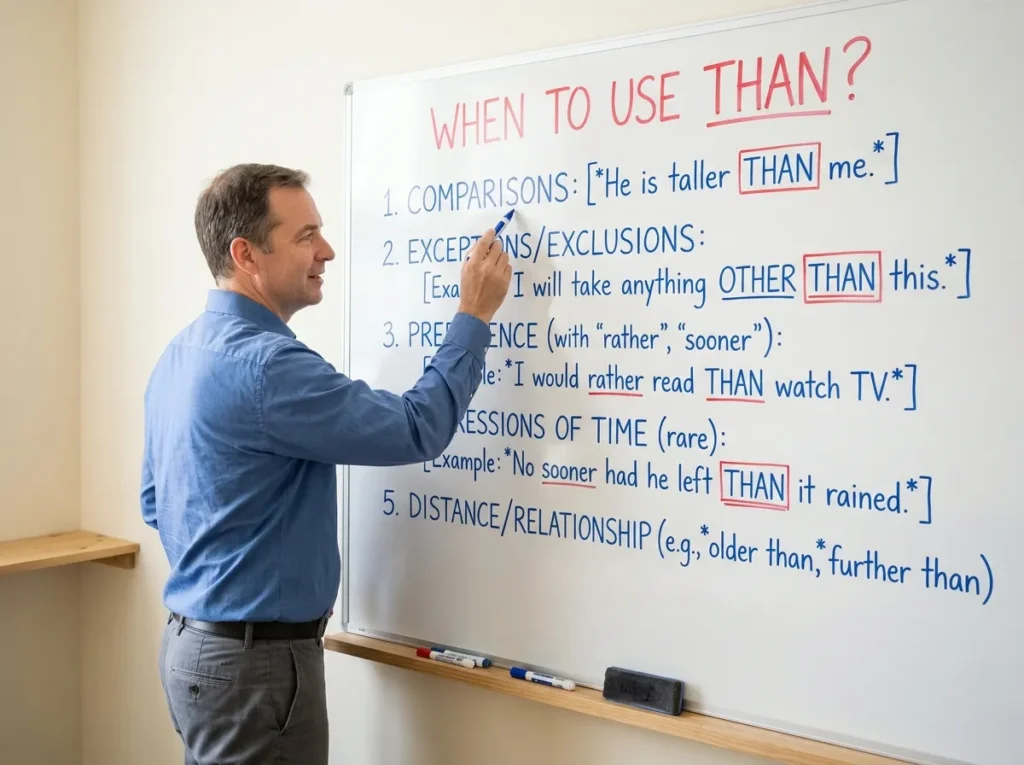
Use than when comparing two people, things, qualities, or amounts. It often follows comparative words such as better, faster, taller, more, and less.
Examples:
- This phone is cheaper than mine.
- We have more work than time.
- I would rather walk than wait.
- Other than coffee, the menu offers several teas.
Than also appears in the expression no sooner … than, which shows that one event follows another immediately: “No sooner had we arrived than it started raining.”
When to Use Then
Use then to describe what happened at a particular time, what comes next, or what follows from a condition.
Examples:
- We ate dinner, then watched a movie.
- Back then, I lived in Chicago.
- Wait until then before making a decision.
- If you finish early, then you can leave.
You may also see since then, every now and then, and and then some. In the then-manager, the word means the person held that position at the time.
Common Mistakes to Avoid
Incorrect: She is younger then her brother.
Correct: She is younger than her brother.
Incorrect: We finished lunch than went shopping.
Correct: We finished lunch, then went shopping.
Incorrect: I would rather read then watch TV.
Correct: I would rather read than watch TV.
Remember: Comparisons need than; time, sequence, and results usually need then.
American vs. British English
American and British English follow the same basic rules. These examples show how both words are used naturally in each variety.
American English
- Than: “This route is shorter than the highway.”
- Then: “Back then, we walked to school.”
- Then in a condition: “If it snows, then we’ll stay home.”
British English
- Than: “The train is quicker than the bus.”
- Then: “Since then, she has changed jobs.”
- Then for sequence: “We’ll finish the report, then send it.”
These are examples of usage, not different grammar rules: than still expresses comparison, and then still expresses time, order, or result in both varieties.
FAQs
Is it “better than” or “better then”?
Use better than because it compares two things.
Can then mean “therefore”?
Yes. In “If you agree, then we can begin,” then introduces the result.
Is “other then” correct?
No, not when you mean “except for.” The correct expression is other than.
Conclusion
Use than for comparisons and then for time, sequence, or results. Check the meaning of your sentence, and you can choose the
correct word with confidence.
Related Articles
- Base or Bass? Meaning, Pronunciation & Examples
- Too Cute vs. To Cute: Which Phrase Is Correct?
- Reinforce vs. Reenforce: Which Spelling Is Correct?

Mignon Fogarty is an experienced English grammar and writing expert specializing in grammar, word usage, and clear American English. At EduNexxt, her focus is making grammar simple, accurate, and practical.
 Bryan Garne
 William Strunk