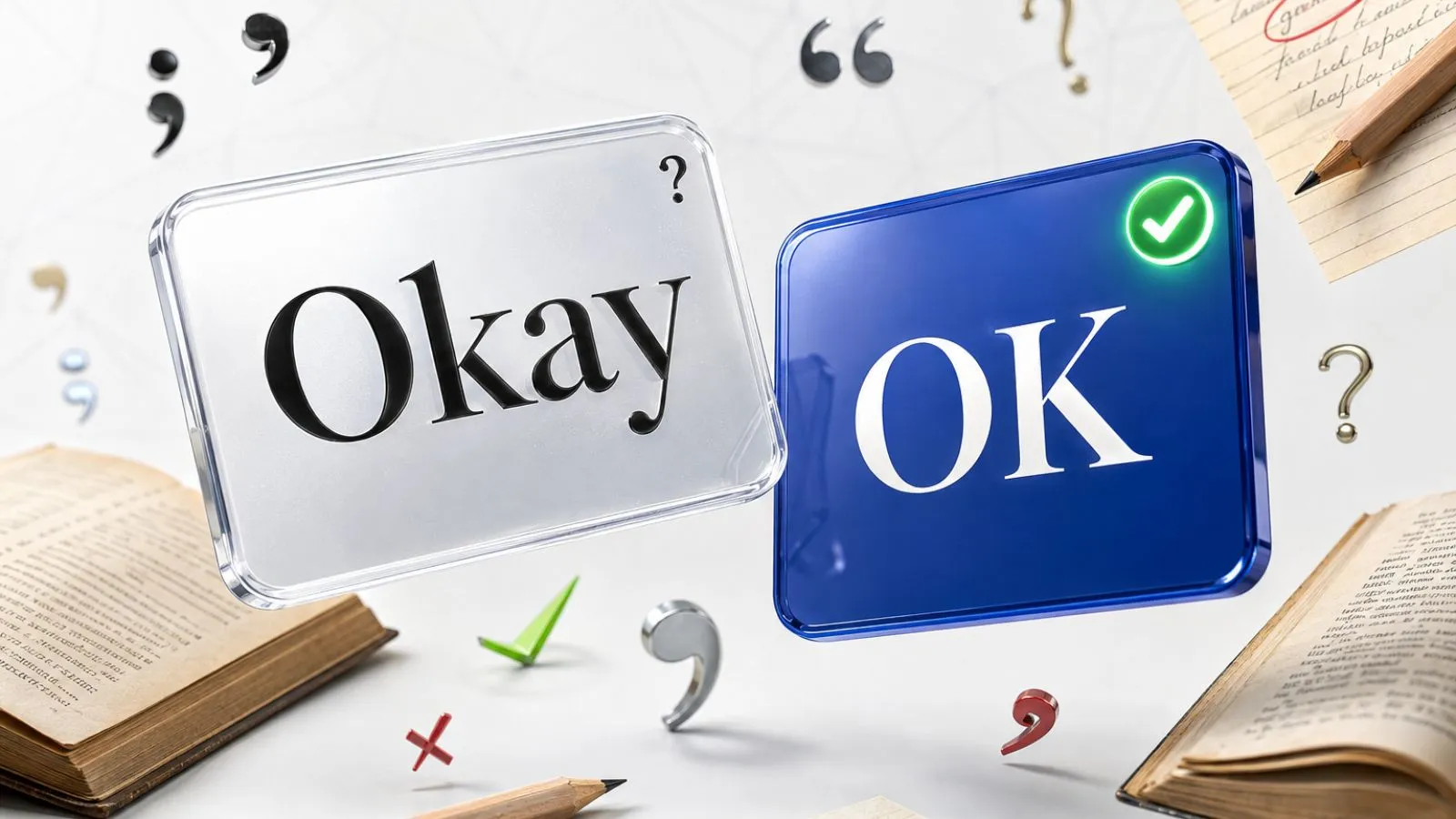
Okey or okay? These words have the same meaning, but okay is the standard and more widely accepted spelling.
Okey is less common and may appear in informal writing or specific names. Knowing the difference helps you choose the right form and write clearly.
In this guide, you’ll learn when to use okay and okey, common mistakes, clear examples, and an easy way to remember the correct spelling.
Quick Answer:
Okay and OK are both correct spellings. They can mean “fine,” “all right,” “acceptable,” or “agreed.” Okay is the full form, while OK is the shorter form.
For example, both “Okay, I understand” and “OK, I understand” are grammatically correct.
Okay vs. OK at a Glance
| Feature | Okay | OK |
| Correct spelling | Yes | Yes |
| Basic meaning | Fine, acceptable, agreed | Same |
| Form | Full spelling | Short form |
| Common use | General writing and conversation | Short replies, messages, signs, labels |
| Shows agreement | Yes | Yes |
| Describes a condition | Yes | Yes |
| Example | Okay, I’ll help. | OK, I’ll help. |
Quick rule: If you mean “fine,” “all right,” “acceptable,” or “agreed,” you can normally use either okay or OK.
What Does “Okay” Mean?
Okay is a versatile English word. Its meaning changes slightly according to context. It can mean:
- fine or well
- acceptable
- satisfactory
- agreed
- understood
- permitted
Consider these examples:
Are you okay?
Here, okay means fine or well.
The movie was okay.
Here, it means acceptable, but not especially good.
Okay, I’ll call you later.
Here, it expresses agreement.
Is it okay if I leave early?
Here, it means acceptable or permitted.
So, the word can do more than simply mean “good.”
What Does “OK” Mean?
OK has essentially the same meanings as okay. It is the shorter form.
OK, I’ll see you tomorrow.
Everything is OK now.
Is it OK if I use your phone?
You can replace OK with okay without changing the basic meaning:
Okay, I’ll see you tomorrow.
Everything is okay now.
Is it okay if I use your phone?
One important point: OK is not an incorrect spelling of okay. It is an established English form used in speech and writing.
How Do You Use “Okay” in a Sentence?
1. To Show Agreement or Understanding
Okay can show that you understand, accept, or agree with something.
“I’ll send the report this afternoon.”
“Okay.”
“Please wait here until I return.”
“Okay, I will.”
The speaker’s tone can also affect the meaning. “Okay!” may sound enthusiastic, while a simple “okay” may only acknowledge information.
2. To Move to a New Topic
In conversation, okay can introduce the next step or topic.
Okay, let’s start the meeting.
Okay, now let’s discuss the final question.
It can also help end a conversation:
Okay, take care. I’ll call you tomorrow.
3. To Check Understanding or Agreement
Okay? can appear at the end of a sentence when someone wants confirmation.
We’ll meet outside the library at six, okay?
Please send the report before Friday, okay?
Depending on the situation, this can mean “Do you understand?”, “Do you agree?”, or “Is that acceptable?”
Okay as an Adjective
Okay commonly works as an adjective meaning fine, all right, or satisfactory.
I’m okay, thanks.
Everything is okay now.
The plan is okay.
It can describe someone’s health or condition:
“How are you feeling?”
“I’m okay, thanks.”
It can also describe quality:
The restaurant was okay, but the service was excellent.
Here, okay means satisfactory rather than excellent. It does not necessarily mean something is bad.
Okay as an Adverb, Noun, and Verb
In informal English, okay can also perform other grammatical roles.
As an adverb
It can mean reasonably well or satisfactorily:
Did you sleep okay?
The printer is working okay now.
In formal writing, a more precise word may sometimes be preferable.
As a noun
Okay can mean approval or permission:
I need my manager’s okay before publishing the report.
In formal writing, approval may be clearer:
I need my manager’s approval before publishing the report.
As a verb
Okay can mean to approve or authorize something:
The manager okayed the proposal.
The editor okayed the final version.
In formal business writing, approved is often more precise.
Okay or OK: Which One Should You Use?
There is no grammar rule requiring you to choose one form over the other.
Use okay when:
- You prefer the full spelling.
- You are writing general prose.
- You want a natural conversational tone.
- You want to avoid abbreviations.
Use OK when:
- You want a short response.
- Space is limited.
- You are writing a sign or label.
- You are using a brief reply.
For example:
Okay, I’ll be there. ✅
OK, I’ll be there. ✅
Both are correct.
Is “Okay” Appropriate in Formal Writing?
Okay is standard English, but it can sound conversational or slightly vague. In formal, academic, or professional writing, a more specific word may sometimes communicate your meaning better.
Compare:
The results were okay.
with:
The results were satisfactory.
Or:
The proposal was okay.
with:
The proposal was approved.
The first sentences are not grammatically wrong. They simply provide less precise information.
Common Mistakes With Okay and OK
Mistake 1: Thinking Only “Okay” Is Correct
❌ OK is wrong.
✅ OK and okay are both correct.
Mistake 2: Thinking “Okay” Always Means “Good”
The movie was okay.
This usually means it was acceptable but not outstanding.
Mistake 3: Using “Okay” When You Need Precision
The application is okay.
This could mean approved, acceptable, complete, or correct. If you know the exact meaning, say it directly:
The application has been approved.
Mistake 4: Assuming They Have Different Meanings
They normally do not.
Okay, let’s go.
OK, let’s go.
Both express agreement or readiness.
10 Examples of Okay and OK
- “Okay, I’ll meet you after work.” — agreement
- “Are you okay after the trip?” — asking about someone’s condition
- “Is it okay if I use your phone?” — asking permission
- “The movie was okay, but the ending was weak.” — acceptable quality
- “OK, let’s move on to the next question.” — moving forward
- “Everything is OK now.” — saying a situation is fine
- “I’ll send the file tonight, okay?” — checking agreement
- “The printer is working okay again.” — describing performance
- “We need the director’s okay before publishing it.” — approval
- “The editor okayed the final version.” — approval as a verb
Memory Trick
Remember this simple equation:
OK = Okay
Think of OK as the shorter form of okay. Neither spelling needs to be corrected to the other.
Okay ✅
OK ✅
The choice is mainly about style and context.
Mini Quiz
1. Which sentence is correct?
A. Okey, I’ll call you later.
B. Okay, I’ll call you later.
C. Okee, I’ll call you later.
D. Okae, I’ll call you later.
Answer: B. Okay, I’ll call you later.
2. Which shorter form is also correct?
A. Okey
B. Okee
C. OK
D. Oka
Answer: C. OK
3. What does “The movie was okay” usually mean?
B. It was acceptable but not excellent.
C. It was terrible.
D. It was canceled.
Answer: B. It was acceptable but not excellent.
4. Which sentence asks for permission?
A. I am okay.
B. The plan is okay.
C. Is it okay if I leave early?
D. Okay, let’s begin.
Answer: C. Is it okay if I leave early?
5. Which sentence uses “okay” as a verb?
A. I’m okay.
B. The movie was okay.
C. The manager okayed the request.
D. Okay, let’s go.
Answer: C. The manager okayed the request.
FAQs
Is “okay” or “OK” correct?
Both okay and OK are correct. They generally have the same meaning and can express agreement, acceptance, understanding, or a satisfactory condition.
Okay is the full spelling, while OK is the shorter form. The choice usually depends on context, style, and personal preference rather than grammatical correctness.
Is “OK” more informal than “okay”?
Both forms are common in everyday English. OK often feels shorter and more convenient, which makes it especially common in brief replies, messages, signs, and labels.
Okay is also natural in conversation and general writing. The difference is mainly stylistic; neither form is grammatically incorrect.
Can I use “okay” in formal writing?
Yes, but consider whether it gives enough detail. Okay is standard English, yet it can sound conversational or vague in some formal contexts.
Depending on the intended meaning, words such as acceptable, satisfactory, approved, permitted, or appropriate may provide greater precision.
Is “okay” an adjective or an adverb?
Okay can have several grammatical roles. It works as an adjective in “I’m okay” and as an adverb in informal expressions such as “The machine works okay.”
It can also function as a noun, verb, and discourse marker. Its grammatical role depends on how it is used in the sentence.
Does “okay” always mean “good”?
No. Okay often means acceptable or satisfactory, rather than good or excellent.
For example, “The restaurant was okay” usually suggests that the experience was neither terrible nor outstanding. Tone and context can make the word sound neutral, mildly positive, or slightly negative.
Key Takeaways
- Okay and OK are both correct.
- OK is the shorter form of okay.
- Both can express agreement, understanding, or acceptance.
- Okay can describe someone’s condition or something’s quality.
- Is it okay…? commonly asks for permission.
- Okay? can check understanding or agreement.
- Okay can function as an adjective, adverb, noun, verb, and discourse marker.
- In formal writing, a more precise word may sometimes be better.
- Okay vs. OK is a style choice, not a correct-versus-incorrect spelling issue.
Conclusion
When choosing between okay or OK, remember that both forms are correct. Okay is the full spelling, while OK is the shorter form, and both can mean “fine,” “all right,” “acceptable,” or “agreed.”
Use the form that fits your context and style. When formal writing calls for greater precision, choose a more specific word when appropriate.

William Strunk is a respected authority on English grammar, usage, and writing style, known for his influential work The Elements of Style. At EduNexxa, his focus is on clear, concise, and effective English.
 Mignon Fogarty
 Bryan Garne