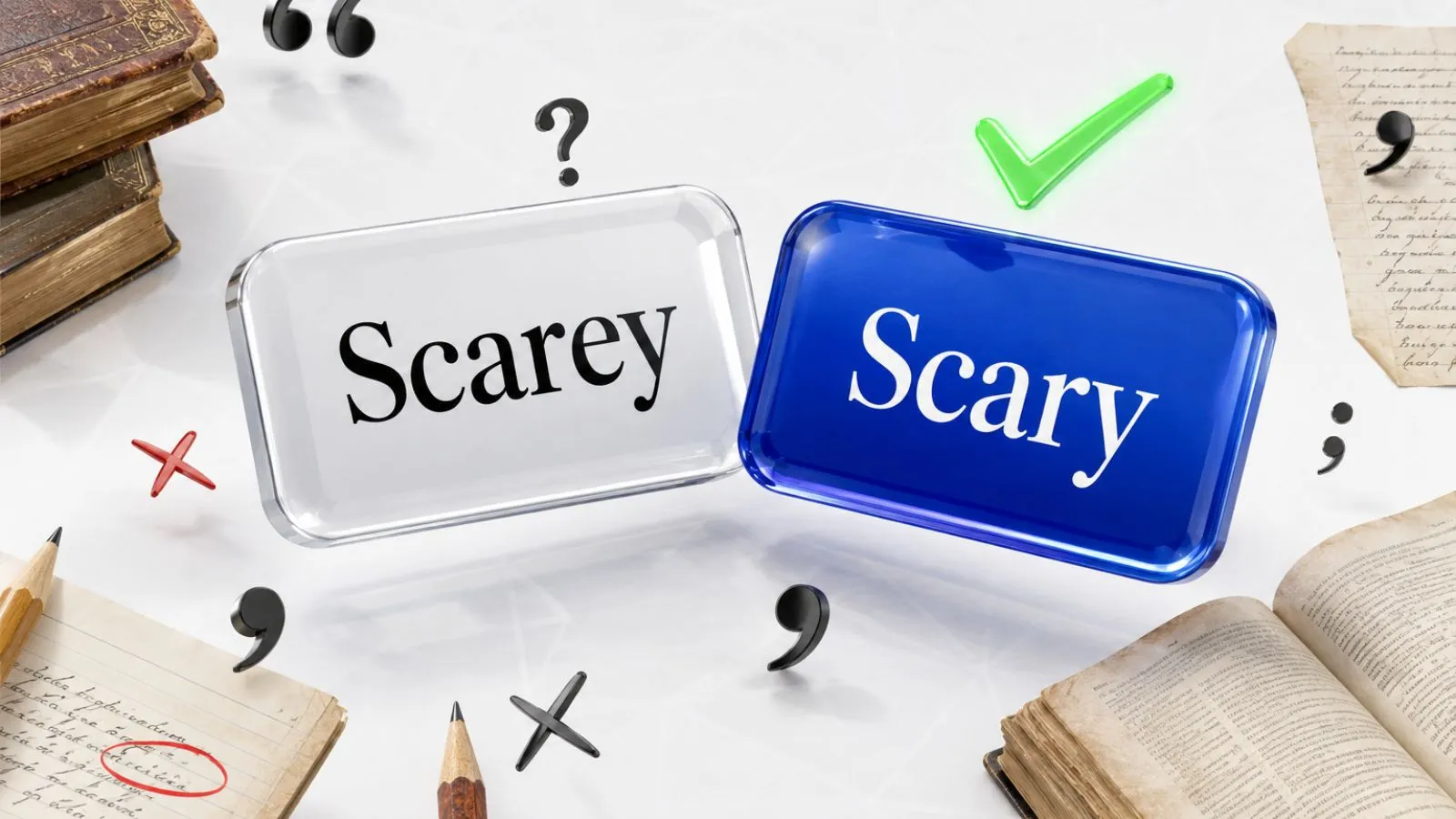
Scarey or scary? These two spellings are easy to confuse, but only one is correct. Scary is the standard spelling for something that causes fear or makes you feel afraid. Scarey is a common misspelling and should be avoided in formal writing.
In this guide, you will learn the difference between scarey and scary, how to use the correct spelling, common mistakes, clear examples, and an easy way to remember it
Quick Answer:
Scary is the correct spelling in standard English. It means “causing fear or making someone feel frightened.”
Scarey is a common misspelling and should be avoided in standard American and British English. For example, write “That movie was scary,” not “That movie was scarey.”
Scary vs. Scarey: Quick Comparison
| Feature | Scary | Scarey |
| Standard spelling | ✅ Correct | ❌ Incorrect |
| Part of speech | Adjective | — |
| Meaning | Causing fear or alarm | Usually intended to mean scary |
| US English | ✅ Standard | ❌ Not standard |
| British English | ✅ Standard | ❌ Not standard |
| Example | That was a scary movie. | That was a scarey movie. ❌ |
| Memory tip | Scare + y = scary | Extra e is unnecessary |
What Does “Scary” Mean?
Scary is an adjective that describes something that causes fear, nervousness, or worry.
For example:
- That movie was scary.
- It was scary to walk home alone at night.
- The dog looked scary, but it was friendly.
- Driving through the storm was scary.
The word comes from the verb scare, which means to frighten someone.
Scary in Different Situations
Something can be scary because it is dangerous, frightening, unexpected, or simply makes you uncomfortable.
The loud noise was scary.
Losing control of the car was a scary experience.
Some people find horror movies scary.
What Does “Scarey” Mean?
In standard modern English, scarey is not the accepted spelling of the adjective.
If you mean something that causes fear, write:
❌ The movie was scarey.
✅ The movie was scary.
❌ That was a scarey experience.
✅ That was a scary experience.
You may occasionally find scarey in informal writing, old texts, or as a simple spelling mistake, but it is not the standard form you should use in school, professional, academic, or published writing.
Why Is “Scarey” a Common Mistake?
The confusion comes from the spelling of scare.
People may naturally think:
scare + y = scarey
But English spelling changes the final e in this case.
The correct pattern is:
scare → scary
Compare:
- scare → scary
- care → caring but careful
- noise → noisy
- easy → easily
For scary, simply remember that the final e in scare disappears before -y.
Scary or Scared: What Is the Difference?
This is another common confusion.
Scary describes something that causes fear.
The horror movie was scary.
Scared describes how a person or animal feels.
I was scared during the horror movie.
A useful way to remember it:
Scary = causes the feeling.
Scared = experiences the feeling.
Compare:
The thunderstorm was scary.
The child was scared.
Scary vs. Scarey: Common Mistakes
Mistake 1: Adding an Extra E
❌ The haunted house was scarey.
✅ The haunted house was scary.
Mistake 2: Confusing Scary With Scared
❌ I am very scary.
✅ I am very scared.
Unless you mean that you frighten other people, scared is usually the word you need when talking about your own fear.
Mistake 3: Assuming “Scarey” Is an Alternative Spelling
Scarey may look reasonable because it seems to follow scare + y, but standard English uses scary.
10 Examples of “Scary”
- The movie was much scarier than I expected.
- That noise outside sounded scary.
- Walking through the dark forest at night can be scary.
- The storm became scary when the wind grew stronger.
- She told us a scary story around the campfire.
- The accident was a scary experience for everyone involved.
- Some children find thunderstorms scary.
- The abandoned building looked scary from the outside.
- It was scary to hear someone knocking at the door so late.
- The ending of the book was surprisingly scary.
Grammar: How to Use “Scary”
Scary is an adjective, so it describes a noun or follows linking verbs such as be, seem, and look.
Before a Noun
It was a scary experience.
We watched a scary movie.
After a Linking Verb
The story was scary.
That place looks scary at night.
Comparative and Superlative Forms
The comparative form is scarier:
This movie is scarier than the first one.
The superlative form is scariest:
That was the scariest scene in the movie.
Notice that the y changes to i before -er and -est:
scary → scarier → scariest
A Simple Memory Trick
Remember:
Scare + y = scary, not scarey.
Think of the word as:
SCAR + Y = SCARY
There is only one e in the root-related spelling you need to remember? Better yet, memorize the whole word:
SCARY has no E after the R.
If you write scarey, remove the e:
❌ scarey
✅ scary
Mini Quiz
1. Which spelling is correct?
A. Scarey
B. Scary
C. Scarry
D. Scarie
Answer: B. Scary
2. That was a ___ movie.
A. scarey
B. scary
C. scared
D. scaried
Answer: B. scary
3. I was ___ when I heard the noise.
A. scary
B. scarey
C. scared
D. scaring
Answer: C. scared
4. What is the comparative form of “scary”?
A. Scareyer
B. Scariier
C. Scarier
D. More scarey
Answer: C. Scarier
5. Which sentence is correct?
A. The haunted house was scarey.
B. The haunted house was scary.
C. The haunted house was scared.
D. The haunted house was scarry.
Answer: B. The haunted house was scary.
FAQs
Is “scarey” a correct spelling?
No. Scary is the standard spelling in modern English.
Scarey is generally treated as a misspelling and should be avoided in formal, academic, professional, and published writing. If you mean something that causes fear or makes someone feel frightened, use scary.
Why is “scary” spelled without an E?
Although the word comes from scare, the standard adjective is spelled scary, not scarey.
English word formation does not always work by simply adding a suffix to the unchanged spelling of a base word. The accepted modern form is scary, so it is best to memorize the spelling directly.
Is “scary” an adjective?
Yes. Scary is an adjective because it describes something that causes fear or alarm.
For example, in “The movie was scary,” the word scary describes the movie. You can also use it before a noun, as in “a scary story” or “a scary situation.”
What is the difference between “scary” and “scared”?
Scary describes something that causes fear, while scared describes the person or animal experiencing fear.
For example, “The dog looked scary” means the dog caused fear, while “I was scared” means I felt afraid. Remember: scary causes the feeling; scared experiences it.
Is “scary” used in American and British English?
Yes. Scary is the standard spelling in both American and British English.
There is no normal US-versus-UK spelling difference here. In both varieties, scary is correct and scarey should generally be treated as a spelling error.
Key Takeaways
- Scary is the correct spelling.
- Scarey is generally a misspelling.
- Scary is an adjective meaning “causing fear.”
- Use scared for someone who feels afraid.
- The comparative form is scarier.
- The superlative form is scariest.
- The correct spelling is scary, not scarey.
- Remember: Scare + y → scary.
Conclusion
When choosing between scarey or scary, always use scary in standard English. It is the adjective used for something that causes fear or makes you feel frightened.
Scarey is not the standard spelling. If you remember one thing, make it this: scary has no extra E.

Mignon Fogarty is an experienced English grammar and writing expert specializing in grammar, word usage, and clear American English. At EduNexxt, her focus is making grammar simple, accurate, and practical.
 Bryan Garne