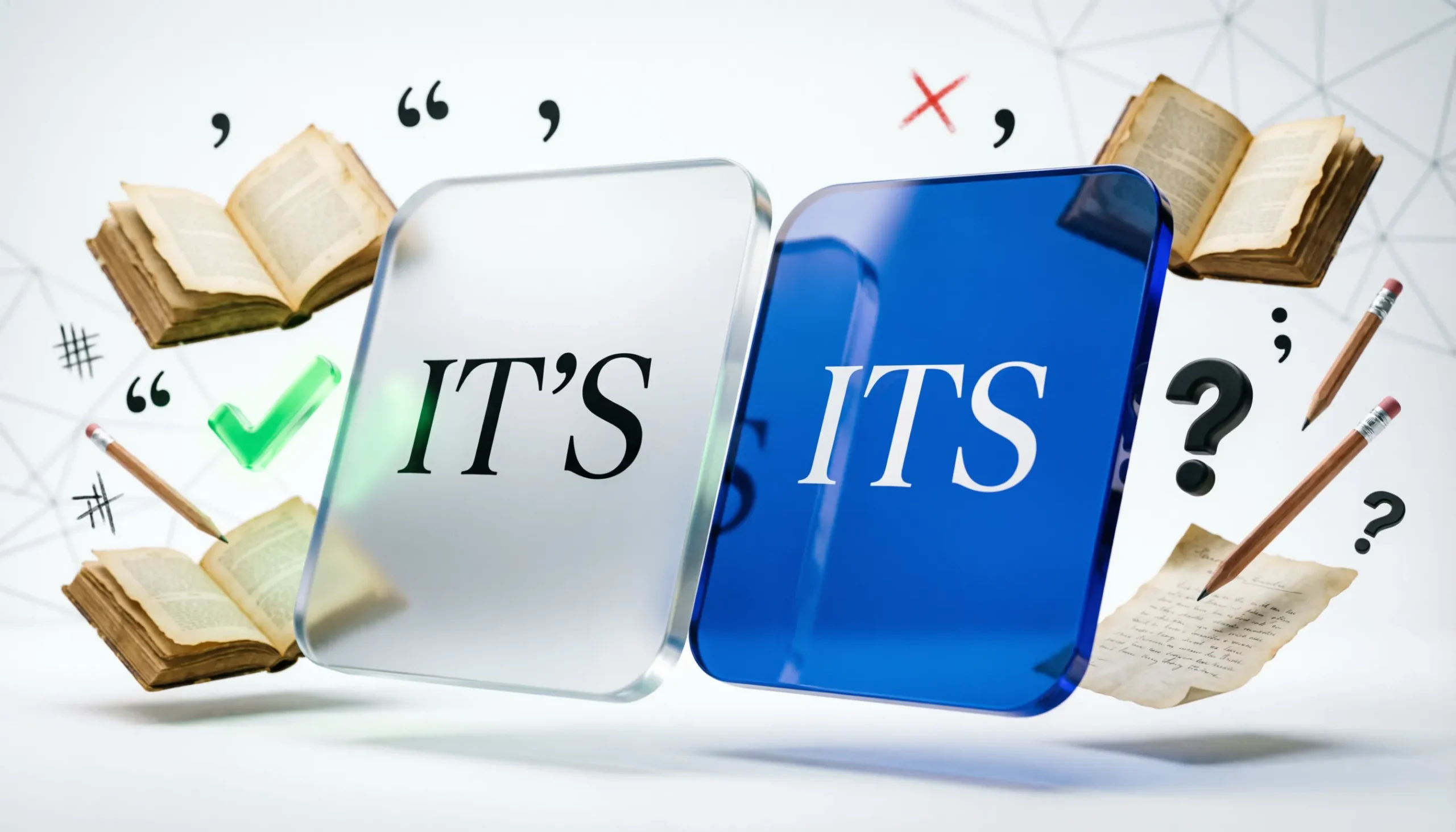
It’s or its? These two forms look almost identical, but that small apostrophe changes their meaning and grammar. It’s is a contraction of “it is” or “it has,” while its is a possessive form showing that something belongs to or is connected with something else. Because the difference is easy to miss, writers often confuse them in emails, essays, and everyday writing.
In this guide, you will learn when to use it’s or its, how to tell them apart, and simple examples that make the correct choice easy to remember.
Quick Answer :
It’s is a contraction of it is or it has. Its is a possessive determiner meaning “of it” or “belonging to it.”
Use the apostrophe only in it’s when it represents missing letters. If you can replace it’s with it is or it has, it’s is correct.
Comparison Table :
| Feature | It’s | Its |
| Meaning | It is / it has | Of it / belonging to it |
| Grammar | Contraction | Possessive determiner |
| Apostrophe | Yes | No |
| Main use | Shortens it is or it has | Shows possession or association |
| Example | It’s getting late. | The dog wagged its tail. |
| Quick test | Replace with it is or it has | Ask whether something belongs to or relates to “it” |
| Common mistake | Using it’s to show possession | Adding an apostrophe to its |
| Incorrect form | — | its’ is incorrect in standard modern English |
| Pronunciation | Usually /ɪts/ | Usually /ɪts/ |
| Memory tip | It’s = it is / it has | Its = belonging to it |
Cambridge Grammar identifies it’s as the contracted form of it is or it has and its as a possessive determiner.
What Does “It’s” Mean?
It’s has two possible meanings:
- It is
- It has
The apostrophe tells us that letters have been removed.
It’s = It Is
Use it’s when you could write it is instead.
- It’s cold outside.
→ It is cold outside. - It’s important to check your work.
→ It is important to check your work. - It’s a difficult question.
→ It is a difficult question. - It’s already too late.
→ It is already too late.
It’s = It Has
It’s can also mean it has, particularly when has is part of a perfect verb construction.
- It’s been a busy week.
→ It has been a busy week. - It’s changed considerably.
→ It has changed considerably. - It’s already happened.
→ It has already happened.
Cambridge gives both “it is” and “it has” as the expanded forms of it’s.
The Important Rule
If it’s does not mean it is or it has, you probably need its instead.
What Does “Its” Mean?
Its shows that something belongs to, comes from, or is associated with something already mentioned.
It can usually be understood as:
of it
belonging to it
Examples:
- The dog hurt its paw.
- The company changed its policy.
- The tree lost its leaves.
- The computer lost its connection.
- The school updated its website.
Cambridge describes its as a possessive determiner used before a noun, similar to my, your, his, and their.
Why Doesn’t “Its” Have an Apostrophe?
This is where many writers make the wrong assumption.
English often uses ’s to show possession:
- Sarah’s book
- the dog’s collar
- the company’s website
So it may seem logical to write it’s when something belongs to “it.”
But its is already a possessive form. It works like his, her, our, and their, so it does not need an apostrophe.
Compare:
The company changed its name.
Not:
The company changed it’s name.
Cambridge specifically notes that possessive its does not take an apostrophe. It’s or Its: The Fastest Way to Choose
Use the replacement test.
Step 1: Replace the word with “it is.”
It’s getting dark.
→ It is getting dark. ✓
So it’s is correct.
Step 2: If that fails, try “it has.”
It’s been a great experience.
→ It has been a great experience. ✓
Again, it’s is correct.
Step 3: If neither works, check for possession.
The company improved its service.
Try:
The company improved it is service. ✗
That does not work.
The service is associated with the company, so its is correct.
The Rule to Remember
It’s = it is / it has
Its = belonging to it
This is the simplest reliable test for most sentences.
Why Are It’s and Its So Easy to Confuse?
There are three main reasons.
1. They Sound the Same
In standard English, it’s and its are normally pronounced the same way, /ɪts/. That means you cannot depend on pronunciation to decide which spelling is correct.
You have to look at the sentence’s meaning and grammatical structure.
2. Apostrophes Usually Suggest Possession
Learners often learn:
apostrophe + s = possession
That rule works for many nouns:
the teacher’s desk
Maria’s phone
the company’s office
But it does not apply to possessive its.
3. “It’s” Looks Like Other Possessive Forms
Forms such as John’s and the dog’s can make it’s look possessive. But in modern standard English, it’s is a contraction, not the normal possessive form.
Common Mistakes With It’s and Its
Mistake 1: “It’s” for Possession
❌ The company updated it’s website.
✅ The company updated its website.
The website belongs to or is associated with the company.
Mistake 2: “Its” Instead of “It’s”
❌ Its important to arrive early.
✅ It’s important to arrive early.
Here, it’s means:
It is important to arrive early.
Mistake 3: “Its’”
❌ The animal injured its’ leg.
✅ The animal injured its leg.
Its’ is not the standard possessive form. The correct possessive spelling is simply its.
Mistake 4: Choosing by Sound
Because it’s and its normally sound alike, listening for the difference will not solve the problem.
Instead, perform the replacement test.
When Should You Use It’s or Its?
In Academic Writing
Both forms can be grammatically correct.
It’s difficult to determine the cause.
The study presents its findings in the final section.
In especially formal academic writing, you may choose it is instead of it’s, depending on the required style. That does not change the rule for its.
In Professional and Business Writing
Use its to show association or possession:
The company revised its hiring policy.
Use it’s when you mean it is or it has:
It’s important to review the agreement.
In Emails
Both forms appear naturally:
It’s great to hear from you.
The team has completed its review.
In Everyday Conversation
Contractions are especially common:
It’s getting late.
It’s been a long day.
But possession still requires its:
The dog is playing with its toy.
10 Original Examples
- School: The university updated its admission requirements.
- Workplace: It’s important to complete the report today.
- Business: The company expanded its services last year.
- Conversation: It’s been a long time since we met.
- Books: The novel is famous for its unusual ending.
- News: It’s unclear whether the agreement will continue.
- Social Media: It’s finally time for the weekend!
- Everyday English: The cat is licking its paws.
- Technology: The application lost its connection to the server.
- Nature: The tree has lost its leaves after the storm.
Notice how the meaning determines the spelling—not the sound.
A Better Memory Trick
Think of the apostrophe in it’s as a signal that something has been shortened.
It’s → it is
It’s → it has
But:
Its → belonging to it
You can also compare its with other possessive forms:
- my
- your
- his
- her
- our
- their
- its
These possessive determiners do not need an apostrophe.
One-Sentence Memory Trick
If you can say “it is” or “it has,” use it’s; if something belongs to it, use its.
A Quick Test
Choose the correct word in each sentence:
- ___ raining outside.
- The company changed ___ logo.
- ___ been a difficult month.
- The dog hurt ___ paw.
- ___ important to read the instructions.
Answers
- It’s — It is raining outside.
- Its — the logo belongs to the company.
- It’s — It has been a difficult month.
- Its — the paw belongs to the dog.
- It’s — It is important to read the instructions.
Is “Its” a Possessive Pronoun?
This point deserves a little precision.
Its is commonly described as a possessive form, but when it comes directly before a noun, grammar references such as Cambridge classify it as a possessive determiner:
its color
its purpose
its name
Unlike mine or yours, its is not normally used alone to answer a possession question.
For example:
Whose ball is this?
The dog’s. ✓
Not:
Its. ✗
Cambridge notes that its is normally used as a possessive determiner and is generally avoided as a standalone possessive pronoun except in expressions such as “of its own.”
Is the Rule Different in American and British English?
No. The basic distinction is the same in standard American and British English:
- it’s = it is / it has
- its = possessive determiner
The main variation you may notice is stylistic. Some formal writing uses fewer contractions and may prefer it is over it’s. The spelling and grammatical distinction between it’s and its, however, remains the same.
FAQs
Is “it’s” possessive?
No. In modern standard English, it’s is a contraction meaning it is or it has. Its, without an apostrophe, is the possessive form. For example, “It’s cold” means “It is cold,” while “The dog hurt its paw” shows that the paw belongs to the dog.
Is “its” always used before a noun?
Its is normally used before a noun as a possessive determiner: its name, its color, its purpose, or its owner. It is not normally used alone as a possessive pronoun. For example, we say “The dog wagged its tail,” rather than using its by itself to answer “Whose?”
Is “its’” ever correct?
No. Its’ is not the standard modern English form. Use its when showing possession or association, and use it’s when you mean it is or it has. For example, “The company changed its policy” is correct, while “The company changed its’ policy” is incorrect.
How can I remember the difference between it’s and its?
Use the replacement test. If you can replace the word with it is or it has, use it’s. If neither expansion works and the word shows that something belongs to or relates to something else, use its. This simple test works in most everyday and professional sentences.
Are it’s and its pronounced the same?
Yes, they are normally pronounced the same in standard English, /ɪts/. Because they are homophones, pronunciation does not tell you which spelling to choose. The correct form depends on grammar and meaning. Look at the sentence and ask whether you mean it is/it has or belonging to it.
Key Takeaways
- It’s is a contraction of it is or it has.
- Its is a possessive determiner.
- Its means “of it” or “belonging to it.”
- Its does not need an apostrophe.
- Its’ is incorrect in standard modern English.
- It’s and its are normally pronounced the same.
- Use the “it is / it has” test when you are unsure.
- If the word shows possession or association, use its.
- The basic rule is the same in American and British English.
- In formal writing, it is may sometimes be preferred over it’s, but its remains the correct possessive form.
Conclusion
The difference between it’s or its comes down to one simple grammatical distinction.
It’s means it is or it has, while its shows possession or association. The apostrophe in it’s marks the missing letters in the contraction; it does not indicate possession.
When you are unsure, use the quickest test: replace it’s with it is or it has. If the sentence works, keep the apostrophe.
If you are describing something that belongs to or is associated with something else, use its. This simple habit can eliminate one of the most common word-choice mistakes in English.
Popular in Grammar & Usage
- Quite or Quiet: Which Word Is Correct in English(2026)?
- Are or Is: Which Verb Is Correct in English Grammar(2026)?
- Loath or Loathe: Which Word Is Correct in English(2026)?
Related More Articles
- Lose or Loose: Which One Is Correct (2026)?
- Desert or Dessert: Which Word Is Correct (2026)?
- Led or Lead: Learn the Difference With Simple Examples(2026)?

Mignon Fogarty is an experienced English grammar and writing expert specializing in grammar, word usage, and clear American English. At EduNexxt, her focus is making grammar simple, accurate, and practical.
 William Strunk
 info.asadblogger@gmail.com