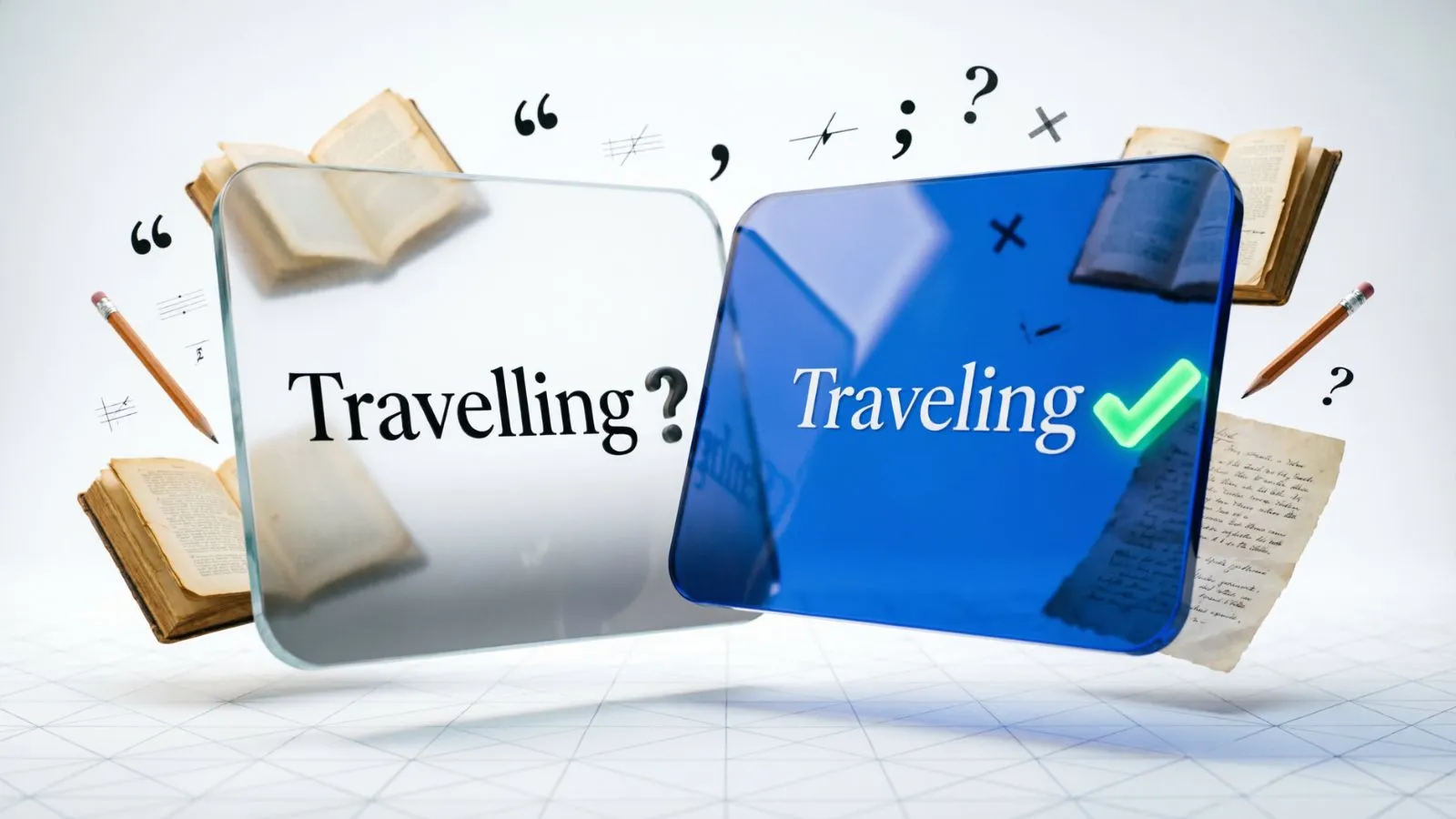
If you are unsure whether to write travelling or traveling, you are not dealing with two different words. Both spellings are correct, but “traveling” is the standard form in American English, while “travelling” is more common in British English and other varieties that follow British spelling conventions. The difference is simply the number of l’s, not the meaning or pronunciation.
Quick Answer:
Traveling is the preferred spelling in American English. Travelling is the preferred spelling in British English and is also widely used in countries and regions influenced by British spelling. Both forms mean going from one place to another, and both can function as the present participle or gerund of travel.
Traveling vs. Travelling: Comparison Table
| Spelling | Common Usage | Meaning | Related Noun |
|---|---|---|---|
| Traveling | American English | Going from one place to another | Traveler |
| Travelling | British English and other British-influenced varieties | Going from one place to another | Traveller |
Regional preferences are not absolute. Both spellings are widely understood internationally.
What Does “Traveling” Mean?
Traveling is the -ing form of the verb travel. It means moving from one place to another, whether by car, plane, train, bus, or another form of transportation.
For example:
She is traveling to Chicago next week.
It can also be used as a gerund:
Traveling can teach you about different cultures.
The one-l spelling is the standard choice in American English.
What Does “Travelling” Mean?
Travelling has exactly the same meaning and grammatical function as traveling. It describes moving between places or spending time away from home.
They are travelling across Europe this summer.
The double-l spelling is standard in British English and is also common in several other varieties that use British spelling conventions.
Why Is It “Traveling” in American English but “Travelling” in British English?
The difference comes from regional spelling conventions.
American English generally uses:
travel → traveling
British English generally uses:
travel → travelling
The same difference appears in related words:
- traveler — American English
- traveller — British English
- traveled — American English
- travelled — British English
This is a spelling difference only. The meaning stays the same.
The broader spelling pattern is also seen in words such as cancel → cancelling/canceled, although English spelling rules can vary depending on the word and variety of English. For this reason, it is better to learn the standard spelling used by the variety of English you are writing.
When Should You Use Traveling or Travelling?
Choose traveling when you are writing in American English. This is the standard form for US readers and fits naturally with other American spellings such as traveler and traveled.
Choose travelling when you are following British English spelling conventions. It is common in the United Kingdom and in other English varieties influenced by British usage.
If you are writing for an international audience, either spelling can be understood. The most important rule is consistency. Do not switch between American and British spellings without a reason.
Common Mistakes
1. Thinking “travelling” is wrong
It is not wrong. Travelling is a standard spelling in British English.
2. Thinking “traveling” is only an informal spelling
It is not. Traveling is the standard American English spelling.
3. Mixing regional spellings
Avoid using traveling in one paragraph and travelling in another when you are following one variety of English. Keep related words consistent as well.
4. Assuming the extra “l” changes the meaning
It does not. Traveling and travelling have the same meaning and grammatical function.
Pronunciation
Traveling and travelling are pronounced essentially the same. The extra l in the British spelling does not add another syllable or create a different word.
The exact vowel sounds can vary slightly between American and British accents, but this is an accent difference rather than a difference between the two spellings.
Six Examples of Traveling and Travelling
- I am traveling to New York for a business conference.
- She enjoys traveling alone and discovering new places.
- They are traveling across the country by train.
- We are travelling to London next month.
- He loves travelling because he enjoys meeting new people.
- The family is travelling through Australia this summer.
Easy Memory Trick
Think about the number of l’s:
American English → traveling → one l
British English → travelling → two l’s
The same pattern appears in the related nouns:
traveler → American English
traveller → British English
So, if you are writing for a US audience, remember one l. If you are following British spelling, remember two l’s.
Mini Quiz
1. Which spelling is standard in American English?
A. Travelling
B. Traveling
C. Travelinng
D. Travling
2. Which spelling is commonly preferred in British English?
A. Traveling
B. Travelling
C. Travelin
D. Travellig
3. Do traveling and travelling have different meanings?
A. Yes
B. No
C. Only in formal English
D. Only in British English
4. Which sentence follows American English spelling?
A. She is travelling to Boston.
B. She is traveling to Boston.
C. She is travelinng to Boston.
D. She is travling to Boston.
5. What mainly causes the difference between traveling and travelling?
A. Different meanings
B. Different pronunciation
C. Regional spelling conventions
D. Different grammatical functions
Answers: 1-B, 2-B, 3-B, 4-B, 5-C
FAQs
Is it “travelling” or “traveling” in American English?
Traveling is the standard spelling in American English. It uses one l and follows the spelling convention used in the United States. The British form travelling, with two l’s, is also understood by American readers but is not the usual US spelling.
Is “travelling” British or American English?
Travelling is primarily associated with British English. It is also widely used in several countries and regions that follow or are influenced by British spelling conventions. American English generally uses traveling with one l.
Are traveling and travelling pronounced differently?
No. The two spellings are essentially pronounced the same. The extra l in travelling is a spelling difference rather than a difference in meaning or syllable count. American and British accents may have slightly different vowel sounds, but that is separate from the spelling.
Should I use traveling or travelling for an international audience?
Either form can work because both are widely understood. However, choose one spelling style and use it consistently. If your content primarily follows American English, use traveling. If it follows British English, use travelling.
Conclusion
Traveling and travelling are both correct spellings of the -ing form of travel. The main difference is regional: traveling is the standard American English form, while travelling is more common in British English and other varieties influenced by British spelling. The two forms have the same meaning and pronunciation. For clear, professional writing, choose the form that matches your audience and keep your spelling consistent throughout the piece.

Mignon Fogarty is an experienced English grammar and writing expert specializing in grammar, word usage, and clear American English. At EduNexxt, her focus is making grammar simple, accurate, and practical.
 William Strunk
 Bryan Garne