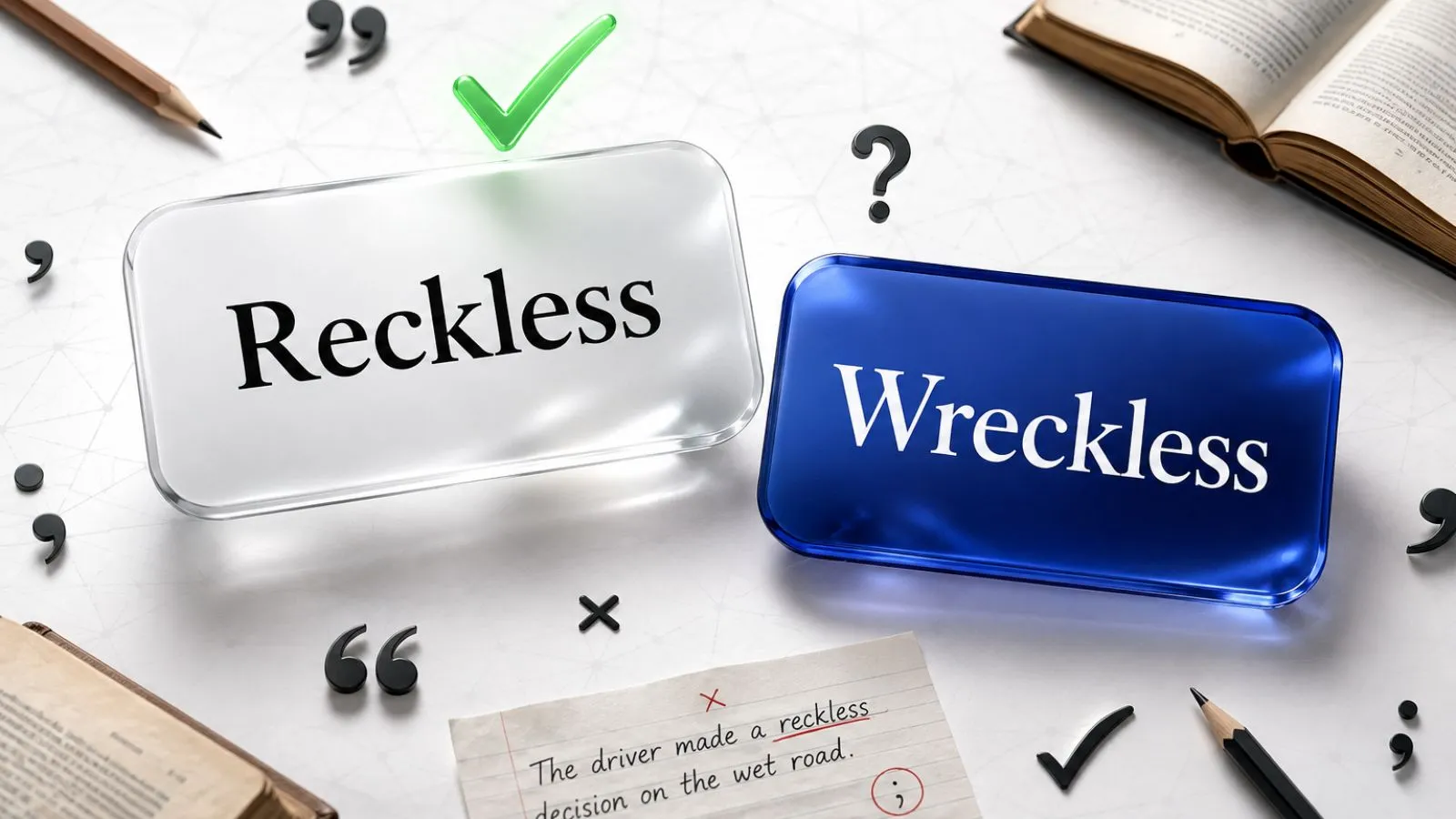
Reckless or wreckless? These words are easy to confuse, but only reckless is the standard English word. It means careless, dangerous, or lacking concern for safety. Wreckless is usually a misspelling, not a correct alternative.
In this guide, you will learn the difference between reckless and wreckless, how to use reckless correctly, common mistakes, clear examples, and an easy way to remember the right spelling.
Quick Answer:
Reckless is the correct standard English word for someone who acts without enough concern for danger, risk, or consequences. Wreckless is generally a misspelling of reckless.
Although wreckless may appear in creative names, slang, or wordplay, use reckless in standard, academic, professional, and formal writing.
Reckless vs. Wreckless at a Glance
| Feature | Reckless | Wreckless |
| Standard spelling | Yes | No, in this meaning |
| Meaning | Careless or unconcerned about consequences | Usually a misspelling of reckless |
| Part of speech | Adjective | Not standard as a synonym for reckless |
| Common use | Very common | Uncommon |
| Formal writing | Correct | Avoid |
| Pronunciation | /ˈrɛkləs/ | Usually intended to sound like reckless |
| Example | He made a reckless choice. | He made a wreckless choice. ❌ |
| Memory tip | Reckless = without care | Wreck = something damaged |
Simple rule
If you mean careless, dangerous, irresponsible, or willing to ignore consequences, use reckless.
His reckless driving put others at risk. ✅
His wreckless driving put others at risk. ❌
The fact that reckless behavior can cause a wreck does not change the spelling.
What Does “Reckless” Mean?
Reckless is an adjective that describes a person, action, or decision that shows little concern for danger or possible results.
For example:
It was reckless to drive so fast in heavy rain.
Here, reckless means dangerously careless.
It can also describe decisions involving unnecessary risk:
The company made a reckless financial decision.
The word does not only apply to physical danger. You can be reckless with money, words, decisions, behavior, or business plans.
His reckless comments caused unnecessary problems.
The main idea is simple: reckless behavior ignores risks or consequences that should reasonably be considered.
What Does “Wreckless” Mean?
In standard English, wreckless is generally not the correct spelling when you mean reckless.
The confusion usually comes from wreck, which means something that has been badly damaged or destroyed, such as a vehicle or ship.
The storm left the boat a wreck.
Because reckless actions can sometimes cause a wreck, wreckless may seem like a logical spelling. However, it is not the standard form of the adjective.
Reckless driving ✅
Wreckless driving ❌
You may occasionally see wreckless in creative writing, brand names, usernames, or intentional wordplay. Those special uses do not make it the standard spelling of reckless.
Why Is “Reckless” Spelled Without W?
The spelling makes more sense when you know a little about the word’s history.
Reckless is connected to the older word reck, which meant to care, heed, or take notice. The suffix -less means “without.”
So, the basic idea is without care or heed.
It is not formed from:
wreck + less
That is why adding a w creates the common spelling mistake.
You do not need to remember the history every time you write the word. Just remember that reckless and wreck are separate words.
How to Use “Reckless” Correctly
Reckless Driving
The driver was stopped for reckless driving.
This describes driving that shows serious disregard for safety.
Reckless Decisions
Quitting without another job lined up could be a reckless decision.
Here, the word highlights the unnecessary risk.
Reckless Behavior
His reckless behavior worried everyone around him.
The company apologized for the executive’s reckless statement.
In each example, reckless suggests that the person did not give enough thought to the possible consequences.
Reckless vs. Careless: What’s the Difference?
Reckless and careless are related, but they do not always have the same strength.
Careless usually means failing to pay enough attention or making a mistake because you did not take enough care.
I was careless and left my keys at home.
Reckless usually suggests a more serious disregard for danger or consequences.
He was reckless and ignored the safety warning.
So, an ordinary mistake may be careless, while knowingly taking a serious and unnecessary risk may be reckless.
This distinction is useful because reckless generally carries a stronger negative meaning.
Common Mistakes
1. Using “Wreckless” Because of “Wreck”
❌ He was driving wrecklessly.
✅ He was driving recklessly.
The possible result may be a wreck, but wreck is not part of the spelling of reckless.
2. Treating “Wreckless” as an Alternative Spelling
❌ That was a wreckless decision.
✅ That was a reckless decision.
In standard English, wreckless is not an alternative spelling for reckless.
3. Calling Every Mistake Reckless
Not every poor choice is reckless.
I was careless and forgot the meeting.
This does not necessarily suggest a serious disregard for danger.
4. Assuming “Wreckless” Can Never Appear
You may encounter wreckless in creative names, slogans, online usernames, or wordplay. In those cases, it may be intentional. But when writing standard English, choose reckless for the meaning of careless or dangerous.
8 Examples of Reckless
- The driver was arrested for reckless driving.
- It was reckless to ignore the warning signs.
- She made a reckless decision without considering the consequences.
- His reckless spending quickly reduced his savings.
- The company was criticized for its reckless business strategy.
- Posting someone’s private information online can be reckless.
- The player was punished for reckless behavior during the game.
- Making a serious accusation without evidence would be reckless.
Quick Decision Guide
Ask yourself:
Do you mean careless, dangerous, irresponsible, or unconcerned about consequences?
→ Reckless ✅
Do you mean something damaged or destroyed?
→ Wreck may be the word you need.
Are you using “wreckless” to mean careless or dangerous?
→ Use reckless instead. ✅
One sentence to remember
Reckless behavior can cause a wreck, but “reckless” is spelled without W.
Memory Trick
Remember:
Reckless = Less Care
Think of reckless as describing someone who shows little or no care about consequences.
Then keep wreck separate:
Reckless → careless or dangerous behavior
Wreck → something damaged or destroyed
This simple connection helps you remember both the spelling and the meaning.
Mini Quiz
1. Which spelling is correct?
A. Wreckless
B. Reckless
C. Reckles
D. Wrekless
Answer: B. Reckless
2. Which sentence is correct?
A. He was driving wrecklessly.
B. He was driving recklessly.
C. He was driving recklesly.
D. He was driving wreclessly.
Answer: B. He was driving recklessly.
3. What does “reckless” mean?
A. Very careful
B. Without proper concern for danger or consequences
C. Completely harmless
D. Well organized
Answer: B. Without proper concern for danger or consequences
4. Which sentence uses “reckless” correctly?
A. She made a reckless decision.
B. She made a wreckless decision.
C. She made a wreck decision.
D. She made a recles decision.
Answer: A. She made a reckless decision.
5. Which word refers to something damaged or destroyed?
A. Reckless
B. Reck
C. Wreck
D. Wreckless
Answer: C. Wreck
FAQs
Is “reckless” or “wreckless” correct?
Reckless is the correct standard spelling when you mean careless, dangerous, irresponsible, or unconcerned about consequences. Wreckless is generally a misspelling in this context.
Although you may see wreckless used creatively in names or slogans, use reckless in normal academic, professional, and formal writing.
Why do people spell reckless as “wreckless”?
The mistake often happens because reckless can describe dangerous behavior that may cause a wreck. That connection makes wreckless look reasonable.
However, the standard word is reckless, which is historically connected to the idea of being without care or heed, rather than being formed from wreck.
What does reckless mean?
Reckless means acting without enough concern for danger, risk, or possible consequences. It can describe driving, decisions, spending, behavior, statements, or strategies.
For example, reckless driving describes dangerous driving that shows little concern for safety, while a reckless decision involves unnecessary or poorly considered risk.
Is “wreckless” ever a real word?
You may encounter wreckless in creative writing, branding, usernames, or informal wordplay, but it is not the standard spelling of reckless. If you mean careless, dangerous, or irresponsible, use reckless.
In school, business, academic, and professional writing, reckless is the appropriate choice.
What is the difference between reckless and careless?
Both words describe a lack of care, but reckless is generally stronger. Careless can describe an ordinary mistake or lack of attention, while reckless often suggests serious disregard for danger or consequences.
Forgetting an appointment may be careless; knowingly ignoring an important safety risk may be reckless.
Key Takeaways
- Reckless is the correct standard spelling.
- Wreckless is generally a misspelling of reckless.
- Reckless means careless, dangerous, irresponsible, or unconcerned about consequences.
- It can describe driving, decisions, spending, behavior, statements, and strategies.
- Reckless usually has a stronger meaning than careless.
- Wreck is a separate word for something damaged or destroyed.
- Reckless does not come from wreck + less.
- Use reckless in standard, academic, professional, and formal English.
- Remember: Reckless = less care; wreck = something damaged.
Conclusion
The difference between reckless or wreckless is simple once you focus on meaning. Use reckless when describing behavior, decisions, or actions that show little concern for danger or consequences.
Wreckless is generally not the standard spelling of this adjective. Remember the key distinction: reckless means without proper care, while a wreck is something damaged or destroyed.

Mignon Fogarty is an experienced English grammar and writing expert specializing in grammar, word usage, and clear American English. At EduNexxt, her focus is making grammar simple, accurate, and practical.
 Bryan Garne