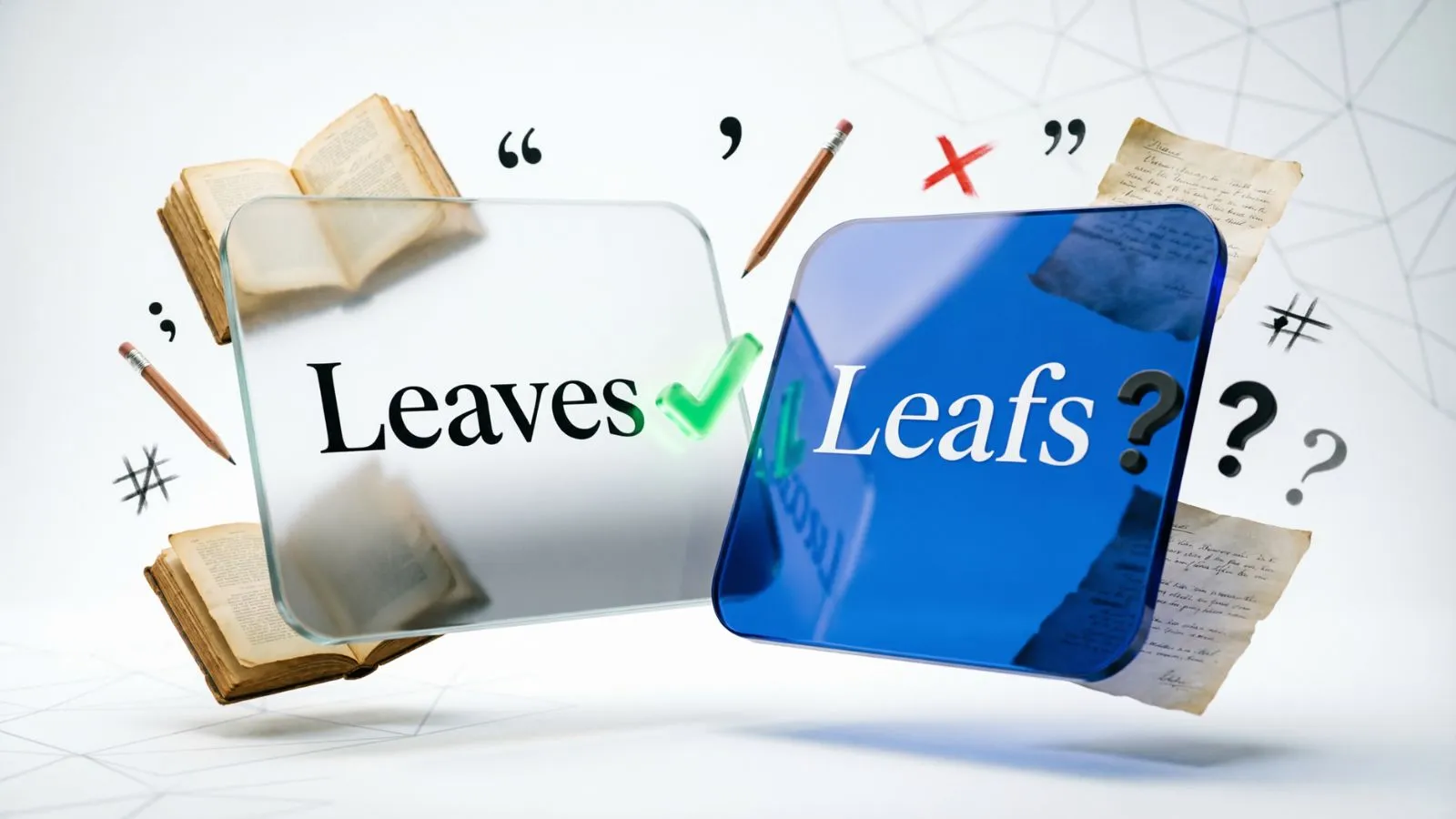
If you are unsure whether the plural of leaf is leafs or leaves, the answer is simple: leaves is the correct plural form of leaf. However, leafs is not always wrong. It is a correct verb form when someone turns or looks through the pages of a book or magazine.
Understanding these two uses will help you avoid a common English spelling and grammar mistake.
Quick Answer
Leaves is the standard plural of leaf when you mean more than one leaf. Leafs is used as the third-person singular form of the verb leaf, meaning to turn or look through pages. Also, leaves can be the verb form of leave, meaning “goes away.”
| Word | Part of Speech | Meaning | Example |
| leaf | Noun | One leaf | The leaf is green. |
| leaves | Plural noun | More than one leaf | The leaves are falling. |
| leafs | Verb | Turns or looks through pages | She leafs through the magazine. |
| leaves | Verb | Goes away or departs | He leaves at six. |
Leaves: The Correct Plural of Leaf
Leaves is the standard plural form of the noun leaf.
A leaf is the usually green, flat part of a plant or tree. When you are talking about more than one, use leaves.
- One leaf
- Two leaves
- Several leaves
For example:
The trees have lost most of their leaves.
The noun leaves can also refer to individual pages or sheets in a book, although this meaning is more common in formal or literary contexts.
Several leaves of the old book were damaged.
So, when leaf is a noun and you mean more than one, leaves is the correct choice.
Leafs: When Is It Correct?
Although leafs is not the standard plural noun of leaf, it is a legitimate English word when leaf is used as a verb.
As a verb, leaf means to turn or look through the pages of a book, magazine, newspaper, or similar publication.
Because leafs is the third-person singular present form, you can write:
She leafs through the magazine while waiting.
The verb forms include:
- I leaf through the book.
- You leaf through the book.
- He leafs through the book.
- They leaf through the book.
Therefore, saying that leafs is always incorrect would be inaccurate. It is incorrect when used as the ordinary plural of the noun leaf, but it is correct as a verb in the appropriate context.
Why Does Leaf Become Leaves?
The plural leaves follows a common English spelling pattern. Some nouns ending in -f or -fe change to -ves when they become plural.
For example:
- leaf → leaves
- knife → knives
- wife → wives
- life → lives
- wolf → wolves
In leaf → leaves, the final f changes to v, and -es is added.
However, this pattern does not apply to every noun ending in -f. Some simply take -s:
- roof → roofs
- chief → chiefs
- belief → beliefs
- chef → chefs
So, you should not assume that every word ending in -f must change to -ves.
Leaves Can Also Mean “Goes Away”
Another important source of confusion is that leaves is also the third-person singular form of the verb leave.
She leaves for work at 8 a.m.
Here, leaves means goes away or departs. It has nothing to do with plants or pages.
Compare these three sentences:
The tree has green leaves.
She leaves early every morning.
She leafs through the book.
The first uses leaves as the plural of leaf. The second uses leaves as a form of leave. The third uses leafs as a form of the verb leaf.
Common Mistakes
Using “leafs” as the plural of leaf
❌ The ground is covered with leafs.
✅ The ground is covered with leaves.
Confusing “leafs” with “leaves”
❌ He leaves through the magazine.
✅ He leafs through the magazine.
When you mean “turns or looks through pages,” the correct verb is leafs.
Assuming every -f word becomes -ves
❌ The building has several new rooves.
✅ The building has several new roofs.
The -f → -ves pattern has exceptions, so individual plural forms sometimes need to be learned separately.
Leafs or Leaves: Examples
- The autumn leaves covered the sidewalk.
- The gardener removed the dry leaves from the plants.
- She leafs through her favorite magazine every morning.
- Strong winds blew hundreds of leaves across the yard.
- He leafs through the book to find the right section.
- My brother leaves for school at seven every morning.
Pronunciation
The spelling difference also creates a difference in the final sound.
- leaf ends with an f sound.
- leaves ends with a v sound.
- leafs ends with an f sound.
So, leaves and leafs are not pronounced exactly the same. The plural leaves has a voiced v sound, while leafs keeps the f sound found in the singular word leaf.
Memory Trick
Use this simple rule:
One leaf → many leaves
Think LEAVES whenever you are talking about multiple leaves on trees or plants.
For LEAFS, remember pages:
She leafs through the book.
And remember that LEAVES has one more meaning:
He leaves at noon.
So:
Leaves = more than one leaf
Leafs = turns through pages
Leaves = also goes away
Mini Quiz
1. What is the correct plural of “leaf”?
A. Leafs
B. Leaves
C. Leafes
D. Leavs
Answer: B. Leaves
2. Which sentence is correct?
A. The tree has many leafs.
B. The tree has many leaves.
C. The tree has many leafes.
D. The tree has many leavs.
Answer: B. The tree has many leaves.
3. Which sentence correctly uses “leafs”?
A. She leaves through the magazine.
B. She leafs through the magazine.
Answer: B. She leafs through the magazine.
4. What does “He leaves at 6 p.m.” mean?
A. He collects leaves.
B. He turns pages.
C. He goes away at 6 p.m.
D. He plants a tree.
Answer: C. He goes away at 6 p.m.
5. Which pair is correct?
A. One leaf → two leafs
B. One leaf → two leaves
Answer: B. One leaf → two leaves
FAQs
Is “leafs” the plural of leaf?
No. Leaves is the standard plural of leaf. For example, “The tree has many leaves.” However, leafs is a correct English word when it is used as the third-person singular form of the verb leaf, meaning to turn or look through pages.
Why does leaf change to leaves?
Leaf changes to leaves because some English nouns ending in -f follow an -f → -ves plural pattern. This pattern is not universal, though. Words such as roof, chief, and belief normally form their plurals with -s.
Is “leafs” ever correct?
Yes. Leafs is correct when leaf is used as a verb meaning to turn or look through pages. For example, “She leafs through the newspaper.” It can also appear in proper names, such as the Toronto Maple Leafs, where Leafs is part of the official name.
What is the difference between leafs and leaves?
Leaves is the standard plural of leaf, while leafs is normally the verb meaning turns or looks through pages. Leaves can also be the third-person singular form of leave, meaning goes away. The sentence context determines which form and meaning is intended.
Conclusion
Leaves is the correct plural of leaf when you mean more than one leaf. Leafs is not the standard plural noun, but it is correct as a verb meaning to turn or look through pages. Remember leaf → leaves for multiple leaves and leafs through a book for the verb. This distinction makes the correct form easy to choose.
Related More Articles
- Chose or Choose: Which One Should You Use (2026)?
- Through or Threw: Which One Should You Use (2026)?
- Led or Lead: Learn the Difference With Simple Examples(2026)?

William Strunk is a respected authority on English grammar, usage, and writing style, known for his influential work The Elements of Style. At EduNexxa, his focus is on clear, concise, and effective English.
 Mignon Fogarty
 Bryan Garne