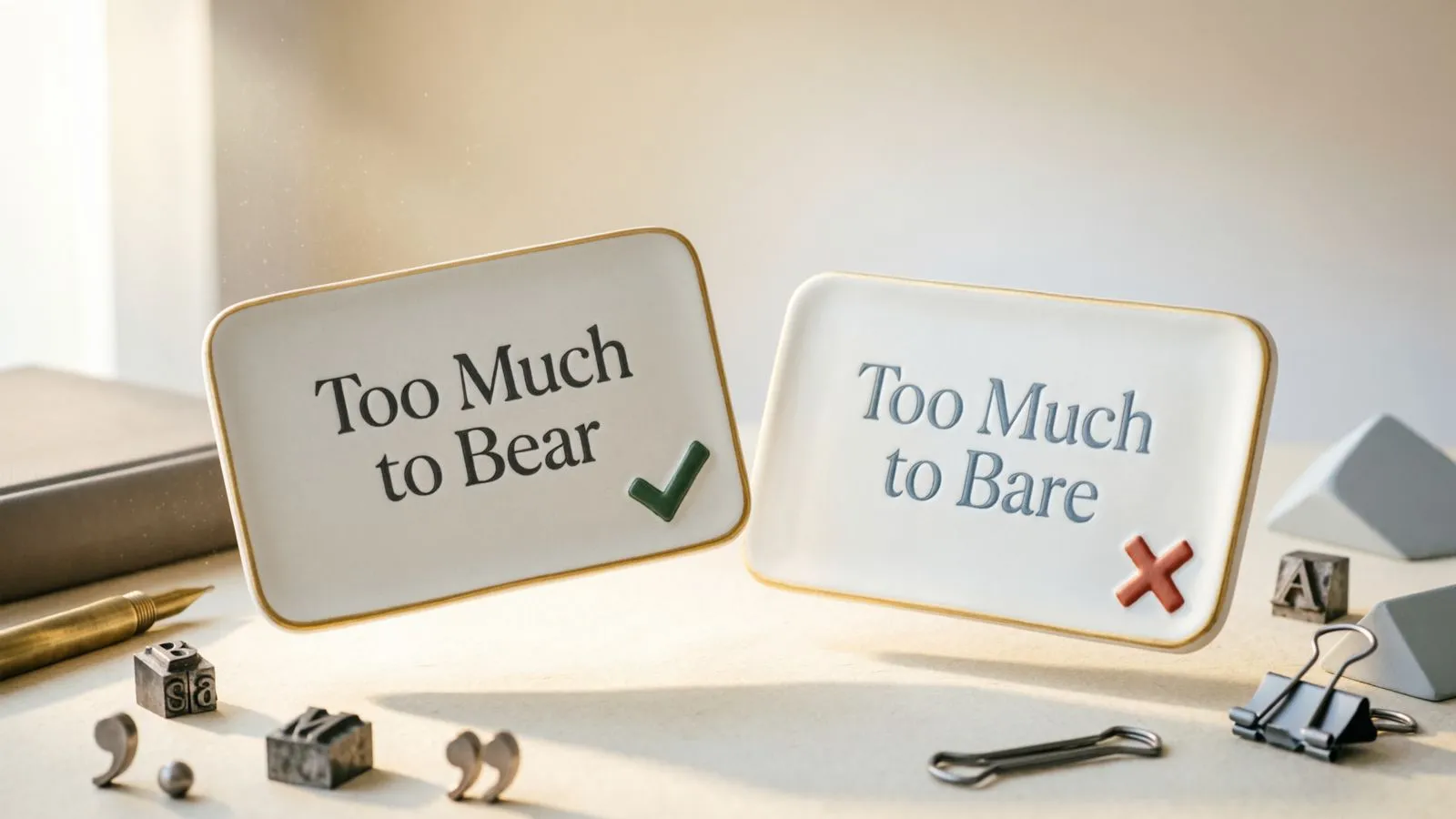
Have you ever written “too much to bare” and wondered if it should be bear? It’s an easy mistake because the words sound alike. The correct expression is “too much to bear.” Here, bear means to endure or handle something difficult, while bare means to expose or uncover.
Quick Answer:
Use too much to bear when something is too difficult, painful, or overwhelming to endure. Use bare for something uncovered or exposed.
Comparison Table
| Phrase/Word | Meaning | Example |
| too much to bear | Too difficult to endure | The loss was too much to bear. |
| bare | Uncovered or exposed | He walked with bare feet. |
What Does “Too Much to Bear” Mean?

Too much to bear describes something that a person cannot easily endure. It can refer to grief, stress, pressure, pain, or another overwhelming experience.
Here, bear means endure, tolerate, or handle.
What Does “Too Much to Bare” Mean?
Bare means to uncover or expose something. You can bare your teeth, bare your arms, or bare the truth.
So too much to bare does not normally mean something is overwhelming. In most writing, it is simply a misspelling of too much to bear.
Bear vs. Bare
Remember the basic difference:
- Bear = endure
- Bare = expose
They sound alike, but they are not interchangeable.
When to Use Each
Use bear when something must be endured:
- too much to bear
- difficult to bear
- hard to bear
Use bare for something exposed:
- bare feet
- bare walls
- bare skin
- bare the truth
Common Mistake
If you mean something is difficult to endure, write too much to bear, not too much to bare.
A simple test: replace bear with endure. If the sentence still works, bear is correct.
Pronunciation
Bear and bare are homophones. In standard American English, both are pronounced /ber/.
Examples
- After months of uncertainty, the waiting became too much to bear.
- She could barely bear the thought of leaving.
- The witness found the memory difficult to bear.
- The hikers crossed the stream with bare feet.
- He bared his arms before the procedure.
- The old cabin had bare walls and little furniture.
Memory Trick
Bear = endure.
Bare = expose.
When something is too difficult to endure, choose bear.
Mini Quiz
- Which is correct: “too much to bear” or “too much to bare”?
- What does bear mean here?
- What does bare mean?
- Are bear and bare pronounced the same?
- “The stress was too much to ___.” Which word fits?
Answers: 1. Too much to bear 2. Endure 3. Expose 4. Yes 5. Bear
FAQs
Is it too much to bear or too much to bare?
The correct expression is too much to bear.
What does too much to bear mean?
It means something is too difficult or overwhelming to endure.
Can “too much to bare” ever be correct?
Only in a literal situation involving exposure or uncovering.
Why are bear and bare confused?
They sound the same but have different meanings and spellings.
Conclusion
Too much to bear is the correct expression when something is difficult to endure. Bare means to expose or uncover. When in doubt, remember: bear = endure; bare = expose.
Too much to bear or bare? Learn the correct phrase, what bear and bare mean, common mistakes, and how to use each correctly.
Related Articles
- In Regard to or In Regards to: Which Is Correct?
- Therefore or Therefor: Which Is Correct?
- Exclamation Point or Exclamation Mark: Which Is Correct?

Mignon Fogarty is an experienced English grammar and writing expert specializing in grammar, word usage, and clear American English. At EduNexxt, her focus is making grammar simple, accurate, and practical.
 Bryan Garne
 William Strunk