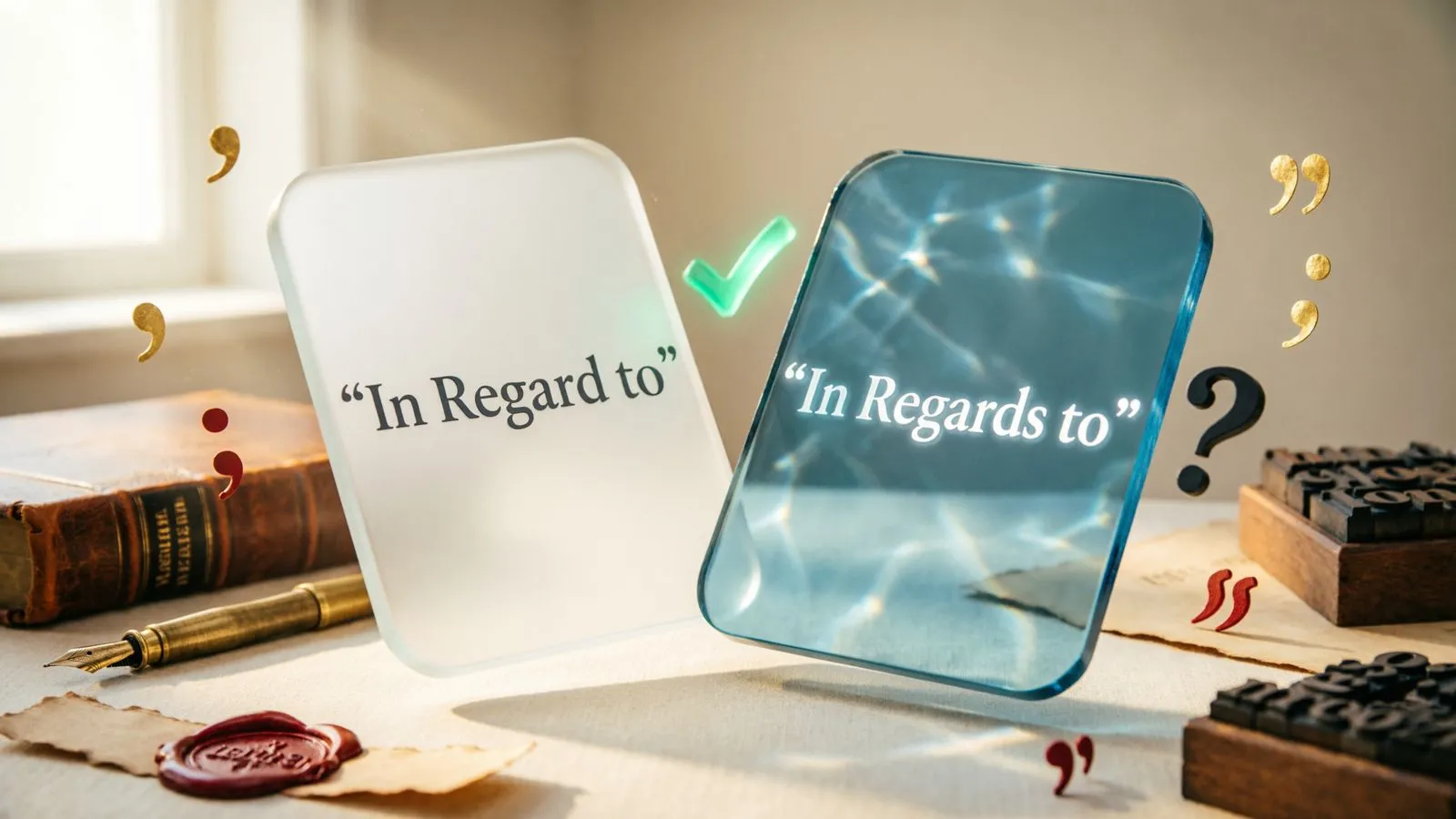
That extra -s is easy to add, especially if you often write “best regards” at the end of an email. But when you mean “about” or “concerning,” the standard phrase is in regard to. In regards to is common in everyday usage, but it is generally considered nonstandard in formal, edited English.
Quick Answer:
Use in regard to:
We are writing in regard to your recent application.
If that sounds too formal, regarding or about can make the sentence shorter and more natural.
In Regard to vs. In Regards to
| Phrase | Usage | Example |
| in regard to | Standard | In regard to your request, we need more information. |
| in regards to | Generally nonstandard | Best avoided in formal writing. |
| with regard to | Standard | With regard to your request, we will respond soon. |
| regarding | Standard, concise | Regarding your request, we need more information. |
What Does “In Regard to” Mean?

In regard to introduces the subject you are discussing. It has a formal tone, so it is common in professional emails, letters, reports, and official communication.
I’m contacting you in regard to the invoice we discussed.
For everyday writing, about is often more direct:
I’m contacting you about the invoice we discussed.
Why “Regards” Can Be Confusing
Regards is a perfectly correct word when used separately. It can mean greetings or good wishes:
Please give my regards to your family.
It is also familiar in email sign-offs:
Best regards,
Daniel
These uses are different from the fixed phrase in regard to.
Other Ways to Say It
Depending on the tone, you can replace in regard to with:
- Regarding — concise and professional
- Concerning — formal and direct
- About — simple and conversational
- With regard to — formal alternative
For example:
Regarding your request, we need more information.
6 Examples
- I’m writing in regard to your recent complaint.
- She called in regard to the meeting schedule.
- We have a question in regard to your order.
- The letter was sent in regard to the contract.
- He contacted the office in regard to his application.
- In regard to your proposal, we need more information.
Common Mistake
❌ We contacted you in regards to your account.
✅ We contacted you in regard to your account.
When this expression means “about” or “concerning,” keep regard singular.
Pronunciation
In regard to: in ri-GARD too
The main stress falls on regard.
Memory Trick
Remember the fixed phrase:
in regard to
Keep regard singular.
Mini Quiz
- Which form is standard?
A. In regard to
B. In regards to - Which sentence is correct?
A. I called in regards to the order.
B. I called in regard to the order. - Which is a concise alternative?
A. Regarding
B. Regards - Which phrase is standard?
A. With regard to
B. With regards to - Which sentence uses regards correctly?
A. Please give my regards to Maria.
B. Please give my regard to Maria.
Answers: 1-A, 2-B, 3-A, 4-A, 5-A
FAQs
Is “in regard to” correct?
Yes. It is the standard form of the expression.
Is “in regards to” acceptable?
It is widely used, but formal and edited English generally prefers in regard to.
What can I use instead?
Regarding, concerning, or about can often make the sentence shorter.
Is “with regard to” correct?
Yes. It is another standard formal expression.
Conclusion
When you mean “about” or “concerning,” use in regard to, particularly in formal writing. For a more direct style, regarding or about may work better. Just keep the separate word regards for uses such as “best regards” or “give my regards.”
Related Articles
- Question Mark Inside or Outside Quotes? Simple Rules
- Vs. or Vs: Which Is Correct? Meaning and Usage
- Exclamation Point or Exclamation Mark: Which Is Correct?

William Strunk is a respected authority on English grammar, usage, and writing style, known for his influential work The Elements of Style. At EduNexxa, his focus is on clear, concise, and effective English.
 Bryan Garne
 Mignon Fogarty