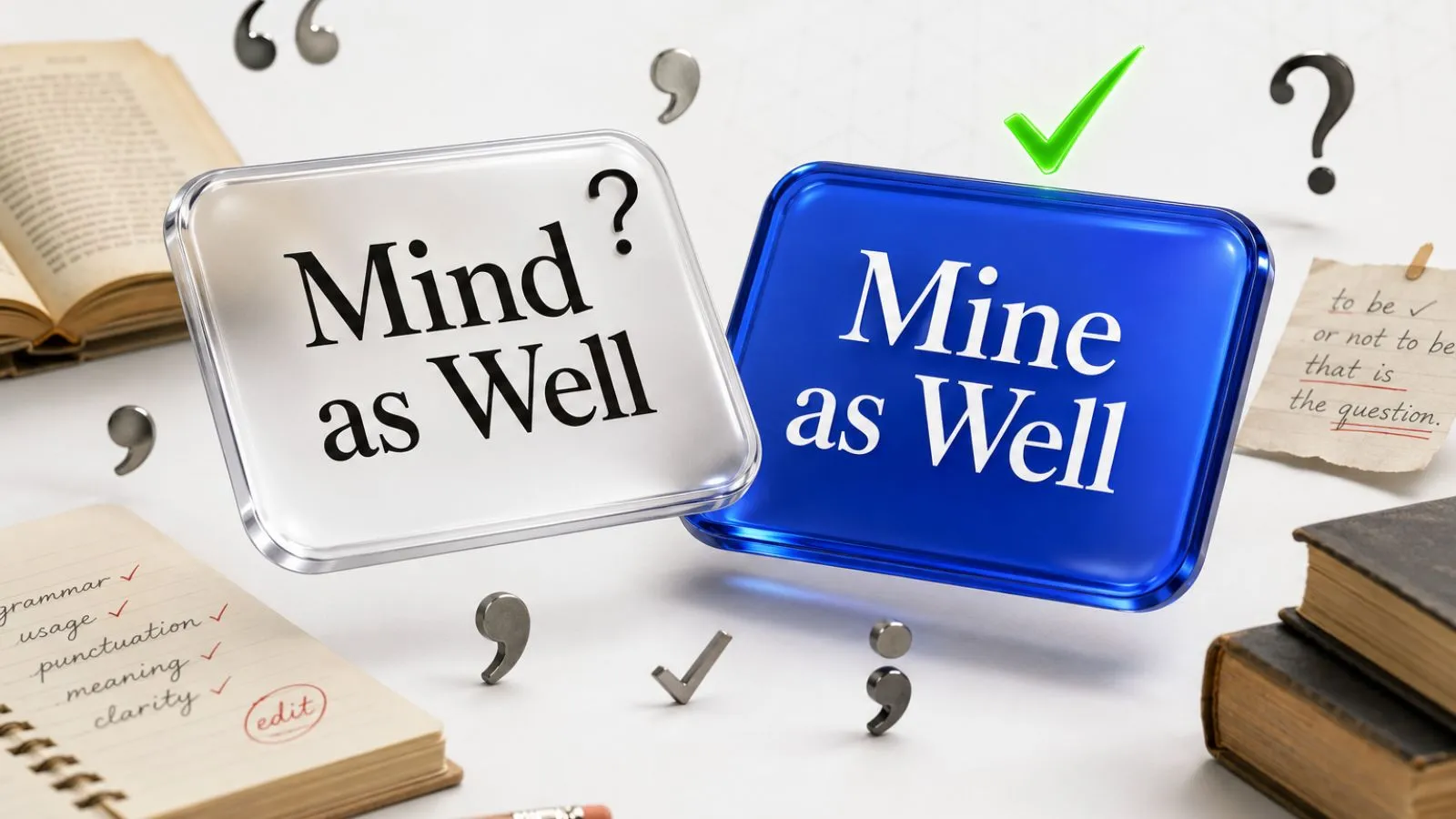
Mind as well or mine as well? These phrases sound similar but have different meanings.
Might as well is the correct phrase, meaning that something is a reasonable choice. Mine as well is usually a spelling mistake.
In this guide, you will learn the correct phrase, its meaning, common mistakes, clear examples, and an easy way to remember it.
Quick Answer :
“Might as well” is the correct phrase, not “mind as well” or “mine as well.”
The expression means that something is a reasonable choice because there is no better alternative.
For example, “We might as well leave now” means leaving now seems like the best or easiest option.
Comparison Table
| Point | Might as well | Mind as well | Mine as well |
| Correct? | Yes | No, for this expression | No, for this expression |
| Meaning | A reasonable choice when there is no better option | “Mind” has other meanings, but not in this phrase | “Mine” shows possession or refers to a place where minerals are extracted |
| Part of speech | Modal verb + adverbial phrase | “Mind” can be a noun or verb | “Mine” can be a pronoun, noun, or verb |
| Grammar rule | might + as well + base verb | Not a standard construction | Not a standard construction |
| Correct usage | “We might as well go.” | “I mind the noise.” | “That book is mine.” |
| Incorrect usage | — | “We mind as well go.” ❌ | “We mine as well go.” ❌ |
| Pronunciation | /maɪt əz wel/ | /maɪnd əz wel/ | /maɪn əz wel/ |
| Common mistake | Confusing the phrase because of fast speech | Hearing might as mind | Hearing might as mine |
| Memory tip | MIGHT = reasonable choice | MIND = thoughts or concern | MINE = belongs to me |
| Example | “We might as well start.” | “I don’t mind waiting.” | “The blue jacket is mine.” |
What Does “Might as Well” Mean?
Might as well is a common English expression used to suggest an action when it seems reasonable, practical, or preferable because there is no better alternative.
Cambridge Dictionary describes may/might as well as an expression used to suggest doing something, often when there is nothing better to do.
Examples
- We might as well take the bus.
There is no strong reason to choose another option. - It is already late, so we might as well finish the project tonight.
Since you are already working, continuing makes sense. - The store is closing soon. We might as well go home.
Going home is the most sensible choice now.
The expression does not usually mean simply “might also.” It has a special meaning connected with making a practical choice. Cambridge specifically distinguishes might as well from might also.
Grammar Pattern
The normal structure is:
Subject + might as well + base verb
Examples:
- I might as well stay.
- You might as well ask.
- We might as well leave.
- They might as well wait.
After might as well, use the base form of the verb.
Correct: We might as well go.
Incorrect: We might as well going. ❌
Incorrect: We might as well to go. ❌
What Does “Mind” Mean?
Mind is a real English word, but it does not belong in the expression might as well.
As a noun, mind can refer to a person’s thoughts, intelligence, or mental activity.
- She has a brilliant mind.
- Try to keep an open mind.
- His mind was focused on the problem.
As a verb, mind can mean to care about, object to, or pay attention to something.
- I don’t mind waiting.
- Do you mind if I sit here?
- Please mind the steps.
Therefore, mind as well can appear as separate words in unusual sentence constructions, but it is not the standard phrase meaning “it would be reasonable to do this.”
What Does “Mine” Mean?
Mine is also a correct English word, but it has a completely different meaning.
Most commonly, mine is a possessive pronoun meaning “belonging to me.”
- This phone is mine.
- That seat is mine.
- The blue notebook is mine.
Mine can also be a noun referring to a place where coal, minerals, or other natural resources are extracted.
- The workers entered the mine.
- The region once had several coal mines.
It can also function as a verb:
- Companies mine the area for minerals.
None of these meanings creates the expression mine as well.
Why Do People Confuse “Might,” “Mind,” and “Mine”?
The main reason is pronunciation.
Might is pronounced /maɪt/, while mind is /maɪnd/ and mine is /maɪn/. When people speak quickly, the final consonant in might may not sound as clear to a listener, especially for English learners.
Compare:
- might → /maɪt/
- mind → /maɪnd/
- mine → /maɪn/
The spelling can therefore become confusing when someone has learned the expression primarily through listening.
The key is to remember that the established phrase is might as well, not something you can choose based on how it sounds.
Key Differences: Might as Well vs. Mind as Well vs. Mine as Well
- Might as well is the correct idiomatic expression.
- Might is a modal verb in this construction.
- Mind relates to thoughts, attention, or concern and does not form this expression.
- Mine usually indicates possession or refers to an excavation site.
- Might as well often suggests that an action is the easiest, most logical, or most reasonable choice.
- Might as well is generally informal and common in everyday conversation. Cambridge Grammar notes that might as well is more common than may as well.
- A Simple Decision Test
Ask yourself:
Am I suggesting that something is a reasonable choice because there is no better option?
If the answer is yes, use:
MIGHT AS WELL
For example:
We have already driven this far, so we might as well visit the museum.
Grammar Rules for “Might as Well”
1. Use the base form after “might as well”
Correct:
She might as well join us.
Incorrect:
She might as well joins us. ❌
Incorrect:
She might as well to join us. ❌
2. Use it to suggest a practical choice
The weather is already bad, so we might as well stay inside.
The speaker is not necessarily excited about staying inside. The point is that, given the circumstances, staying inside seems reasonable.
3. “May as well” is also correct
May as well and might as well can both express this idea. However, might as well is more common.
- We might as well start now.
- We may as well start now.
In everyday American English, might as well is a very natural choice.
4. “Just” can add emphasis
You can also say:
We might just as well leave now.
This can add emphasis to the idea that leaving is the sensible option.
When Should You Use “Might as Well”?
Academic Writing
Use it carefully. Academic writing generally favors more precise and formal wording.
Instead of:
We might as well use the first method.
A formal alternative could be:
The first method is the most practical option under these conditions.
Professional and Business Writing
It can work in informal workplace communication:
We have already prepared the materials, so we might as well send them today.
For highly formal reports, a more direct phrase may sound better:
Sending the materials today would be the most practical option.
Emails
Might as well is perfectly natural in casual or internal work emails:
Since everyone is available, we might as well hold the meeting this afternoon.
Daily Conversation
This is where might as well appears most naturally.
It’s only a five-minute walk, so we might as well walk.
We’re already at the mall, so we might as well have lunch here.
Cambridge identifies the expression as fairly informal, making it especially useful in ordinary conversation.
Common Mistakes
Mistake 1: Writing “Mind as Well”
Incorrect:
We mind as well go now. ❌
Correct:
We might as well go now. ✓
Mistake 2: Writing “Mine as Well”
Incorrect:
You mine as well ask her. ❌
Correct:
You might as well ask her. ✓
Mistake 3: Using the Wrong Verb Form
Incorrect:
We might as well going home. ❌
Correct:
We might as well go home. ✓
Mistake 4: Confusing “Might as Well” With “Might Also”
These expressions are different.
You might as well buy the tickets now.
Buying them now seems sensible.
You might also buy a guidebook.
Buying a guidebook is an additional possibility.
Cambridge specifically warns that may/might as well does not have the same meaning as may/might also.
10 Original Examples of “Might as Well”
- School: Since the teacher has not arrived yet, we might as well review yesterday’s lesson.
- Workplace: The meeting starts in ten minutes, so we might as well prepare the presentation now.
- Business: Sales are slower this afternoon, so we might as well use the time to update our product descriptions.
- Conversation: “Are you staying home tonight?” “Yes, I might as well watch a movie.”
- Books: The detective realized he was already near the library, so he might as well check the old records.
- News: With the storm expected overnight, residents might as well complete their preparations early.
- Social media: If you’re already reading this post, you might as well share it with someone who needs the tip.
- Everyday English: We’re already at the grocery store, so we might as well pick up some bread.
- Travel: Our flight does not leave until evening, so we might as well explore the city.
- Family: Since everyone is awake, we might as well have breakfast together.
Memory Trick: “MIGHT = Makes Sense”
Use this simple trick:
MIGHT AS WELL = It makes sense to do it.
When you mean “There is no better reason not to do this”, choose might as well.
Remember the three words this way:
- MIGHT → reasonable choice
- MIND → thoughts or concern
- MINE → belongs to me
So:
We might as well go. ✓
We mind as well go. ✗
We mine as well go. ✗
Mini Quiz
1. Which sentence is correct?
A. We mind as well leave.
B. We mine as well leave.
C. We might as well leave.
D. We might as well leaving.
Answer: C. We might as well leave.
2. What does “might as well” usually express?
A. Ownership
B. A reasonable choice
C. Anger
D. Possession
Answer: B. A reasonable choice
3. Choose the correct sentence.
A. I might as well stay.
B. I mind as well stay.
C. I mine as well stay.
D. I might as well staying.
Answer: A. I might as well stay.
4. Which word means “belonging to me”?
A. Might
B. Mind
C. Mine
D. Might as well
Answer: C. Mine
5. Which sentence uses “mind” correctly?
A. We mind as well go home.
B. I don’t mind waiting.
C. You mine as well ask.
D. They might as well going.
Answer: B. I don’t mind waiting.
FAQs
Is it “mind as well” or “might as well”?
The correct expression is “might as well.” It means that something is a reasonable or practical choice because there is no better alternative.
For example, “We might as well leave now” means leaving now seems like the most sensible option. Mind as well is not the standard phrase with this meaning.
Is it “mine as well” or “might as well”?
The correct phrase is “might as well,” not “mine as well.” Mine is normally a possessive pronoun meaning “belonging to me,” as in “That book is mine.”
It does not form the idiom used to suggest a reasonable action. Use might as well + base verb instead.
What does “might as well” mean?
Might as well means that doing something seems reasonable because there is no better alternative or because the circumstances make it the easiest choice.
For example, “It is already late, so we might as well stay here.” The expression is especially common in informal spoken English.
Is “may as well” also correct?
Yes. May as well and might as well can both be used to make a suggestion when an action seems like the easiest or most logical choice.
However, might as well is more common. Both are generally informal expressions.
What is the grammar pattern for “might as well”?
The standard pattern is subject + might as well + base verb.
For example, “We might as well go,” “She might as well stay,” and “They might as well ask.” Do not use to or an -ing form immediately after “might as well.”
Key Takeaways
- Might as well is the correct phrase.
- Mind as well is not the standard expression.
- Mine as well is also incorrect when expressing this meaning.
- Might as well suggest that an action is reasonable because there is no better alternative.
- The normal structure is might as well + base verb.
- May as well is also grammatical, although might as well is more common.
- Mind can refer to thoughts or concern.
- Mine usually expresses possession.
- Do not confuse might as well with might also.
- A quick memory trick is: MIGHT AS WELL = It makes sense to do it.
Conclusion
The correct expression is “might as well,” not “mind as well” or “mine as well.”
Use might as well when you want to suggest that an action is sensible, practical, or worth doing because there is no better option.
Although mind and mine are both legitimate English words, they have completely different meanings.
Remember “might as well + base verb,” and you will avoid this common mistake in both writing and conversation.
Related More Articles
- Desert or Dessert: Which Word Is Correct (2026)?
- Lose or Loose: Which One Is Correct (2026)?
- Led or Lead: Learn the Difference With Simple Examples(2026)?

Bryan Garner an experienced English language writer specializing in grammar, usage, word choice, and clear American English. He focuses on making complex language rules simple, accurate, and practical.
 William Strunk
 info.asadblogger@gmail.com