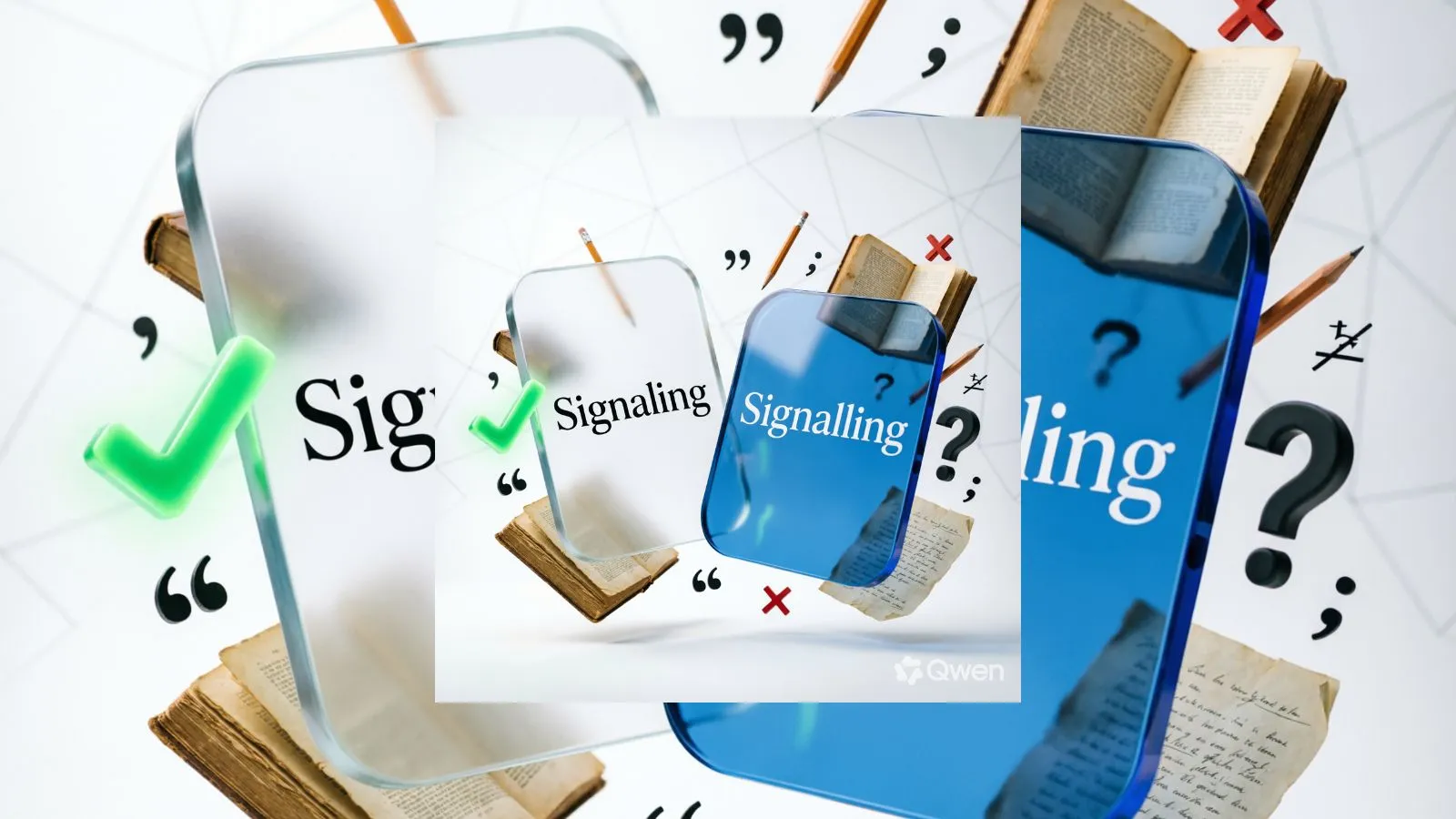
Signaling is the standard spelling in American English, while signalling is the standard spelling in British English. Both forms come from the verb signal and mean the same thing: giving a sign, message, or indication.
The only real difference is the spelling, so the form you choose should match the variety of English you are using.
Quick Answer:
Use signaling in American English and signalling in British English. Both are correct. The related past forms are signaled in American English and signalled in British English.
Signaling vs. Signalling
| Spelling | Common Variety | Meaning |
| Signaling | American English | Giving or sending a sign, message, or indication |
| Signalling | British English | The same meaning |
What Do Signaling and Signalling Mean?
Both forms are the present participle of signal. The verb can mean giving someone a sign, communicating information, or showing that something is happening.
A driver might be signaling before making a turn. A warning light could be signalling a problem. A report might also be signaling or signalling a change in direction.
The meaning stays the same. Only the regional spelling changes.
Why Are the Spellings Different?
The difference comes from American and British spelling conventions, especially the way the final l is handled before -ed and -ing.
American English:
signal → signaled → signaling
British English:
signal → signalled → signalling
American English normally uses one l, while British English doubles it. You can see the same pattern in pairs such as traveled/travelled, labeled/labelled, and modeled/modelled.
When to Use Signaling
Use signaling when you are writing in American English or for a US audience.
Common phrases include signaling a turn, signaling a warning, signaling a change, and signaling an intention.
If the rest of your writing follows American spelling, signaling will fit naturally.
When to Use Signalling
Use signalling when your writing follows British English conventions.
You may come across phrases such as signalling a turn, signalling a warning, signalling a change, and signalling an intention.
British English also uses signalled for the past tense and past participle.
Common Mistakes
Mixing the two forms
Both spellings are correct, but switching between signaling and signalling in the same article can make the writing look inconsistent.
Assuming one form is wrong
Neither spelling is universally incorrect. The right choice depends on the English variety you are following.
Forgetting the related form
The same regional difference appears in signaled/signalled, so related forms should follow the spelling style you choose.
Pronunciation
Signaling and signalling are pronounced the same way. The extra l in the British spelling changes the written form, not the pronunciation.
6 Examples
- The driver is signaling before making a left turn.
- The flashing light is signaling that the battery is low.
- His response was signaling a change in policy.
- The driver was signalling before turning at the junction.
- The warning system was signalling a possible problem.
- The report was signalling growing concern about the issue.
Memory Trick
American English → signaling → 1 l
British English → signalling → 2 ls
Think: US uses one L; UK uses two.
Mini Quiz
1. Which spelling is standard in American English?
A. Signalling
B. Signaling
C. Signalinng
D. Signalingg
2. Which spelling is standard in British English?
A. Signaling
B. Signalling
C. Signallling
D. Signalingg
3. Do signaling and signalling have different meanings?
A. Yes
B. No
C. Only in the US
D. Only in the UK
4. Which form would normally suit a US audience?
A. Signalling
B. Signaling
C. Signalled
D. Signalld
5. What is the main difference between signaling and signalling?
A. Meaning
B. Pronunciation
C. Regional spelling
D. Part of speech
Answers: 1-B, 2-B, 3-B, 4-B, 5-C
FAQs
Is it signaling or signalling?
Both are correct. Signaling is standard in American English, while signalling is standard in British English.
Is signalling British and signaling American?
That is the usual regional pattern. American English generally uses signaling, while British English generally uses signalling.
Are signaling and signalling pronounced differently?
No. Both forms have the same standard pronunciation. The difference is in spelling, not sound.
Which spelling should I use?
Use signaling for American English and signalling for British English. Choose the form that matches the rest of your writing.
Key Takeaways
- Signaling is standard American English.
- Signalling is standard British English.
- Both forms have the same meaning and pronunciation.
- Signaled/signalled follow the same regional pattern.
- Consistency is the main rule.
Conclusion
Signaling and signalling are both correct spellings of the present participle of signal. American English normally uses one l, while British English uses two. Once you know which English variety you are writing in, the choice is straightforward. Just keep the related forms consistent throughout the same piece of writing.
Related More Articles
- Honor or Honour: Which Spelling Is Correct (2026)?
- Canceled or Cancelled: Which Spelling Is Correct?
- Humor or Humour: Which Spelling Is Correct (2026)?

Mignon Fogarty is an experienced English grammar and writing expert specializing in grammar, word usage, and clear American English. At EduNexxt, her focus is making grammar simple, accurate, and practical.
 William Strunk
 Bryan Garne