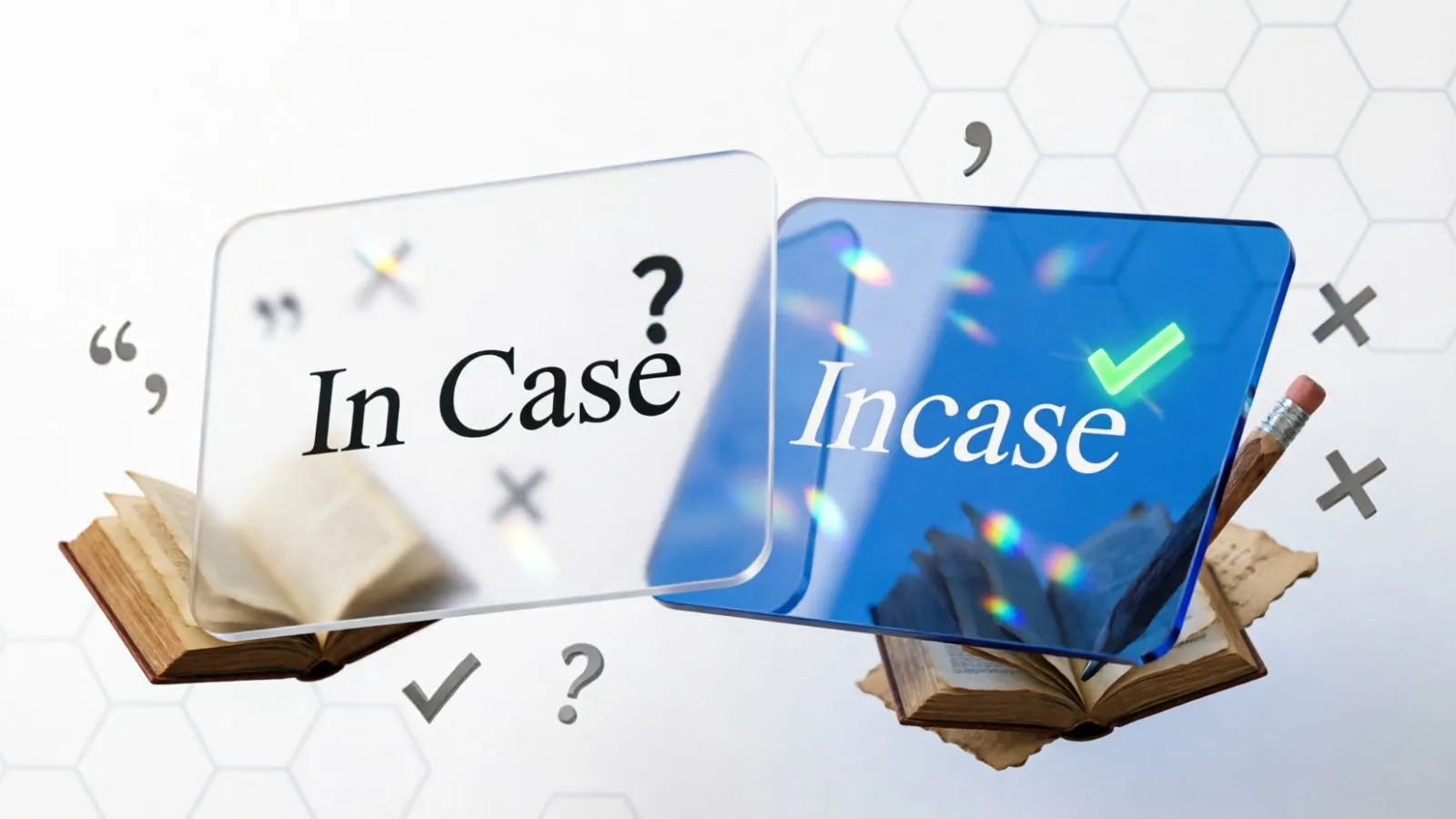
In case and incase are not interchangeable. In case is the two-word phrase used for a possibility or precaution, while incase is not standard. Another word, encase, is a verb meaning to surround or cover something completely. Once you separate these meanings, the spelling becomes much easier to remember.
Quick Answer:
In case ✅ = precaution or possibility
Take an umbrella in case it rains.
Incase ❌ = not standard
Encase ✅ = surround or cover something
In Case vs. Incase
| Form | Meaning | Example |
| In case | Possibility or precaution | Call me in case you need help. |
| Incase | Not standard | ❌ Incase you need help |
| Encase | Surround or cover completely | The gift was encased in glass. |
When to Use “In Case”
Use in case when you prepare for something that might happen:
Bring a charger in case your phone dies.
It also appears in in case of + noun and just in case:
In case of fire, use the exit.
I saved the address just in case.
In Case vs. If
Use if when one action depends on a condition:
If it rains, we’ll stay home.
Use in case when you prepare for a possibility:
We took umbrellas in case it rained.
If = condition; in case = precaution.
In Case vs. Encase
In case refers to a possibility; encase means to surround or cover something.
The fragile object was encased in foam.
Common Mistakes
Writing “incase”
❌ Incase you need anything, call me.
✅ In case you need anything, call me.
Confusing “in case” with “encase”
❌ The necklace was in case in plastic.
✅ The necklace was encased in plastic.
Using “in case” for a condition
❌ In case you need help, call me now.
✅ If you need help, call me now.
Pronunciation
In case is /ɪn keɪs/. Encase is pronounced differently.
6 Examples
- Take a jacket in case it gets cold.
- Save her number just in case you need help.
- In case of emergency, follow the exit signs.
- We brought extra water in case the hike took longer.
- The artwork was encased in protective glass.
- If you need more information, contact the office.
Memory Trick
In case = precaution
If = condition
Encase = surround
Always write in case as two words.
Mini Quiz
1. Which spelling is correct?
A. Incase
B. In case
C. In-case
D. Inca se
2. Which sentence is correct?
A. Incase it rains, take an umbrella.
B. In case it rains, take an umbrella.
C. In-case it rains, take an umbrella.
D. Incase it rain, take an umbrella.
3. Which sentence uses “encase” correctly?
A. Encase it rains, take an umbrella.
B. The box was encased in foam.
C. I called her encase I needed help.
D. Encase of fire, leave the building.
4. Which word expresses a condition?
A. Encase
B. In case
C. If
D. Incase
5. Which phrase is correct?
A. Incase of fire
B. In case fire
C. In case of fire
D. Encase of fire
Answers: 1-B, 2-B, 3-B, 4-C, 5-C
FAQs
Is “incase” one word?
Not for the meaning “if something happens” or “as a precaution.” Use in case.
Is “encase” a real word?
Yes. It means to surround or cover something.
Is “in case” the same as “if”?
Not always. If gives a condition; in case describes preparation.
Is “in case of” correct?
Yes. Use in case of + noun, such as in case of fire.
Conclusion
In case is the standard phrase for a possibility or precaution. Incase is not standard, while encase means to surround or cover something. Remember: in case = precaution; if = condition; encase = surround.
Related Articles
- Up to Date or Up-to-Date: Which Is Correct?
- Anytime or Any Time: What is the Difference?
- Everyday or Every Day: Which Is Correct?

Bryan Garner an experienced English language writer specializing in grammar, usage, word choice, and clear American English. He focuses on making complex language rules simple, accurate, and practical.
 William Strunk
 Mignon Fogarty