
Holistic or Wholistic often confuses writers because both spellings look correct and are used in similar contexts.
The word holistic is the standard and widely accepted spelling, while wholistic is a less common variant that emphasizes the idea of “whole.”
This confusion happens because both forms are linked to the same meaning looking at something as a complete system rather than separate parts.
Using the right spelling matters in formal writing, academic work, and professional communication.
This guide explains the difference between holistic and wholistic, when each form is used, and how to choose the correct spelling with confidence.
Quick Answer
Holistic is the standard spelling in American and British English.
It describes an approach that considers the entire person, system, or situation rather than individual parts.
Wholistic is a recognized but uncommon variant that highlights the idea of “wholeness.”
In most formal, academic, and business writing, holistic is the preferred choice.
Holistic vs. Wholistic Comparison Table
| Feature | Holistic | Wholistic |
| Correctness | Standard spelling | Accepted variant |
| Frequency | Very common | Much less common |
| Meaning | Considering the whole | Considering the whole |
| Definition | Looking at complete systems rather than separate parts | Same meaning as holistic |
| Part of Speech | Adjective | Adjective |
| Pronunciation | hoh-LIS-tik | woh-LIS-tik or hoh-LIS-tik |
| Formal Writing | Preferred | Usually avoided |
| Academic Use | Common | Rare |
| Business Use | Common | Rare |
| Common Mistake | Thinking it relates directly to “holy” | Assuming it is the only correct form |
| Memory Tip | Most dictionaries prefer holistic | Think of whole in the spelling |
| Example | A holistic approach improves patient care. | Some practitioners use a wholistic philosophy. |
What Does “Holistic” Mean?
Holistic means considering something as a complete system rather than focusing on individual parts.
The term comes from the idea that all parts of a system are connected.
Grammar Role
- Part of speech: Adjective
- Pronunciation: /hoʊˈlɪstɪk/
Examples
- The doctor recommended a holistic treatment plan.
- The company adopted a holistic business strategy.
- Teachers use a holistic method to evaluate student progress.
- Environmental scientists often take a holistic view of ecosystems.
What Does “Wholistic” Mean?
Wholistic has the same meaning as holistic. Some writers prefer this spelling because it visibly includes the word whole.
Grammar Role
- Part of speech: Adjective
- Pronunciation: /woʊˈlɪstɪk/ or /hoʊˈlɪstɪk/
Examples
- The wellness center describes its philosophy as wholistic.
- Some alternative health practitioners use the term wholistic care.
- The organization promotes a wholistic view of education.
Key Differences Between Holistic and Wholistic
Although the meanings are identical, the spellings differ in usage.
- Holistic is the standard form.
- Wholistic is a less common variant.
- Dictionaries usually list holistic as the primary spelling.
- Academic and professional writing almost always prefers holistic.
- Some wellness and alternative health communities use wholistic to emphasize completeness.
Practical Examples
✅ The university promotes a holistic admissions process.
✅ The company uses a holistic marketing strategy.
⚠️ The clinic offers wholistic therapies. (Correct, but less common.)
Grammar Rule
There is no grammatical difference between holistic and wholistic. The choice is a matter of spelling preference and convention.
General Rule
- Use holistic in:
- Academic writing
- Business communication
- Journalism
- Professional documents
- Formal English
- Use wholistic only if:
- A brand, organization, or author specifically prefers it.
- You want to emphasize the concept of wholeness.
When to Use Each Word
| Context | Recommended Choice |
| Academic papers | Holistic |
| Business reports | Holistic |
| Professional emails | Holistic |
| News articles | Holistic |
| Daily conversation | Holistic |
| Wellness branding | Holistic or Wholistic |
| Alternative medicine contexts | Either |
Why People Confuse Holistic and Wholistic
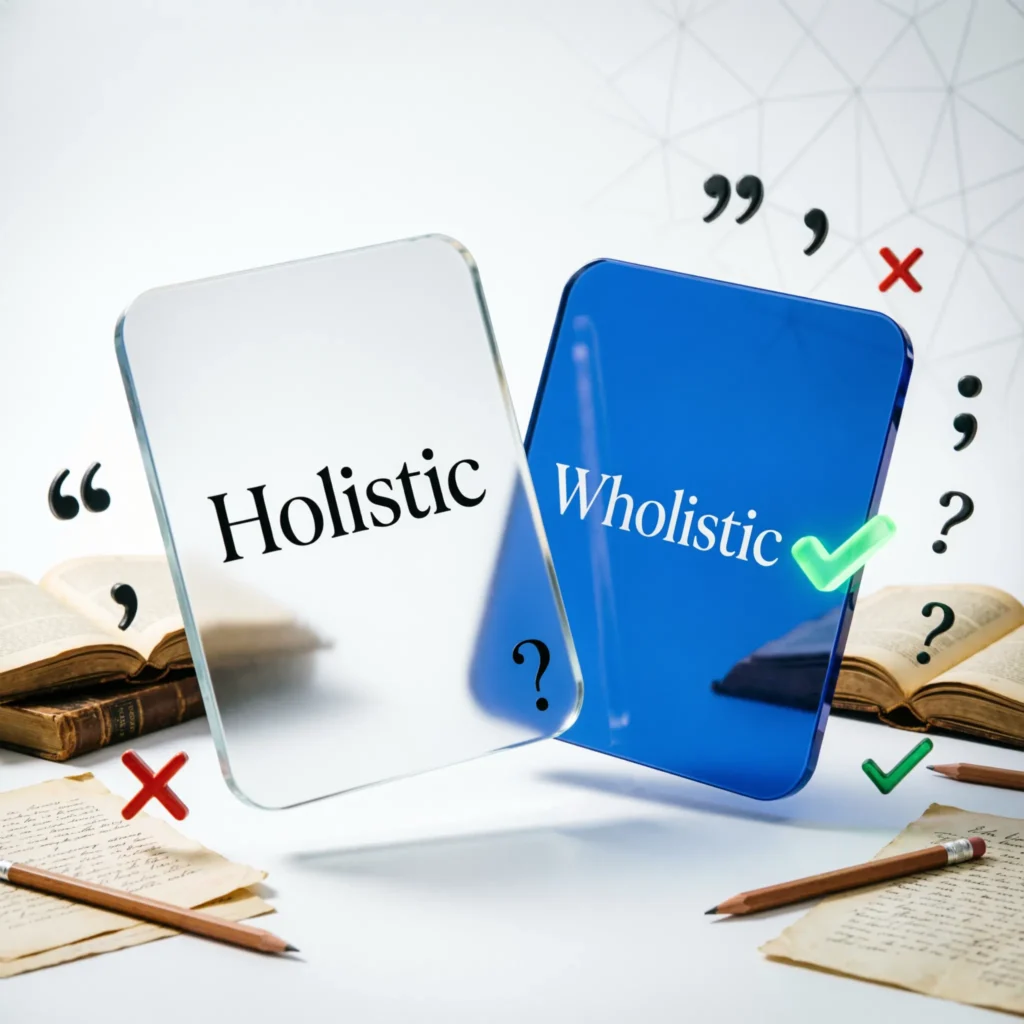
People often assume wholistic must be more accurate because it contains the word whole. However, the accepted standard spelling in modern English remains holistic.
Incorrect Assumption
❌ Wholistic is always more correct.
Correct Understanding
✅ Holistic is the standard form, while wholistic is an accepted variant.
Original Examples
- The school uses a holistic approach to student development.
- Our manager created a holistic plan for company growth.
- The article offered a holistic analysis of climate change.
- Doctors increasingly support holistic patient care.
- The consultant provided a holistic business review.
- The news report examined the issue from a holistic perspective.
- Some wellness brands prefer the term wholistic healing.
- The book explains a holistic method of learning.
- Social media users often discuss holistic living.
- Parents appreciated the school’s holistic education model.
Memory Trick
Use this simple rule:
Holistic = Standard spelling for almost every situation.
If you are writing for school, work, publishing, or business, choose holistic.
Think:
H = Highly accepted
Mini Quiz
1. Which spelling is more common in formal English?
A. Wholistic
B. Holistic
C. Both equally
D. Neither
Answer: B
2. Which word is preferred in academic writing?
A. Holistic
B. Wholistic
C. Both equally
D. None
Answer: A
3. Do holistic and wholistic have different meanings?
A. Yes
B. No
C. Sometimes
D. Rarely
Answer: B
4. Which spelling is less common?
A. Holistic
B. Wholistic
C. Both
D. Neither
Answer: B
5. Which sentence is most suitable in business writing?
A. We use a wholistic strategy.
B. We use a holistic strategy.
C. Both are impossible.
D. Neither is correct.
Answer: B
FAQs
Is wholistic a real word?
Yes. Wholistic is a recognized variant spelling of holistic. However, it is much less common and appears less frequently in formal writing, academic publications, and professional documents.
Which spelling is correct: holistic or wholistic?
Both spellings are correct, but holistic is the standard form used in American and British English. Most dictionaries, style guides, and publishers prefer holistic.
Why do some people use wholistic?
Some writers use wholistic because the spelling emphasizes the idea of “whole” or complete thinking. It is especially common in wellness and alternative health contexts.
Is holistic used in medicine?
Yes. Terms such as holistic healthcare, holistic medicine, and holistic treatment are widely used to describe approaches that consider physical, mental, emotional, and social factors together.
Is there an American vs. British English difference?
No. Both American and British English strongly favor holistic. The variant wholistic exists in both forms of English but remains uncommon.
Key Takeaways
- Holistic is the standard spelling.
- Wholistic is an accepted but uncommon variant.
- Both words have the same meaning.
- Use holistic in formal, academic, and business writing.
- Use wholistic only when a specific style or brand prefers it.
- Most readers expect the spelling holistic.
Conclusion
The choice between holistic and wholistic is mainly a matter of convention rather than meaning.
Both words describe an approach that considers the whole picture, but holistic is the preferred spelling in modern English.
For school, work, publishing, and everyday writing, holistic is usually the best option because it is widely recognized and accepted.
Read More Post
- Click or Clique: What is the Difference (2026)?
- Whomever or Whoever: How to Choose the Right Word(2026)?
- Quite or Quiet: Which Word Is Correct in English(2026)?

Mignon Fogarty is an experienced English grammar and writing expert specializing in grammar, word usage, and clear American English. At EduNexxt, her focus is making grammar simple, accurate, and practical.
 Bryan Garne
 William Strunk