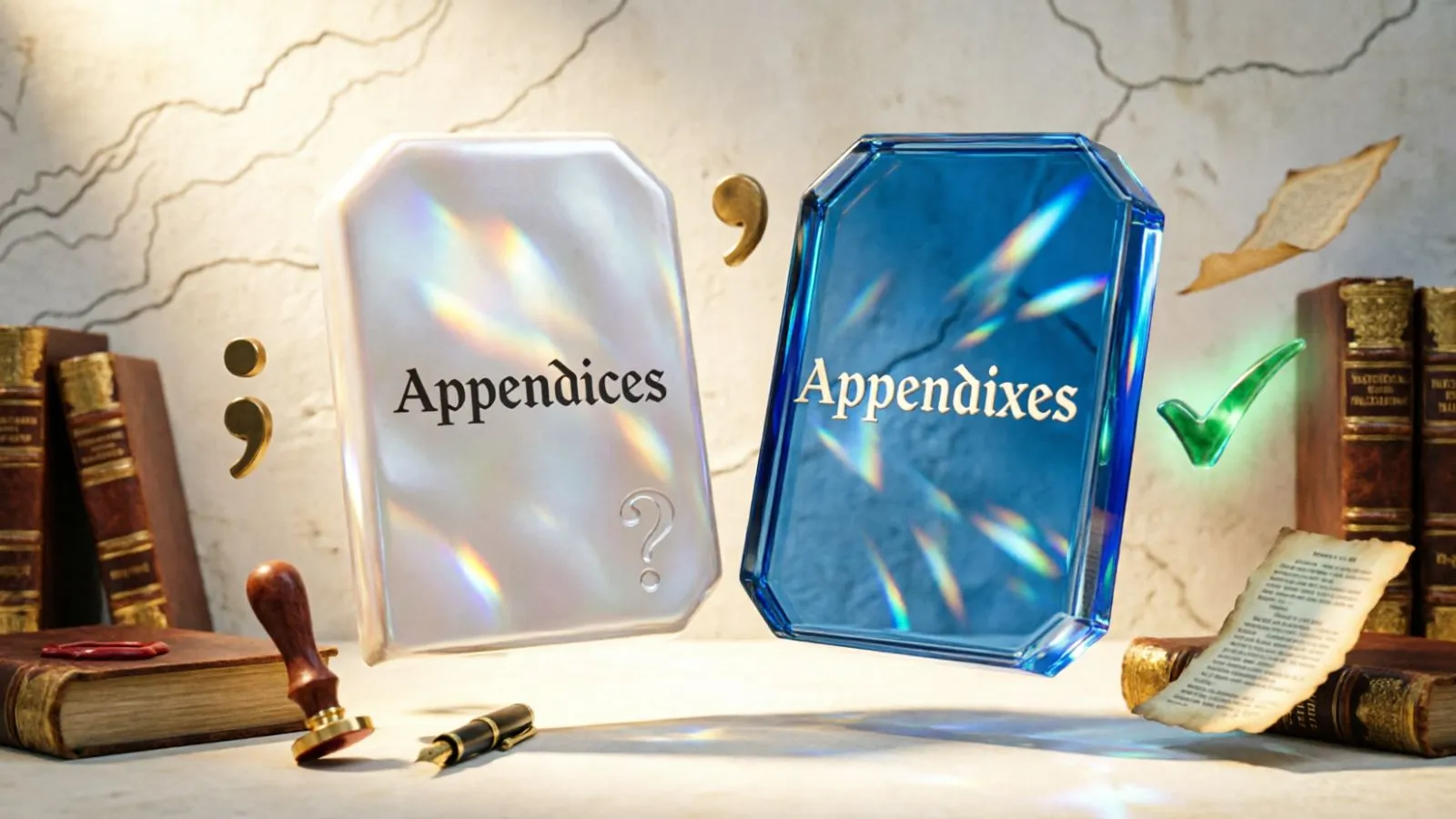
Appendices and appendixes are both correct plurals of appendix. Appendices is more common, especially in academic and professional writing, while appendixes is also perfectly acceptable. For a research paper, thesis, or formal report, appendices is usually the more familiar choice. Whichever form you use, keep it consistent throughout the document.
Quick Answer:
Quick Answer
Appendices ✅ = more common, especially in academic writing
Appendixes ✅ = accepted alternative
Appendices vs. Appendixes
| Form | Common Use | Example |
| Appendices | More common in academic writing | The paper has two appendices. |
| Appendixes | Accepted alternative | The book contains several appendixes. |
What Does “Appendix” Mean?
An appendix is a section at the end of a book, report, thesis, or paper. It usually contains supporting information that is useful but does not need to appear in the main text.
An appendix might contain:
- detailed tables or data
- survey questions
- calculations
- interview transcripts
- supporting documents
When a document has more than one, both appendices and appendixes are valid.
Why Are There Two Plurals?
The two forms come from different plural patterns. Appendices follows the traditional Latin form, while appendixes uses the regular English -es ending.
Both forms have become established in English. In academic writing, appendices is especially common, including in APA Style.
When to Use Each
Use appendices when you want the more familiar form in academic or formal writing:
The dissertation contains three appendices.
Use appendixes when it fits the style of your publication or institution:
The manual includes several technical appendixes.
There is no need to switch between the two. Pick the form that fits your style and use it consistently.
Common Mistakes
Assuming “appendixes” is wrong
❌ Appendixes is incorrect.
✅ Appendixes is an accepted plural.
Mixing both forms
Using appendices in one section and appendixes in another can make a document look inconsistent.
Confusing the singular and plural
✅ One appendix
✅ Two appendices
✅ Two appendixes
Pronunciation
Appendices and appendixes have slightly different endings, so they are not pronounced exactly the same.
6 Examples
- The thesis includes two appendices with supporting data.
- The report contains several appendices at the end.
- The manual includes technical appendixes for reference.
- The survey questions are listed in the appendices.
- The book contains detailed appendixes.
- Check the appendices for the complete results.
Memory Trick
Think of it this way:
Appendices = the more common academic choice
Appendixes = accepted English alternative
Mini Quiz
1. Which plural is more common in academic writing?
A. Appendixs
B. Appendices
C. Appendixes
D. Appendixi
2. Is “appendixes” correct?
A. Yes
B. No
C. Only in British English
D. Only informally
3. What is the singular form?
A. Appendices
B. Appendixes
C. Appendix
D. Appendixs
4. Which sentence is correct?
A. The paper includes two appendices.
B. The paper includes two appendixs.
C. The paper includes two appendix.
D. The paper includes two appendixi.
5. What should you do when using either plural?
A. Mix both forms
B. Avoid plural forms
C. Follow your style guide and stay consistent
D. Always use appendixes
Answers: 1-B, 2-A, 3-C, 4-A, 5-C
FAQs
Is “appendices” or “appendixes” correct?
Both are correct. Appendices is more common, especially in academic writing.
Which form should I use in a research paper?
Appendices is usually the more familiar choice in academic writing.
Is “appendixes” wrong?
No. It is an accepted plural form.
What is the plural of “appendix”?
Both appendices and appendixes are accepted.
Conclusion
Appendices and appendixes are both correct. Appendices is the more common choice in academic writing, while appendixes is also valid. Follow your style guide when one is provided, and otherwise choose one form and use it consistently.
Related Articles
- Cannot vs. Can Not: Which Is Correct (2026)?
- Ahold or A Hold: Which Is Correct?
- Offsite or Off-Site: Which Spelling Is Correct?

Bryan Garner an experienced English language writer specializing in grammar, usage, word choice, and clear American English. He focuses on making complex language rules simple, accurate, and practical.
 Mignon Fogarty
 William Strunk